Saturn: the "Ringed Beauty" and His Moons
|
|
|
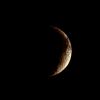
Japetus-PIA11620.jpgJapetus, from far away... (Natural Colors; credits: Lunexit)54 visiteCaption NASA:"A crescent Japetus shows, at the top right of this image, some of the dark terrain characterizing this unusual Saturnian moon.
Scientists continue to investigate the nature of the moon's surface.
Lit Terrain seen here is on the Saturn-facing side of Japetus (about 1471 KM, or approx. 914 miles across). North on Japetus is up and rotated 5° to the left.
Scale in the original image was 7 Km (about 4,5 miles) per pixel. The image has been magnified by a factor of two and contrast-enhanced to aid visibility.The image was taken in Visible Green Light with the Cassini Spacecraft narrow-angle camera on Sept. 11, 2009.
The view was acquired at a distance of approx. 1,2 MKM (about 746.000 miles) from Japetus and at Phase Angle of 125°".MareKromium
|
|
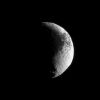
Japetus-PIA11632.jpgCrescent Japetus54 visiteCaption NASA:"Japetus shows off its puzzling light and Dark Terrain.
Scientists continue to investigate the nature of this moon's Surface. Lit Terrain seen here is on the Saturn-facing side of Japetus. North on Japetus is up and rotated 8° to the left. Scale in the original image was approx. 7 Km (about 4,5 miles) per pixel. The image has been magnified by a factor of 2 and contrast-enhanced to aid visibility.
The image was taken in Visible Light with the Cassini Spacecraft narrow-angle camera on Sept. 13, 2009. The view was obtained at a distance of approx. 1,2 MKM (such as about 746.000 miles) from Japetus and at a Sun-Japetus-Spacecraft, or Phase, Angle of 103°".MareKromium
|
|
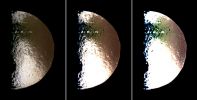
Japetus-PIA11689.jpgColor-Dichotomy on Japetus (False Colors; credits: NASA/JPL/Space Science Institute)59 visiteCaption NASA:"Three different false-color views of Saturn's moon Japetus show the boundary of the so-called global "Color Dichotomy" on the Hemisphere of this moon facing away from Saturn.
Such a "Color Dichotomy", which has been detected in images from the Cassini Imaging Team, is a second global pattern found on Japetus besides the well-known global "Brightness Dichotomy".
This image consists of three panels, each of which was contrast-enhanced in different ways to bring out Surface Features. Minimal enhancement was applied to the image on the left panel while those on the middle and right panels were enhanced more (with contrast increased by factors of two and four, respectively), making them appear brighter and overexposed.
In the case of Japetus' Brightness Dichotomy, the Dark Terrain extends towards its Trailing Side at Equatorial Regions, while the Bright Terrain extends towards Japetus' Leading Side in the Polar Regions (see PIA11116).
In the case of the Color Dichotomy seen here, its boundary is quite well correlated with the boundary between Japetus' Leading and Trailing Hemispheres. At Near-InfraRed wavelengths, the Bright Terrain on the Leading Side is redder than the one visible on the Trailing Side. This pattern is visible in the panel on the left, which uses normal contrast enhancement. The characteristic reddish distribution also appears on the dark material, as seen in the middle and right-hand panels that have been adjusted with even higher contrast.
Indeed, the otherwise uniformly dark material shows different color hues, depending on whether the viewer looks at the Leading vs. the Trailing Side.
Cassini scientists think this effect is caused by material falling onto Japetus from the outer irregular moons of Saturn. (see PIA06145 to learn more)
Images obtained with InfraRed, Green and UltraViolet Spectral Filters (centered at 953, 563 and 338 nanometers, respectively) were combined to create these False Color views. The color seen here is similar to that produced in (red, green and blue) Natural Color views.
North on Japetus is approx. up in these images. The images were taken with the Cassini Spacecraft narrow-angle camera on Oct. 15, 2004. The view was obtained at a distance of approx. 1,2 MKM (such as about 746.000 miles) from Japetus and at a Sun-Japetus-Spacecraft, or Phase, Angle of 88°.
Image scale is roughly 7 Km (a little more than 4 miles) per pixel".MareKromium
|
|
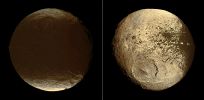
Japetus-PIA11690.jpgGlobal View of Japetus' "Brightness Dichotomy" (Approx. True Colors; credits: Lunexit)62 visiteCaption NASA:"These two global images of Japetus show the extreme brightness dichotomy on the Surface of this peculiar Saturnian moon. The left-hand panel shows Japetus' Leading Hemisphere and the right-hand panel shows its Trailing Side. While Low and Mid Latitudes of the Leading Side exhibit a Surface almost as dark as charcoal, broad tracts of the Trailing Side are almost as bright as snow.
The dark terrain covers about 40% of the Surface of Japetus and it has been named "Cassini Regio". The names of the bright terrain are Roncevaux Terra (North) and Saragossa Terra (South).
On both Hemispheres, the dominant landforms are impact craters. The largest known well-preserved basin on Japetus, called "Turgis", has a diameter of about 580 Km (approx. 360 miles). It lies at 17° North Latitude and 28° West Long., at the Eastern Edge of the Cassini Regio and is visible on the right side of the left-hand panel. The prominent basin on the Southern Trailing Side (at the lower left of the right-hand panel) is named Engelier.
Engelier is located at 41° South Latitude and 265° West Longitude, and it has a diameter of about 504 Km (such as approx. 313 miles).
Its formation destroyed about half of Gerin, another large basin on Japetus. Gerin is located at 46° South Latitude and 233° West Longitude; it has a diameter of about 445 Km (approx. 276 miles).
Tortelosa Montes, a part of the giant Equatorial Ridge that was discovered in Cassini images on December 25, 2004, is visible in the left panel as a thin line within Cassini Regio, and as a tall prominence at the Western Limb. It continues onto the Trailing Side (right side of right panel), where the bright Western Flanks of the Carcassone Montes appear as dominant bright spots within the Western Edge of Cassini Regio.
The cause of the extreme brightness dichotomy on Japetus is likely to be "thermal segregation of water ice" on a global scale.
Thermal effects are usually expected to act latitudinally.
That is, Polar Areas are colder than Equatorial Terrain in most cases due to the more oblique angle of the Solar Irradiation. Therefore, an additional process is required to explain the longitudinal difference as well.
In one model, dark, reddish dust coming in from space and preferentially deposited on the Leading Side forms a small, but crucial difference between the Leading and Trailing Hemispheres, which is sufficient to allow the thermal effect to evaporate the water ice on the Leading Side completely, but only marginally on the Trailing Side. (see PIA11689 to learn more)
Japetus' extremely slow Rotation Rate (about 1 hour and 54 minutes), its distance from the Sun, its relatively small size and Surface Gravity and its outer position within the regular satellite system of Saturn are also crucial contributing conditions for this mechanism to work as observed.
North on Japetus is approx. up in the images. Japetus has a diameter of about 1471 Km (approx. 914 miles).
The right-hand panel, released previously as PIA08384, shows a mosaic of 60 different images, obtained on September 10, 2007.
The left-hand panel is a color composite of three images obtained through InfraRed, Green and UltraViolet Spectral Filters (centered at 752, 568 and 338 nanometers, respectively) by Cassini's narrow-angle camera on Dec. 27, 2004.
The view was acquired at a distance of approx. 717.000 Km (about 446.000 miles) from Japetus and at a Sun-Japetus-Spacecraft, or Phase, Angle of 22°.
Scale in the original image on the left was about 4 Km (approx. 2,5 miles) per pixel. For ease of comparison, the scales in both the left and right images were set to 1400 meters (such as 4600 feet) per pixel".MareKromium
|
|
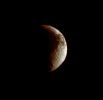
Japetus-PIA12521.jpgCrescent Japetus (possible Natural Colors; credits: Dr Paolo C. Fienga - Lunexit Team)60 visiteCaption NASA:"The Cassini Spacecraft examines the rough Dark-Light Dichotomy of the Terrain on Saturn's moon Japetus. Scientists continue to investigate the nature of this moon's Surface.
Lit Terrain seen here is on the Saturn-facing side of Japetus.
North on Japetus is up and rotated 8° to the left. Scale on Japetus was about 7 Km (about 4,3 miles) per pixel in the original image. The image was contrast enhanced and magnified by a factor of two to enhance the visibility of Surface Features.
The image was taken in Visible Green Light with the Cassini Spacecraft narrow-angle camera on Sept. 13, 2009. The view was acquired at a distance of approx. 1,2 MKM (about 746.000 miles) from Iapetus and at a Sun-Japetus-Spacecraft, or Phase, Angle of 103°".MareKromium
|
|
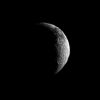
Japetus-PIA12539.jpgCrescent Japetus54 visiteCaption NASA:"The Cassini Spacecraft looks toward a crescent of Saturn's dark and light moon, Japetus.
Scientists continue to investigate the nature of this moon's surface. Lit Terrain seen here is in the Transition Area between the Saturn-facing Side and the Trailing Hemisphere of Japetus. North on Iapetus is up and rotated 23° to the left.
The image was taken in Visible Light with the Cassini Spacecraft narrow-angle camera on Nov. 29, 2009. The view was acquired at a distance of approx. 1,5 MKM (about 932.000 miles) from Japetus and at a Phase Angle of 117°.
Image scale in the original image was roughly 9 Km (about 5,5 miles) per pixel.
The image was contrast enhanced and magnified by a factor of two to enhance the visibility of Surface Features".MareKromium
|
|
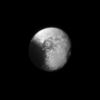
Japetus-PIA12556.jpgPlanet or Planetoid?54 visiteCaption NASA:"The oblate shape of the moon Japetus is particularly noticeable in this portrait.
The two-toned surface of the moon Japetus also stands out against the darkness of space in this image.
This view looks toward the Saturn-facing Side of Japetus. North is up and rotated 26° to the left.
Scale in the original image was about 22 Km (approx. 14 miles) per pixel.
The image was contrast enhanced and magnified by a factor of three to enhance the visibility of surface features.
The image was taken in Visible Light with the Cassini Spacecraft narrow-angle camera on Dec. 16, 2009. The view was acquired at a distance of approx. 3,6 MKM (about 2,2 MMs) from Japetus and at a Sun-Japetus-Spacecraft, or Phase, Angle of 27°".MareKromium
|
|

Japetus-PIA12657.jpgLight and Darkness on Japetus (possible Natural Colors; credits for the additional process. and color.: Dr Paolo C. Fienga - Lunexit Team)54 visiteCaption NASA:"Light and Dark Terrain covers the Surface of Saturn's moon Japetus; Lit Terrain seen here is on the area between the Saturn-facing Side and Trailing Hemisphere of Japetus. North is up and rotated 4° to the right.
The image was taken in Visible Light with the Cassini Spacecraft narrow-angle camera on Dec. 1, 2009. The view was obtained at a distance of approx. 1,4 MKM (about 870.000 miles) from Japetus and at a Sun-Japetus-Spacecraft, or Phase, Angle of 100°.
Image scale is roughly 8 Km (approx. 5 miles) per pixel".MareKromium
|
|

Japetus-PIA12697.jpgJapetus74 visiteCaption NASA:"With its light and dark Surface, Japetus appears almost like a "Yin & Yang" symbol or a comma punctuation mark in this Cassini image. This view looks toward the Saturn-facing side of Japetus. North on is up and rotated 41° to the right.
The image was taken in VL with the Cassini Spacecraft narrow-angle camera on May 12, 2010. The view was acquired at a distance of approx. 1,5 MKM (about 932.000 miles) from Japetus and at Phase Angle of 74°. Image scale is roughly 9 Km (about 5,8 miles) per pixel".MareKromium
|
|

Japetus-PIA12706.jpgJapetus67 visiteCaption NASA:"Some of Japetus' Dark Surface interrupts the moon's lighter Terrain in this Cassini view.
Scientists continue to investigate the nature of this moon's dark and light Surface. Lit Terrain seen here is on the Trailing Hemisphere of Japetus. North on Japetus is up and rotated 10° to the right.
The image was taken in visible light with the Cassini Spacecraft narrow-angle camera on May 9, 2010. The view was acquired at a distance of approx. 1,3 MKM (about 808.000 miles) from Iapetus and at a Phase Angle of 95°.
Image scale is roughly 8 Km (about 5 miles) per pixel".MareKromium
|
|
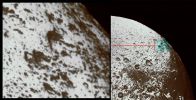
Japetus-SquaredTerrain.jpgSquares on Japetus?54 visiteUno splendido, inquietante ed...illusorio profilo individuato dal sempre bravissimo Marco Faccin. Strutture squadrate su Giapeto? Evidenze di "artificialità"?...
Ovviamente no: questo frame (e relativo detail mgnf) rappresentano solo un modo per vedere - e per far vedere! - come, volendo, si possono trovare "strutture regolari" su altri Corpi Celesti.
Illusioni determinate dalla distanza, dall'angolo di ripresa, dalla qualità del frame e dalla voglia di vedere "segni tangibili di intelligenza (passata o presente) altrove": trovare queste strutture (che appartengono alla Classe delle Strutture "Effimere") è un gioco; evidenziarle è una curiosità; spiegarle per quello che sono (senza costruirci sopra delle eso-archeo-baggianate) è, secondo noi, un dovere.
Un grazie di cuore (ed un grande BRAVO!) al Dr Faccin per aver individuato un dettaglio (comunque) intrigante e per lo spunto di riflessione che, con esso, ci ha voluto dare.MareKromium
|
|
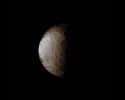
Japetus-V2-LXT.jpgJapetus (Natural Colors; credits: Lunar Explorer Italia)54 visitenessun commentoMareKromium
|
|
| 2245 immagini su 188 pagina(e) |
 |
|
|
|
|
75 | |
|
|
|
|





