Saturn: the "Ringed Beauty" and His Moons
|
|
|

Japetus-PIA07660.jpgLand of the Day, Land of the Night55 visiteAlthough it is no longer "Uncharted Land", the origin of the dark territory of Cassini Regio on Iapetus remains a mystery.
Also puzzling is the equatorial ridge that bisects this terrain, and how it fits into the story of the moon's strange brightness dichotomy. The ridge is seen here, curving along the lower left edge of Iapetus.
The view looks down onto the Northern Hemisphere of Iapetus, and shows terrain on the moon's Leading Hemisphere.
The image was taken in polarized green light with the Cassini spacecraft narrow-angle camera on Nov. 12, 2005 at a distance of approx. 417.000 Km (such as about 259.000 miles) from Iapetus and at a Sun-Iapetus-spacecraft, or phase, angle of 95°. Image scale is about 2 Km (about 1 mile) per pixel.
|
|

Japetus-PIA08125.jpgJapetus54 visiteSunlight strikes the terminator (the boundary between day and night) Region on Saturn's moon Iapetus at nearly horizontal angles, making visible the vertical relief of many features.
This view is centered on terrain in the Southern Hemisphere of Iapetus. Lit terrain visible here is on the moon's Leading Hemisphere.
In this image, a large, central-peaked crater is notable at the boundary between the dark material in Cassini Regio and the brighter material on the Trailing Hemisphere.
The image was taken in visible light with the Cassini spacecraft narrow-angle camera on Jan. 22, 2006, at a distance of approx. 1,3 MKM (such as about 800.000 miles) from Iapetus and at a Sun-Iapetus-spacecraft, or phase, angle of 67°. Resolution in the original image was 8 Km (about 5 miles) per pixel. The image has been magnified by a factor of two and contrast-enhanced to aid visibility.
|
|

Japetus-PIA08164.jpgThe unusual colors of Japetus56 visiteThese two views of Iapetus primarily show terrain in the Southern part of the moon's dark Leading Hemisphere - the side of Iapetus that is coated with dark material. The bright South Pole of Iapetus is visible, along with some terrain (at the bottom) that lies on the bright Trailing Hemisphere.
The dark terrain known as Cassini Regio is uniformly dark between the equator and about 30° South Lat. From there down to about 50 to 60° South Lat., the dark material looks "patchy" because south-facing crater walls are bright (being largely devoid of the dark material). South of this Region, only some northward-facing crater walls are still dark, while the bright terrain has a somewhat reddish color.
Beyond 90° South, the reddish color becomes white. The Region at the bottom of the color view presented here shows this "color boundary" in the bright terrain, which also marks the boundary between the Leading and Trailing Hemispheres.
The monochrome image on the left was taken using a filter sensitive to wavelengths of infrared light centered at 930 nanometers. The image was obtained with the Cassini spacecraft narrow-angle camera on April 8, 2006, at a distance of approximately 866,000 kilometers (538,000 miles) from Iapetus and at a Sun-Iapetus-spacecraft, or phase, angle of 88 degrees. The image scale is 5 kilometers (3 miles) per pixel.
The color view on the right was created by combining images taken in ultraviolet, green and infrared spectral filters. The images were acquired with the Cassini spacecraft narrow-angle camera on April 9, 2006, at a distance of approximately 692,000 kilometers (430,000 miles) from Iapetus and at a Sun-Iapetus-spacecraft, or phase, angle of 101 degrees. The image scale is 4 kilometers (2.5 miles) per pixel.
|
|

Japetus-PIA08177.jpgThe darkest moon is there...54 visiteA distant glimpse of Japetus reveals details within the dark terrain of the Cassini Regio, including an impact basin at top that is roughly 400 Km (about 250 miles) wide.
Researchers remain unsure about the mechanism that has darkened the Leading Hemisphere.
This view looks toward the Southern Hemisphere on the leading side of Japetus (1.468 Km, or about 912 miles across). North is up.
The image was taken in visible light with the Cassini spacecraft narrow-angle camera on April 4, 2006, at a distance of approx. 1,4 MKM (such as about 900.000 miles) from Japetus.
The image scale is roughly 9 Km (about 6 miles) per pixel.
|
|

Japetus-PIA08273.jpgDuotone Moon53 visiteCaption NASA originale:"The many impact scars borne by Japetus are made far more conspicuous in the Region of Transition from its dark Hemisphere to its bright one.
In this terrain, the dark material that coats Cassini Regio accentuates slopes and crater floors, creating a land of stark contrasts.
The image was taken in visible light with the Cassini spacecraft narrow-angle camera on Sept. 6, 2006 at a distance of approx. 2,2 MKM (about 1,4 MMs) from Japetus and at a Sun-Japetus-spacecraft, or phase, angle of 26°. Image scale is roughly 13 Km (about 8 miles) per pixel".
|
|
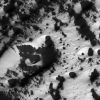
Japetus-PIA08373.jpgThe "Transition Region" of Japetus: Coated Craters56 visiteCaption NASA:"Cassini surveys a bright landscape coated by dark material on Iapetus. This image shows terrain in the Transition Region between the moon's dark Leading Hemisphere and its bright Trailing Hemisphere. The view was acquired during Cassini's only close flyby of the two-toned Saturn moon.
The image was taken on Sept. 10, 2007, with the Cassini spacecraft narrow-angle camera at a distance of approximately 5.260 Km (3.270 miles) from Japetus. Image scale is 32 meters (105 feet) per pixel".MareKromium
|
|

Japetus-PIA08374.jpgThe "Transition Region" of Japetus53 visiteCaption NASA:"Dark material splatters the walls and floors of craters in the surreal, frozen wastelands of Japetus. This image shows terrain in the Transition Region between the moon's dark Leading Hemisphere and its bright Trailing Hemisphere.
The view was acquired during Cassini's only close flyby of the two-toned Saturn moon.
The image was taken on Sept. 10, 2007, with the Cassini spacecraft narrow-angle camera at a distance of approximately 6.030 Km (3.750 miles) from Japetus. Image scale is 36 meters (118 feet) per pixel".MareKromium
|
|

Japetus-PIA08375.jpgThe "Voyager" Mountains54 visiteCaption NASA:"Cassini zooms in, for the first time, on the patchy, bright and dark mountains originally identified in images from the NASA Voyager spacecraft taken more than 25 years earlier. The image was acquired during Cassini's only close flyby of Iapetus, a two-toned moon of Saturn.
The terrain seen here is located on the Equator of Japetus at approximately 199° West Longitude, in the Transition Region between the moon's bright and dark Hemispheres. North is up.
The image was taken on Sept. 10, 2007, with the Cassini spacecraft narrow-angle camera at a distance of approximately 9.240 Km (5.740 miles) from Japetus. Image scale is 55 meters (180 feet) per pixel".MareKromium
|
|

Japetus-PIA08375~0.jpgSnow on Japetus' Mountains (Natural Colors; credits: Lunar Explorer Italia)104 visiteDopo aver effettuato la consueta colorizzazione Multispettrale ed in Colori Naturali, la nostra idea è che le chiazze bianche e dai riflessi blu che caratterizzano alcuni rilievi della misteriosa Luna Saturniana Giapeto debbano essere riferiti a ghiaccio d'acqua (la cui albedo e specifica colorazione lo rende inconfondibile).
Pronti a scusarci in caso di errore, rimettiamo la parola ai nostri Amici di Pasadena (che, sino ad oggi, sull'argomento in questione non si sono sbilanciati).MareKromium
|
|

Japetus-PIA08376-1.jpgRising Japetus (false colors - elab. NASA)53 visiteThe slim crescent of Iapetus looms before the Cassini spacecraft as it approaches the mysterious moon.
Iapetus, 1,468 kilometers (912 miles) across, seen here in false color, is unique in its dramatic variation in brightness between the northern polar region and the middle and low latitudes. Equally prominent is the moon's equatorial ridge of towering mountains. The profile of the ridge against the darkness of space reveals that it is topped by a cratered plateau approximately 15 kilometers (9 miles) wide. Further west, the profile of the ridge changes from a long plateau to discrete peaks.
The mosaic consists of four image footprints across the surface of Iapetus and has a resolution of 489 meters (0.3 miles) per pixel.
A full-resolution clear filter image was combined with half-resolution images taken with infrared, green and ultraviolet spectral filters (centered at 752, 568 and 338 nanometers, respectively) to create this full-resolution false color mosaic.
The color seen in this view represents an expansion of the wavelength region of the electromagnetic spectrum visible to human eyes. The intense reddish-brown hue of the dark material is far less pronounced in true color images. The use of enhanced color makes the reddish character of the dark material more visible than it would be to the naked eye. In addition, the scene has been brightened to improve the visibility of surface features.
This view was acquired with the Cassini spacecraft narrow-angle camera on Sept. 10, 2007, at a distance of about 83,000 kilometers (51,600 miles) from Iapetus.
MareKromium
|
|

Japetus-PIA08376-2.jpgRising Japetus (possible natural colors - elab. Lunexit)54 visitenessun commentoMareKromium
|
|

Japetus-PIA08377.jpgCraterland... (HR - possible natural colors; elab. Lunexit)53 visiteThis HR view shows a vast range of crater sizes in the dark terrain of the Leading Hemisphere of Saturn's moon Japetus.
Across the scene, a few small bright spots indicate fresh, rayed craters where impactors have punched through the thin blanket of dark material to the cleaner ice beneath.
The slight elevation on the bottom half of the image is part of the giant Equatorial Ridge that spans a wide fraction of Japetus' circumference. The numerous craters on top of the ridge indicate that it is an old surface feature.
The mosaic consists of three image footprints across the surface of Japetus.
The view is centered on terrain near 0,5° North Latitude and 141,6° West Long.
Image scale is approx. 22 meters (72 feet) per pixel. Illumination is from the left.
The clear spectral filter images in this mosaic were obtained with the Cassini spacecraft narrow-angle camera on Sept. 10, 2007, at a distance of approx. 63.000 Km (such as about 39.000 miles) from Japetus and at a phase angle of about 125°.MareKromium
|
|
| 2245 immagini su 188 pagina(e) |
 |
|
|
|
|
73 | |
|
|
|
|





