| |

Saturn: the "Ringed Beauty" and His Moons
|
|
|

Janus&Epimetheus-PIA07699.jpgHigh-Phase in the Darkness: Janus and Epimetheus55 visiteThis close pairing of Janus and Epimetheus shows the 2 moons at "high phase," meaning that only a thin sliver of sunlit terrain is visible on each moon. Portions of each are also lit feebly by reflected light from Saturn.
Janus (181 Km, or about 113 miles across) is at top and Epimetheus (116 Km, or about 72 miles across) is below.
The image was taken in visible light with the Cassini spacecraft narrow-angle camera on Dec. 25, 2005, at a distance of approx. 479.000 Km(roughly 298.000 miles) from Janus and about 455,000 Km (roughly 283.000 miles) from Epimetheus. The image scale is about 3 Km (approx 2 miles) per pixel on both moons.
|
|
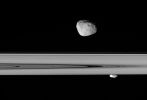
Janus&Prometheus-PIA08192.jpgJanus and Prometheus73 visiteSaturn's moons Janus and Prometheus look close enough to touch in this stunningly detailed view.
From just beneath the Ring-Plane, Cassini stares at Janus on the near side of the Rings, and Prometheus on the far side. The image shows that Prometheus is more elongated than Janus.
The view takes in the Cassini Division (about 4800 Km, or approx. 2980 miles wide), from its outer edge to about halfway across its width.
The image was taken in visible light with the Cassini spacecraft narrow-angle camera on April 29, 2006 at a distance of approx. 218.000 Km (such as about 135.000 miles) from Janus and approx. 379.000 Km (such as about 236.000 miles) from Prometheus. Image scale is about 1 Km (roughly 0,6 mile) per pixel on Janus and about 2 Km (a little more than 1 mile) per pixel on Prometheus.
|
|
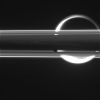
Janus&Titan-N00055796.jpgPassing-by... (1)55 visiteUna piccola serie di 3 frames (decisamente suggestivi) i quali ci mostrano alcuni istanti del transito della Sonda Cassini in una porzione dello spazio circum-saturniano capace di mostrarci lo spettacolo dell'incrocio (si tratta, come ovvio, di un semplice gioco prospettico) fra la piccola luna Giano (Janus), gli Anelli di Saturno e Titano.
Data:"N00055796.jpg was taken on March 21, 2006 and received on Earth March 22, 2006. The camera was pointing toward Janus that, at the time, was approximately 724.598 Km away.
The image was taken using the CL1 and CL2 filters".
|
|
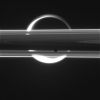
Janus&Titan-N00055798.jpgPassing-by... (2)55 visiteData:"N00055798.jpg was taken on March 21, 2006 and received on Earth March 22, 2006. The camera was pointing toward Janus that, at the time, was approximately 724.179 Km away.
The image was taken using the CL1 and CL2 filters".
Nota: la distanza fra Cassini e Titano, in questo frame - così come nel precedente e nel successivo - dovrebbe essere compresa fra i 2,2 ed i 2,4 MKM.
|
|

Janus&Titan-N00055802.jpgPassing-by... (3)54 visiteData:"N00055802.jpg was taken on March 21, 2006 and received on Earth March 22, 2006. The camera was pointing toward janus that, at the time, was approximately 723.396 Km away.
The image was taken using the CL1 and CL2 filters".
|
|
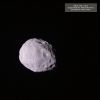
Janus-EB-LXTT.jpgJanus (credits: Elisabetta Bonora - Lunexit Team)55 visitenessun commentoMareKromium
|
|

Janus-MF-EB-LXTT.jpgJanus (RAW Natural Colors; credits for the additional process. and color.: Elisabetta Bonora and Marco Faccin - Lunexit Team)149 visiteJanus - apparently, and according to our Readers, one of the most interesting Celestial Bodies that we have shown and talked about on our APOD in the past - is one of the so-called "Inner Natural Satellites" of the Giant Gas-Planet Saturn; it is also called and known, sometimes, as Saturn X, and it occupies (better yet: shares) the same orbit as the Saturnian Inner Minor moon Epimetheus. This (now we know NOT infrequent) circumstance, however caused, in the past, some confusion to many astronomers which, at the time of Janus' discovery - and according to their different observations - assumed that there should have been only one Celestial Body in the orbit where Janus was spotted.
For a long time, in fact, the Astronomical Community struggled to figure out what was going on, until they realized that what they were trying to solve, was (let us use this expression) an "impossible equation": in other words, they were trying to reconcile (so-called "reductio ad unum") different observations of different and distinct Objects, on the wrong assumption that what they all were looking at, was just a single Celestial Body.
The discovery of Janus is attributed to its first observer, such as the French Astronomer Audouin Dollfus, who spotted Janus on December 15, 1966. The newly discovered Object was given the temporary designation of "S/1966 S 2". Previously, though, another Astronomer (Jean Texereau) had also photographed the very same Celestial Body (to be exact, on October 29, 1966), but without realizing the discovery! On December 18 of the same year, then, Richard Walker made a similar observation which is now credited as the discovery of Epimetheus.
Twelve years later, in October 1978, Stephen M. Larson and John W. Fountain finally realized that the 1966 observations would have been better explained by assuming that they were relative NOT to one, BUT to two distinct Objects (as we said, Janus and Epimetheus), sharing very similar (or perhaps the same, as we know now) orbits. Finally, in the AD 1980, the NASA - Voyager 1 Spacecraft confirmed that this "controversial moon" was, in fact, a couple of co-orbital Celestial Bodies.
Afterwards, Janus was observed on other occasions and given different provisional designations. It was observed, for instance, by the NASA - Pioneer 11 Probe when it passed near Saturn on September 1st, 1979. Janus was also observed by Dan Pascu on February 19, 1980 (and then provisionally designed as "S/1980 S 1") and then by John W. Fountain (once again), Stephen M. Larson (again), Harold J. Reitsema and Bradford A. Smith on the 23rd (and, this time, the observed object was, always provisionally, recorded as "S/1980 S 2").
All these Scientists, in a way and in the end, should therefore share, to various degrees, the title of Discoverer of Janus, but this "fair dispute", so far (and as far as we know), has not been solved.
As far as the physical characteristics of Janus are concerned, we can say that this relatively small moon (whose dimensions are approx. 203 × 185 × 153 Km) is extensively cratered, and a few of these craters are more than 30 Km across. The Janian Surface, as we already wrote in the past, appears to be older than Prometheus' one, but younger than Pandora's. Furthermore, if you consideri its oval (or, if you prefer, its "non-spherical") shape, its (very) low Density and relatively high Albedo, it seems logic to conclude, for the time being, that Janus should just be a porous and icy "rubble pile" (such as the final result of a cloud of Cosmic Debris that have coalesced under the influence of gravity).
The so-called Rubble Piles-type Celestial Bodies have a low density because there are, we believe, large cavities between the various "chunks" - such as fragments - of rocky material that made them up; Rubble Piles may also form when an Asteroid or a moon (which may originally be monolithic - such as "one single piece of rock") is smashed by an impact, and the shattered pieces left over by the impact, in time, fall back together, primarily due to self-gravitation (---> mutual attraction). In other words: a Celestial Body like Janus is formed, in our opinion, by a mass of different materials that cohered over time (we repeat: something like a "cloud" of Cosmic Debris - rocks, boulders, dust etc. - which, in time, due to a mutual gravitational attraction, got together until they became one - yet extremely fragile - Celestial Body).
In the light of the above considerations and assumptions, we, as IPF, believe that Janus can reasonably be assimilated, for instance (and among others), to Asteroid 25143 Itokawa or 433 Eros.MareKromium
|
|

Janus-N00021433.jpgRings and Janus55 visitenessun commento
|
|
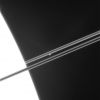
Janus-N00028725.jpgJanus and the "Lord of the Rings"56 visitenessun commento
|
|

Janus-N00028962.jpgJanus and the "Lord of the Rings"57 visitenessun commento
|
|

Janus-N00041468-2.jpgJanus?61 visitenessun commento
|
|

Janus-N00041468.jpgJanus and Prometheus56 visiteN00041468.jpg was taken on October 13, 2005 and received on Earth October 14, 2005. The camera was pointing toward JANUS - distant approximately 876.959 Km away - and the image was taken using the CL1 and CL2 filters. This image has not been validated or calibrated.
|
|
| 2245 immagini su 188 pagina(e) |
|
|
|
|
|
59 | |
|
|
|
|
|
|





