| |

Saturn: the "Ringed Beauty" and His Moons
|
|
|
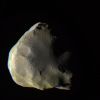
Helene-N00172877_78_79.jpgHelene (RAW Natural Colors; credits for the additional process. and color.: Dr Marco Faccin - Lunexit Team)228 visitenessun commentoMareKromium
|
|

Helene-N00172899_900.jpgHelene (High-Def-3D; credits for the additional process.: Dr Marco Faccin - Lunexit Team)231 visitenessun commentoMareKromium
|
|

Helene-PCF-LXTT-IPF.jpgHelene (Absolute Natural Colors; credits for the additional process. and color.: Dr Paolo C. Fienga - Lunexit Team) 134 visiteHelene (one of the many moons of the Giant Gas-Planet Saturn) was discovered by the French Astronomers Pierre Laques and Jean Lecacheux in 1980, from ground-based observations carried out at the "Pic du Midi" Observatory; at first, it was designated S/1980 S 6. Afterwards, in 1988, it was officially named Helene (after Helen of Troy, who was the granddaughter of Cronus - Saturn -, according to Greek mythology).
This small moon (we are talking about a Celestial Body, mostly made of Ice and Rock, which is approx. 30 Km across) is also designated as Saturn XII, a number which it received in 1982, under the designation of Dione B (since Helene is co-orbital with Dione and located in its Leading Lagrangian Point - L4). Helene is one of 4 (four) known so-called "Trojan Moons" of the Saturnian System.
For sake of clarity, please remember that:
A) the Saturnian System contains two sets of Trojan Moons. Both Tethys and Dione have, in fact, two Trojan Moons: Telesto and Calypso, which are located in Tethys' L4 and L5 Lagrangian Points, respectively, and Helene with Polydeuces, which are located in Dione's L4 and L5 Lagrangian Points, respectively;
B) in Astronomy, a co-orbital configuration refers to 2 (two) or more Celestial Objects - such as Asteroids, Moons, or even Planets - that orbit at the same, or very similar, distance from their Parent Object as well as from each other. In other words, they are in a 1:1 (one-to-one) mean Motion Resonance;
C) there are several Classes of co-orbital Objects, depending on their Point of Libration. The most common and best-known Class, is the Trojan, which librate around one of the two stable Lagrangian Points (also known as "Trojan Points"), L4 and L5, 60° ahead of, and behind, the larger Parent Body, respectively. Another class is the so-called "Horseshoe Orbit", in which the Celestial co-Orbital Objects librate around 180° from the larger Parent Body. Objects librating around 0° are called, instead, "Quasi-Satellites".
When two co-Orbital Objects are of similar masses (and thus they exert a non-negligible - i.e.: meaningful - Gravitational Influence on each other) they can even arrive to exchange their orbits. For instance, talking about Janus and Epimetheus, we know that the Timing and Magnitude of their Momenta exchange in such a way that the two moons actually "trade" their orbits, while never getting closer (---> approaching each other) than about 10.000 Km. The exchange takes place about once every 4 years; the last close approaches occurred on January 21, 2006, and in 2010, when Janus' Orbital Radius increased by ~20 Km, while Epimetheus' decreased by ~80 Km. However, Janus' orbit is less affected by the swop, because Janus itself is about 4 times more massive than Epimetheus. As far as it is currently known, this "arrangement" is unique in the Solar System.
As we already said hereabove, Helene was initially observed from Earth in 1980 but, when the NASA - Voyager Probes passed through the Saturnian System, they allowed us to get much closer views of it. Afterwards, the NASA - Cassini Spacecraft, which went into orbit around Saturn in 2004, provided still better views and allowed more in-depth analysis of this moon, including views of its Surface under different lighting conditions. Although conventional Impact Craters and Hills do appear, this image also shows Terrain that looks unusually smooth and streaked. Some of the closest images of Helene to date are from the Cassini Spacecraft's 1800 Km Fly-By that occurred on March 3, 2010, and another very successful imaging sequence which was obtained in June 2011.
There have been many other approaches over the course of the Cassini mission, and future Fly-Bys may yield additional data.This frame has been colorized in Natural Colors (such as the colors that a perfect human eye would actually perceive if someone were onboard the NASA - Cassini Spacecraft and then looked outside, towards the Saturnian moon Helene), by using an original technique created - and, in time, dramatically emproved - by the Lunar Explorer Italia Team.MareKromium
|
|

Helene-PIA07547.jpgThe Trojan Moons: Helene, from 760.000 Km82 visiteCaption NASA originale:"Saturn's moons Helene and tiny Polydeuces (not seen here) are Trojan moons of Dione, orbiting about 60° ahead of and behind, the much larger moon. Trojan moons are usually found near gravitationally stable points ahead or behind a larger moon. Polydeuces (or S/2004 S5) was discovered by the Cassini imaging team. Helene is 32 Km (20 miles) across, while Dione is 1.118 Km (695 miles) across.
Tethys also has two of its own Trojan moons.
The image was taken in visible light with the Cassini spacecraft narrow-angle camera on May 20, 2005, at a distance of approx. 760.000 Km (such as about 472.000 miles) from Helene. The image scale is 5 Km (about 3 miles) per pixel. This view of Helene has been magnified by a factor of three and sharpened to aid visibility".
Nota: raffrontate questa immagine di Helene con quella ottenuta dalla Sonda Voyager 2. Ma secondo Voi stiamo guardando sempre lo stesso oggetto?!?
|
|

Helene-PIA08269.jpgMoments of "Helene"64 visiteCaption NASA originale:"This set of images exposes details on small and crumpled-looking Helene. Large portions of this Trojan moon of Dione appear to have been blasted away by impacts.
Cassini passed within 50.000 Km (about 31,000 miles) of Helene (which is about 32 Km - or 20 miles across) on Aug. 17, 2006, when these images were acquired.
The views were obtained over the course of an hour and are presented here in reverse order (i.e.: the leftmost image was taken latest).
The images were taken in visible light with the Cassini spacecraft narrow-angle camera. As presented here, the views were acquired at distances ranging from about 62.000 to 51.000 Km (such as about 39.000 to 32.000 miles) from Helene and at a Sun-Helene-spacecraft, or phase, angle of 111 to 120°. Image scale is roughly 375 to 300 meters (approx. 1.230 to 984 feet) per pixel, from left to right".
|
|

Helene-PIA08335-00.jpgHelene (HR and False Colors)71 visiteCaption NASA:"Cassini came close to Saturn's small moon Helene on Feb. 25, 2006, acquiring this High-Resolution (HR) view. This object seems to be buried in its own crater debris, like another Saturnian moon, Telesto.
Helene (32 Km, or 20 miles across) orbits 60° ahead of Dione in the larger moon's orbit, making it a "trojan" moon of Dione. Trojan moons are named for the Trojan group of asteroids that orbit 60° ahead of and behind Jupiter as it circles the Sun.
This image was taken in visible light with the Cassini spacecraft narrow-angle camera at a distance of approx. 68.000 Km (42.000 miles) from Helene and at a Sun-Helene-spacecraft, or phase, angle of 99°. Image scale is roughly 406 mt (1.334 feet) per pixel".
|
|

Helene-PIA09015.jpgJust like an old "apple": Helene (False Colors)64 visiteCaption NASA:"The Cassini spacecraft reveals details on the surface of small, irregularly shaped Helene in this close-up view, obtained during the Spacecraft's closest encounter with this moon during its four-year primary mission.
Helene (32 Km, or 20 miles across) is a Trojan Moon, sharing Dione's orbit but staying 60° or 400.000 Km (about 250.000 miles) ahead of the much larger moon.
The image was taken in visible green light with the Cassini spacecraft narrow-angle camera on July 20, 2007. The view was acquired at a distance of approx. 39.000 Km (such as about 24.000 miles) from Helene and at a Sun-Helene-spacecraft, or phase, angle of 61°.
Image scale is roughly 231 meters (758 feet) per pixel".MareKromium
|
|

Helene-PIA12653.jpgHelene69 visitenessun commentoMareKromium
|
|

Helene-PIA12758-PCF-LXTT.jpgHelene (Absolute Natural Colors; credits for the additional process. and color.: Dr Paolo C. Fienga - Lunexit Team)243 visitenessun commentoMareKromium
|
|

Helene-PIA12779-PCF-LXTT.jpgLike a "Cosmic Apple"... (Natural Colors; credits for the additional process. and color.: Dr Paolo C. Fienga - Lunar Explorer Italia)143 visiteCaption NASA:"Saturn's small, irregularly shaped moon Helene is strikingly illuminated in this close view captured by Cassini during the Spacecraft's June 18, 2011, Fly-By. Although it is not visible at this exposure, the Planet (Saturn?) actually fills the dark background of this image of Helene.
This view looks toward the anti-Saturn side of Helene (which is about 33 Km, or approx. 21 miles across). North on Helene is up. The lit Terrain on the right is on the Leading Hemisphere, while lit Terrain at the top of the image surrounds the North Pole.
This image was taken in Visible Light with the Cassini Spacecraft narrow-angle camera. The view was obtained at a distance of approximately 11,000 kilometers (7,000 miles) from Helene and at a Sun-Helene-Spacecraft, or Phase, Angle of 151°.
Image scale is roughly 67 meters (220 feet) per pixel".MareKromium
|
|

Helene_Mimas-PIA08897.jpgCelestial Wonders around Saturn: Helene and Mimas76 visiteCaption NASA:"Mimas (397 Km, or 247 miles across) is seen here just before gliding in front of Helene (32 Km, or 20 miles across), which lays about 192.000 Km (approx. 119.000 miles) in the distance beyond the larger moon.
The limb of Mimas is flattened in the West, where the rim if the large crater Herschel lies.
This view looks toward the lit side of the Rings from about 3° below the Ring-Plane.
The image was taken in visible light with the Cassini spacecraft narrow-angle camera on Feb. 3, 2007 at a distance of approx. 1,3 MKM (about 800.000 miles) from Mimas and 1,5 MKM (approx. 1 MMs) from Helene.
Image scale is roughly 8 Km (approx. 5 miles) per pixel on Mimas and 9 Km (about 6 miles) per pixel on Helene".
|
|

Huygens-IMG001253-br500.jpgThe "Huygens Probe", "camera artifacts" and 4 "known" stars92 visiteShown in white boxes are known stars; the probe is the brightest item on the lower right. The other dots are artifacts of the camera. Although only a few pixels across, this image is helping navigators reconstruct the probe's trajectory and pinpoint its position relative to Cassini. This information so far shows that the probe and Cassini are right on the mark and well within the predicted trajectory accuracy. This information is important to help establish the required geometry between the probe and the orbiter for radio communications during the probe descent on January 14. The Huygens probe, built and managed by ESA, will remain dormant until the onboard timer wakes it up just before the probe reaches Titan's upper atmosphere. Then it will begin a dramatic plunge through Titan's murky atmosphere, tasting its chemical makeup and composition as it descends to touch down on its surface. The data gathered during this 2,5 hours descent will be transmitted from the probe to the Cassini orbiter. Afterward, Cassini will point its antenna to Earth and relay the data through NASA's Deep Space Network to JPL and on to the European Space Agency's Space Operations Center in Darmstadt, Germany, which serves as the operations center for the Huygens probe mission.
|
|
| 2245 immagini su 188 pagina(e) |
|
|
|
|
|
51 | |
|
|
|
|
|
|





