Saturn: the "Ringed Beauty" and His Moons
|
|
|
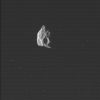
Epimetheus-N00030856.jpgEpimetheus, from approx. 75.000 Km57 visiteLa forma di Epimetheus, assolutamente irregolare, ci suggerisce una sua possibile origine "traumatica": forse si tratta, infatti, di un semplice frammento di un corpo celeste più grande il quale, in tempi lontani, andò in pezzi a seguito di una collisione con un grande asteroide. Non è neppure da escludere che Epimetheus sia un residuo di cospicue dimensioni della collisione che generò gli stessi Anelli di Saturno e questa ipotesi, laddove (in un futuro) venisse verificata ed accolta, ci spiegherebbe, in parte, le cause dell'attuale posizione e del ruolo di questa luna negli equilibri del complesso Sistema Saturniano. La superficie di Epimetheus, fortemente craterizzata, ci suggerisce un'età molto avanzata per questa luna; in primo piano, poi, notiamo un grande cratere da impatto che ricorda, per forma e dimensioni, lo Stickney Crater di Phobos.
|
|
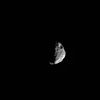
Epimetheus-N00037090.jpgEpimetheus, from about 87.000 Km53 visitenessun commento
|
|

Epimetheus-N00055513.jpgThe Runners...Again!54 visiteCaption NASA originale:"N00055513.jpg was taken on March 20, 2006 and received on Earth March 20, 2006. The camera was pointing toward Epimetheus that, at the time, was approximately 452.867 Km away.
This image was taken using the CL1 and CL2 filters and it has not been validated or calibrated".
|
|
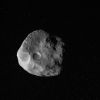
Epimetheus-N00098337.jpgEpimetheus (1)54 visiteCaption NASA:"N00098337.jpg was taken on December 03, 2007 and received on Earth December 04, 2007. The camera was pointing toward EPIMETHEUS that, at the time, was approx. 39.290 Km away, and the image was taken using the P120 and GRN filters.
This image has not been validated or calibrated".MareKromium
|
|

Epimetheus-N00098342.jpgEpimetheus (2)53 visiteCaption NASA:"N00098342.jpg was taken on December 03, 2007 and received on Earth December 04, 2007. The camera was pointing toward EPIMETHEUS that, at the time, was approximately 40.388 Km away, and the image was taken using the RED and CL2 filters.
This image has not been validated or calibrated".MareKromium
|
|

Epimetheus-PIA06226.jpgEpimetheus up close (from about 74.600 Km) but in false colors56 visiteCaption NASA originale:"The color of Epimetheus in this view appears to vary in a non-uniform way across the different facets of the moon's irregular surface. Usually, color differences among planetary terrains identify regional variations in the chemical composition of surface materials. However, surface color variations can also be caused by wavelength-dependent differences in the way a particular material reflects light at different lighting angles. The color variation in this false-color view suggests such "photometric effects" because the surface appears to have a more bluish cast in areas where sunlight strikes the surface at greater angles. The slightly reddish feature in the lower left is a crater named Pollux. The large crater just below center is Hilairea, which has a diameter of about 33 Km. At 116 Km across, Epimetheus is slightly smaller than its companion moon, Janus (181 Km across), which orbits at essentially the same distance from Saturn".
|
|

Epimetheus-PIA06605.jpgEpimetheus, from approx. 2,5 MKM56 visiteCaption NASA originale:"One of Saturn's strange co-orbital moons, Epimetheus, was captured by Cassini in this view. Irregularly shaped Epimetheus occasionally swaps orbits with nearby Janus and both moons play a role in maintaining the outer edge of Saturn's bright A-Ring. Epimetheus is 116 Km (approx. 72 miles) across.
The image was taken in visible light with the Cassini spacecraft narrow-angle camera on Jan. 22, 2005, at a distance of approximately 2,5 MKM (approx. 1,6 MMs) from Epimetheus and at a phase angle of 90°.
Resolution in the image is 15 Km (approx. 9 miles) per pixel.
The image has been contrast-enhanced to aid visibility".
|
|

Epimetheus-PIA06614.jpgEpimetheus, from approx. 1,1 MKM55 visiteCaption NASA originale:"Epimetheus is one of Saturn's "co-orbital moons" because it shares nearly the same orbit as Janus at a distance of approximately 151.000 Km (such as 94.000 miles) from Saturn. Epimetheus is about 116 Km (72 miles) across while Janus is 181 Km (113 miles) across.
The image was taken in visible light with the Cassini spacecraft narrow-angle camera on Feb. 18, 2005, at a distance of approx. 1,1 MKM (684,000 miles) from Epimetheus and at a phase angle of 96°. Resolution in the original image was 6 Km (4 miles) per pixel. The image has been contrast-enhanced and magnified by a factor of four to aid visibility".
|
|
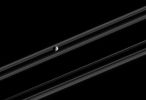
Epimetheus-PIA06615.jpgEpimetheus, from approx. 990.000 Km56 visiteCaption NASA originale:"Saturn's small, irregularly-shaped moon Epimetheus orbits against the backdrop of the planet's rings, which are nearly edge-on in this view. Some of the moon's larger geological features can be seen here. The image was taken in visible light with the Cassini spacecraft narrow-angle camera on Feb. 18, 2005, at a distance of approximately 990.000 Km (approx. 615.000 miles) from Epimetheus and at a phase angle of 99°. Resolution in the original image was 6 Km per pixel. The image has been contrast-enhanced and magnified by a factor of two to aid visibility".
|
|

Epimetheus-PIA06640.jpgEpimetheus from 1,8 MKM87 visiteCaption NASA originale:"Small and asteroid-like in appearance, Epimetheus is seen here with Saturn's nearly edge-on rings in the distance. Epimetheus (that has been defined by NASA as a "rubble" moon - rubble----->macerie/detriti) has a mean density that is less than that of water, suggesting that it might be somewhat porous.
The image was taken in visible light with the Cassini spacecraft narrow-angle camera on March 12, 2005, at a distance of approx. 1,8 MKM (such as 1,1 MMs) from Saturn and at a phase angle of 90°. Resolution in the original image was 10 Km per pixel. The image has been contrast-enhanced and magnified by a factor of two to aid visibility".
|
|

Epimetheus-PIA07531.jpgEpimetheus55 visiteCaption NASA originale:"Cassini continues to survey the small worlds that orbit near Saturn's Rings, capturing this view of Epimetheus.
The moon's lumpy, irregular topography can be seen here, along with several impact craters. The image was taken in visible light with the Cassini spacecraft narrow-angle camera on May 20, 2005, at a distance of about 345.000 Km from Epimetheus and at a phase angle of 26°.
Resolution in the original image was 2 Km per pixel.
The view was also magnified by a factor of two and contrast-enhanced to aid visibility of the moon's surface".
|
|

Epimetheus-PIA07567.jpgEpimetheus, from approx. 87.000 Km53 visiteCaption originale:"From 34° above Saturn's equatorial plane, Cassini gazed down at Saturn's moon Epimetheus. The region seen here includes territory farther North and East than that imaged in March 2005 (PIA06226).
The two largest craters visible here are the only officially named features on Epimetheus. The crater at the left (at about the 9 o'clock position) is named Pollux; the crater at lower left (containing a string of several smaller craters) is called Hilairea. Epimetheus is 116 Km (about 72 miles) across. The image was taken in visible light with the Cassini spacecraft narrow-angle camera on July 14, 2005, at a distance of approx. 87.000 Km (about 54.000 miles) from Epimetheus and at a phase angle of 95°. The image scale is 520 mt (approx. 1710 feet) per pixel".
|
|
| 2245 immagini su 188 pagina(e) |
 |
|
|
|
|
48 | |
|
|
|
|





