| |

Saturn: the "Ringed Beauty" and His Moons
|
|
|

Enceladus.jpgEnceladus from Cassini/Huygens55 visitenessun commento
|
|

Enceladus.jpgEnceladus, the "E-Ring Creator"...53 visiteCaption NASA:"The active moon Enceladus appears to be making Saturn's E-Ring. An amazing picture showing the moon at work was taken late last year (AD 2006) by the Saturn-orbiting Cassini spacecraft and is shown above. Enceladus is the bright point near the center, right near the center of Saturn's E-Ring. Streams of ice and water vapor can be seen pouring off Enceladus into the E-Ring.
The above bright image of the normally faint E-Ring was made possible by aligning Cassini so that Saturn blocked the Sun. From that perspective, small ring particles reflect incoming sunlight more efficiently. Cassini has now been orbiting Saturn for almost three years, and is scheduled to swoop by the unexpectedly cryovolcanic Enceladus at least several more times".MareKromium
|
|

EnceladusFountains-PIA07762.gifThe "Fountains" of Enceladus121 visiteJets of icy particles burst from Enceladus in this GIF sequence of 4 images taken on Nov. 27, 2005. The sensational discovery of active eruptions on a third outer Solar System body (after Jupiter's moon, Io, and Neptune's moon, Triton) is one of the great highlights of the Cassini mission.
Images taken in January 2005, appeared to show the plume originating from the fractured South Polar Region of Enceladus, but the visible plume was only slightly brighter than the background noise in the image because the lighting geometry was not suitable to reveal the true details of the feature. This potential sighting, in addition to the detection of the icy particles in the plume by other Cassini instruments, prompted imaging scientists to target Enceladus again with exposures designed to confirm the validity of the earlier plume sighting.
The new views show individual jets, or plume sources, that contribute to the plume with much greater visibility than the earlier images.
The full plume towers over the 505-kilometer-wide (314-mile) moon, and is at least as tall as the moon's diameter.
The four, 10-second exposures were taken over the course of about 36 minutes at approximately 12-minute intervals. Enceladus rotates about 7.5 degrees in longitude over the course of the frames, and most of the observed changes in the appearances of the jets are likely due to changes in the viewing geometry. However, some of the changes may be due to actual variation in the flow from the jets on a time scale of tens of minutes.
Additionally, the shift of the sources seen here should provide information about their location in front of and behind the visible limb (edge) of Enceladus.
These images were obtained using the Cassini spacecraft narrow-angle camera at distances between 144,350 and 149,520 kilometers (89,695 and 92,907 miles) from Enceladus and at a phase angle of about 161 degrees. Image scale is about 900 meters (2,950 feet) per pixel on Enceladus.
|
|

EnceladusPlume-IMG002944-br500.jpgEnceladus' Plume Mechanics53 visiteCaption NASA:"This graphic shows how the ice particles and water vapor observed spewing from geysers on Saturn's moon Enceladus may be related to liquid water beneath the surface.
The large number of ice particles and the rate at which they are produced require high temperatures, close to the melting point of water. These warm temperatures indicate that there may be an internal lake of liquid water at or near the moon's South Pole, where the geysers are present.
This internal lake could be similar to Earth's Lake Vostok, where liquid water is locked in ice beneath Antarctica. The presence of liquid water inside Enceladus would have major implications for future studies of the possibility of life in the outer solar system". MareKromium
|
|
EnceladusSky-EB-N00148200-N00148225.gifIcy-Jets, Cosmic Rays and other UFO's in the Space of Saturn (GIF-Movie; credits: Elisabetta Bonora)72 visiteDalla nostra Amica e Partner, Elisabetta Bonora, un suggestivo GIF-Movie che ci porta nello Spazio circum-Enceladiano ad ammirare, ancora una volta, assieme alle Fontane di ghiaccio tipiche della "Luna di Neve", una serie di interssantissimi targets: dalla semplice "noise" (i puntini bianchi che tempestano il filmato e che assecondano patterns del tutto casuali) ai noti ed agevolmente riconoscibili "Cosmic Rays", passando dal transito di (MOLTI) altri OVNI - e cioè Oggetti Volanti Non Identificati - i quali, talora in coppia (porzione superiore del quadro), talora singolarmente (porzione inferiore), sfrecciano davanti alle ottiche di CASSINI.
Si tratta di Lune Saturniane? Sinceramente, noi ne dubitiamo...
Grandissimi Complimenti ad Elisabetta Bonora!
Technical Data: from N00148200 up to N00148229 ---> frames taken between 16:00 and 16:35 UTC; from this data we can derive that the average time-lap existing between each exposure was about 1' and 10" (in other words, the captioned pictures were taken about every 70" from each other). During that period of time the speed of the CASSINI Probe varied from 10,23 Km-per-sec up to 10,42 Km-per-sec.MareKromium
|
|
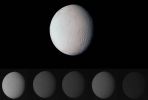
Enceladus_Approach.jpgApproaching Enceladus, from Voyager 255 visitenessun commentoMareKromium
|
|

Enceladus_and_Titan-PIA14617-PCF-LXTT-IPF.jpgSo close, and yet so far... (Absolute Natural Colors; credits for the additional process. and color.: Dr Paolo C. Fienga - Lunar Explorer Italia/Italian Planetary Foundation)94 visiteThe Saturnian moon Enceladus can be seen partially (as a matter of fact, we have to say almost completely) eclipsed by the shadow of its Gas-Giant Parent Planet, in this really fascinating view, taken by the the NASA - Cassini Spacecraft, which also features another Saturnian moon, such as Titan, in the distance. The Cassini Spacecraft flew by Enceladus, shown in the upper left of the picture, at a distance of about 16.000 miles (such as approx. 26.000 Km).
The Terminator - such as the Line separating the day from the night side - of Enceladus (whose dimension is approx. 313 miles, or about 504 Km across) can be barely seen on the very far left of the moon itself, while the shadow of Saturn runs all the way across from its Middle Northern, until the South Polar Regions. Titan (whose dimension is approx. 3200 miles, or about 5150 Km across), as we already mentioned hereabove, is well visible in the lower right of the frame, and, at the time that the picture was taken, it was about 684.000 miles (such as approx. 1,1 Million KiloMeters - MKM) away from the Spacecraft.
This view looks toward the Saturn-facing Sides of both Enceladus and Titan; North is up (obviously for both moons) and the image was taken in Visible Light, with the Cassini Spacecraft Wide-Angle Camera on October, 1st, 2011. The view was obtained at a Sun-Enceladus-CASSINI Spacecraft, or Phase, Angle of 29°. The Scale in the original image was approx. 2 miles (such as a little more than 3 Km) per pixel on Enceladus. The original image was also contrast enhanced and magnified by a factor of 1.5, so to enhance the visibility of a few Enceladian Surface Features (and in fact, if you look carefully, while Titan is - as usual, when observed from a great distance - completely featureless, a few Impact Craters and some Surface Striations, can actually be seen in the Northern Regions of the icy moon Enceladus).
This picture (which is an Original NASA - Cassini Spacecraft b/w frame published on the NASA - Planetary Photojournal with the ID n. PIA 14617) has been additionally processed and then colorized, according to an informed speculation carried out by Dr Paolo C. Fienga (LXTT-IPF), in Absolute Natural Colors (such as the colors that a human eye would actually perceive if someone were onboard the NASA - Cassini Spacecraft and then looked outside, towards the Saturnian moons Enceladus and Titan), by using an original technique created - and, in time, dramatically improved - by the Lunar Explorer Italia Team. Different colors, as well as different shades of the same color, mean, among others, the existence of different Elements present on the Surface of Enceladus and in the Atmosphere of Titan, respectively, each having a different Albedo (---> Reflectivity) and Chemical Composition.MareKromium
|
|

Enceladus_cassini_full.jpgEnceladus: the Paradise of "Interplanetary Skiers"53 visiteDa "NASA - Picture of the Day" del 24.02.2005:"Small, icy, inner moon of Saturn, Enceladus is only about 500 Km in diameter. But the distant world does reflect over 90% of the received sunlight, giving its surface about the same reflectivity as fresh snow. Seen here in a sharp view from the Cassini spacecraft's recent flyby, Enceladus shows a variety of surface features and very few impact craters - indicating that it has been an active world even though this tiny moon should have completely cooled off long ago. In fact, the resurfaced appearance of Enceladus could be the result of liquid water geysers or water volcanos. Since Enceladus orbits within the outer E-Ring of Saturn, the moon's surface may be kept snow-bright as it is continuously bombarded with icy ring particles. Eruptions on Enceladus itself would in turn supply material to the E-Ring. Would you like to ski there? Why not, but take note: Enceladus has only about 1/100th the surface gravity of Earth and a surface temperature of approx. - 200°C!".
|
|
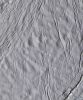
Enceladus~0.jpgEnceladus (close-up)53 visiteCaption NASA da "NASA - Picture of the Day" del 17 Marzo 2005:"The surface of Enceladus is as white as fresh snow. Still, an impressive variety of terrain is revealed in this contrast enhanced image. At a resolution of about 30 meters per pixel, the close-up view spans over 20 Km - recorded during the touring Cassini spacecraft's March flyby of the icy Saturnian moon. Enceladus is known to be the most reflective moon in the solar system and the recent Cassini encounters have also detected the presence of an atmosphere, making Enceladus the second moon of Saturn with such a distinction. In fact, Enceladus' fresh looking surface and significant atmosphere both indicate that the tiny, 500 Km diameter moon is active. Researchers suspect that ice volcanos or geysers coat the surface with fresh material and replenish the moon's atmosphere, ultimately providing the icy particles that compose Saturn's tenuous E-Ring".
|
|

Enceladus~1.jpgEnceladus' "Tiger Stripes"54 visiteDa "NASA - Picture of the Day" del 6 Settembre 2005:"The Tiger Stripes on Saturn's moon Enceladus might be active. Even today, they may be spewing ice from the Moon's icy interior into space, creating a cloud of fine ice particles over the Moon's South Pole and creating Saturn's mysterious E-Ring. Recent evidence for this has come from the Cassini spacecraft. Cassini detected a marked increase in particle collisions during its July flyby only 270 Km over a South Polar Region of Enceladus. Pictured above, a HR image of Enceladus is shown from the close flyby. The unusual surface features dubbed "Tiger Stripes" are visible on the left in false-color blue. Why Enceladus is active remains a mystery, as the neighboring moon Mimas, approximately the same size, appears quite dead".
|
|

EncelalusPIA11137.jpgRelict Tiger Stripe54 visitenessun commentoMareKromium
|
|

Enygma-W00012847.jpgEnygma (1)55 visiteDallo spazio di Saturno, una sequenza di 4 frames che, se da un lato ci ricorda la procedura di allineamento e messa a fuoco delle telecamere della Sonda Cassini (frames 1 e 2), da un altro punto di vista ci richiama alla mente immagini misteriose, inesplicabili e, forse, anche un pizzico inquietanti (frames 3 e 4).
Che cosa stiamo guardando? Una stella lontana, uno delle tante Lune di Saturno o...Che cosa?
Original caption:"W00012847.jpg was taken on January 05, 2006 and received on Earth January 06, 2006. The camera was pointing toward SKY, and the image was taken using the CL1 and BL1 filters. This image has not been validated or calibrated".
|
|
| 2245 immagini su 188 pagina(e) |
|
|
|
|
|
46 | |
|
|
|
|
|
|





