| |

Saturn: the "Ringed Beauty" and His Moons
|
|
|

Enceladus-PIA11697.jpgThe South Pole of Enceladus55 visiteCaption NASA:"This wide-angle image shows the South Polar Region of Saturn's moon Enceladus and outlines the area covered by the High-Resolution mosaic combining data from the Imaging Science Subsystem and Composite InfraRed Spectrometer onboard the NASA's Cassini Spacecraft (see the frame PIA11696).
The outlined area focuses on Baghdad Sulcus, a fracture in the South Polar Region.
Cassini captured the data for this wide-angle image during the Spacecraft's close Fly-By of the moon that occurred on Nov. 21st, 2009. This image and others from that Fly-By are among the best Visible Light images that Cassini will capture of the Region around the so-called "Tiger Stripes" - such as those Fissures that keep spraying icy particles, water vapor and organic compounds -, before the moon's South Polar Region enters Winter darkness for the coming years.
This wide-angle view shows not only Baghdad Sulcus, but also other nearby Fractures. The Lit Terrain seen here is on the Leading hemisphere and Saturn-facing Side of Enceladus.
The South Pole lies in shadow near the bottom middle of the image.
The wide-angle view was acquired at a distance of approx. 2000 Km (such as about 1200 miles) from Enceladus and at a Sun-Enceladus-Spacecraft, or Phase, Angle of 114°.
Scale in the wide-angle view is approx. 116 meters (381 feet) per pixel".MareKromium
|
|
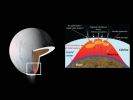
Enceladus-PIA12080.jpgMelted Ice54 visiteCaption NASA:"These drawings depict explanations for the source of intense heat that has been measured coming from Enceladus' South Polar Region. These models predict that water could exist in a deep layer as an ocean or sea and also near the Surface.
Cassini scientists infer that the temperature of the ice in the South Polar Region must be close to its melting point (shown in red). A layer of liquid water (dark blue) might exist between the ice and the silicate core (brown), allowing the ice to deform independent of the rock, providing even more mechanical energy and more flexing of the icy shell for extreme tidal heating.
Tidal heating could also cause friction in faults near the surface, leading to pockets of partially melted ice".MareKromium
|
|

Enceladus-PIA12081.jpgEnceladus' Ice-Plume Models70 visiteCaption NASA:"These illustrations indicate possible ways in which the water vapor and ice particles in the plume of Enceladus may be formed. The Cassini spacecraft recently found a small fraction of salt-rich ice particles from the plumes, while Earth-based observations indicate gas from the plumes is very poor in sodium. These measurements are helping scientists to evaluate how the plumes form.
In model A, salty water boils explosively near the surface of Enceladus when it encounters the vacuum of space. This model can be ruled out, because such explosive activity would spread large amounts of sodium into space where it would have been seen by the Earth-based observers. If this model was correct, then nearly all the ice particles observed by Cassini would be salt-rich, instead of just a fraction of them.
In model B, salty water evaporates more slowly at some depth in a narrow fissure, creating vapor which escapes to the surface to form the plume. This model also seems unlikely because the fissure would rapidly become clogged by salt left behind as water evaporates. The water would also freeze, because not enough heat could reach the water surface up the narrow fissure to replace the heat lost by evaporation.
In model C, the warm ice evaporates directly into vapor to form the plume, in a process called sublimation. The salty particles found in the plume would have been created by liquid water in an earlier epoch and would have been stored in the near-surface layers of Enceladus until the present. These particles would now be incorporated into the plume by the escaping gases. This model cannot be ruled out, but seems unlikely because it may be difficult to dislodge old ice grains from the walls of the fracture.
In model D, the liquid water results from melting of near-surface ice rather than coming from an underlying salty ocean. The water is initially only slightly salty, but its salinity increases as evaporation removes some of the water and leaves the salt behind. Thus, in this model, the salt-rich ice particles seen by Cassini would be derived from initially salt-poor water. This model may be plausible and has not yet been evaluated in detail.
In model E, the water is originally salty, and perhaps comes from a subsurface ocean in contact with an underlying rocky core. The water evaporates slowly into a pressurized chamber, from which water vapor and ice particles, including salty particles from the salt water, escape to the surface along narrow fissures. The large area of the evaporating water surface prevents accumulated salt from clogging the vent and allows enough heat to reach the water surface from below to prevent the water from freezing. This model seems he simplest, and perhaps most likely of the models shown here, but is not the only possibility. Enceladus' plumes may involve a combination of several of these idealized models".MareKromium
|
|
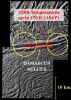
Enceladus-PIA12082.jpgHeat in Damascus Sulcus55 visiteCaption NASA:"This image shows the location of Cassini's most precise measurements so far of the surface temperatures at the active "Tiger Stripe" fractures that cut the South Polar Region of Enceladus. The background image, which shows the Tiger Stripe fracture named Damascus Sulcus, was obtained by Cassini's cameras during the close Enceladus flyby on August 11, 2008 (see PIA11113).
The yellow circles show the approximate location of two of the active plumes of ice particles identified by the Cassini cameras.
The red rectangles show the region of Damascus Sulcus from which heat radiation was measured by Cassini's Composite Infrared Spectrometer (CIRS) at about the same time as the images were taken. The CIRS measurements indicate temperatures up to at least 170 Kelvin (-103 Centigrade or -154 Fahrenheit) near Damascus Sulcus. This is more than 100 degrees Kelvin (180 degrees Fahrenheit) warmer than the surrounding surface, due to heat escaping from Enceladus' interior along the fractures. However, even warmer temperatures are probable over smaller regions close to the Tiger Stripes, and temperatures are expected to be warmer still below Enceladus' Surface.
Therefore, subsurface temperatures may be high enough to melt ice to create liquid water, as is suggested by recent Cassini measurements of the salty composition of ice grains ejected from the Tiger Stripes".MareKromium
|
|
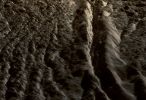
Enceladus-PIA12207.jpgPerspective view of Damascus Sulcus, Enceladus (Natural Colors; credits: Lunexit)54 visiteThis perspective view of Damascus Sulcus was generated using high resolution images of Enceladus acquired in August 2008 at 12 to 30 meters (40 to 100 feet) resolution, together with a new topographic map of the region produced by Dr. Paul Schenk (http://www.lpi.usra.edu/lpi/schenk/) at the Lunar and Planetary Institute in Houston, TX.
Damascus Sulcus is one of several prominent linear structures, dubbed “Tiger Stripes”, within the geologically active South Polar Region of Enceladus. Damascus Sulcus consists of two large parallel ridges separated by a deep V-shaped medial trough. The ridges are each 100 to 150 meters high (325 to 500 feet), while the entire width of Damascus Sulcus is approx. 5 Km (a little more than 3 miles). The medial trough between the ridges is 200 to 250 meters (650 to 820 feet) deep, and may have formed by daily shear (sliding) faulting triggered by tidal forces.
These medial troughs may be the primary source of numerous jets making up the large active water vapor plume over the South Pole of Enceladus. Several small ridges can be seen along the floor of the medial trough. These could be blocks of crust that have slid down the walls of the trough or fractured blocks pushed up from below.
Flanking Damascus Sulcus are repeating sets of broken and disrupted parallel ridges a few tens of meters high. These are typical of the plains that lie between the tiger stripe structures and resemble crumpled or folded rock patterns seen on Earth. Relief has been exaggerated by a factor of ~10 to enhance clarity.
The raw data from which this product was developed were retrieved from the Planetary Data System's Cassini archives. The Cassini-Huygens mission is a cooperative project of NASA, the European Space Agency and the Italian Space Agency. The Jet Propulsion Laboratory, a division of the California Institute of Technology in Pasadena, manages the mission for NASA's Science Mission Directorate, Washington, D.C. The Cassini orbiter and its two onboard cameras were designed, developed and assembled at JPL. The imaging operations center is based at the Space Science Institute in Boulder, Colo. (http://ciclops.org)MareKromium
|
|
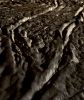
Enceladus-PIA12208.jpgPerspective view of Baghdad Sulcus, Enceladus (Natural Colors; credits: Lunexit)54 visiteThis perspective view of Baghdad Sulcus was generated using high resolution images of Enceladus acquired in August 2008 at 12 to 30 meters (40 to 100 feet) resolution, together with a new topographic map of the region produced by Dr. Paul Schenk (http://www.lpi.usra.edu/lpi/schenk/) at the Lunar and Planetary Institute in Houston, TX. Lower resolution images to either side were acquired at 50 to 80 meter (165 to 260 feet) resolution.
Baghdad Sulcus is one of several prominent linear structures, dubbed “Tiger Stripes”, within the geologically active South Polar Region of Enceladus. This view shows a wedge-shaped area between two prominent branches of Baghdad Sulcus. Each branch consists of two large parallel ridges up to 2 Km (approx. 1,2 mile) across separated by a deep V-shaped medial trough.
The ridges are 80 to 100 meters (approximately 260 to 325 feet) high. The medial troughs between the ridges are 200 to 250 meters (650 to 820 feet) deep. The maximum separation between the two branches is about 12 Km (about 7.5 miles).
Troughs such as those shown here are probably the source of numerous jets making up the large active water vapor plume over the South Pole of Enceladus. The floors of the medial troughs are often broken up into smaller ridges. These could be blocks of crust that have slid down the walls of the trough or fractured blocks pushed up from below. Relief has been exaggerated by a factor of ~10 to enhance clarity.
The raw data from which this product was developed were retrieved from the Planetary Data System's Cassini archives. The Cassini-Huygens mission is a cooperative project of NASA, the European Space Agency and the Italian Space Agency. The Jet Propulsion Laboratory, a division of the California Institute of Technology in Pasadena, manages the mission for NASA's Science Mission Directorate, Washington, D.C. The Cassini orbiter and its two onboard cameras were designed, developed and assembled at JPL. The imaging operations center is based at the Space Science Institute in Boulder, Colo. (http://ciclops.org)MareKromium
|
|
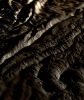
Enceladus-PIA12209.jpgPerspective view of Cairo Sulcus, Enceladus (Natural Colors - credits: Lunexit)54 visiteThis perspective view of Cairo Sulcus was generated using high resolution images of Enceladus acquired in August 2008 at 12 to 30 meters (40 to 100 feet) resolution, together with a new topographic map of the Region produced by Dr. Paul Schenk (http://www.lpi.usra.edu/lpi/schenk/) at the Lunar and Planetary Institute in Houston, TX. Lower resolution images to either side were acquired at 50 to 80 meter (165 to 260 feet) resolution.
Cairo Sulcus is one of several prominent structures, dubbed “Tiger Stripes”, within the geologically active South Polar Region of Enceladus. These structures consist of two large parallel ridges up to 2 Km (approx. 1,2 miles) across separated by a deep V-shaped medial trough. This view highlights one of the wall scarps of the medial trough of Cairo Sulcus, the brightly lit scarp crossing the left-hand side of the view. This wall scarp stands 175 to 250 meters (575 to 820 feet) high. Vertical striations and large boulders tens of meters across clutter the surface of this scarp, evidence of faulting and/or slumping of crustal ices. Troughs such as these are probably the source of numerous jets making up the large active water vapor plume over the South Pole of Enceladus. The parallel sets of rounded mounds and ridges In the foreground are up to 50 meters (165 feet) high. These are typical of the plains that lie between the tiger stripe structures and resemble crumpled or folded rock patterns seen on Earth. Relief has been exaggerated by a factor of ~10 to enhance clarity.
The raw data from which this product was developed were retrieved from the Planetary Data System's Cassini archives. The Cassini-Huygens mission is a cooperative project of NASA, the European Space Agency and the Italian Space Agency. The Jet Propulsion Laboratory, a division of the California Institute of Technology in Pasadena, manages the mission for NASA's Science Mission Directorate, Washington, D.C. The Cassini orbiter and its two onboard cameras were designed, developed and assembled at JPL. The imaging operations center is based at the Space Science Institute in Boulder, Colo. (http://ciclops.org)MareKromium
|
|

Enceladus-PIA12517.jpgA "Pearl of Ice", in the Night of Saturn (possible Natural Colors; credits: Dr Paolo C. Fienga - Lunexit Team)54 visiteCaption NASA:"The Cassini Spacecraft looks toward the South Pole of Enceladus, with a glimpse of Saturns Rings in the distance, during the Spacecraft's close Fly-By of Nov. 2, 2009.
(see PIA08386 to learn more about the active South Pole of Enceladus)
This view looks toward the anti-Saturn side of Enceladus. The Rings have been brightened relative to Enceladus to increase visibility.
The image was taken in Visible Light with the Cassini Spacecraft wide-angle camera on Nov. 2, 2009. The view was acquired at a distance of approx. 10.400 Km (aout 6500 miles) from Enceladus and at a Sun-Enceladus-Spacecraft, or Phase, Angle of 6°.
Image scale is roughly 630 meters (2100 feet) per pixel".MareKromium
|
|
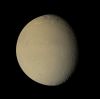
Enceladus-PIA12673.jpgEnceladus (possible Natural Colors; credits for the additional process. and color.: Dr Paolo C. Fienga - Lunexit Team)54 visiteCaption NASA:"The Cassini Spacecraft examines old and new terrain on Saturn's fascinating Enceladus, a moon where jets of water ice particles and vapor spew from the South Pole.
Newly created terrain is at the bottom, in the center and on the left of this view. Older, cratered terrain is on the right. See PIA11685 for another view of this area and more information about its geology. This image was captured during Cassini's Nov. 21, 2009, flyby of the moon. This view looks toward the Leading Hemisphere of Enceladus.
North on Enceladus is up and rotated 3° to the right.
The image was taken in Visible Light with the Cassini Spacecraft narrow-angle camera. The view was obtained at a distance of approx. 133.000 Km (such as about 83.000 miles) from Enceladus and at a Sun-Enceladus-Spacecraft, or Phase, Angle of 46°.
Image scale is roughly 796 meters (2612 feet) per pixel".MareKromium
|
|

Enceladus-PIA12713-PCF-LXTT.jpgThe "Fountains" of Enceladus at "High Phase" (Absolute Natural Colors; credits for the additional process. and color.: Dr Paolo C. Fienga - Lunexit Team)87 visiteCaption NASA:"Saturn's moon Enceladus, imaged at High Phase, shows off its spectacular Water Ice Plumes emanating from its South Polar Region.
This image was captured at a Phase, or Sun-Enceladus-Spacecraft, Angle of 159° so that Sunlight would reveal the backlit plumes.
Sunlight brightly illuminates Terrain on the left. Light reflected off Saturn illuminates the rest of the moon more dimly. This view looks toward the Trailing Hemisphere of Enceladus. North is down. Background stars, elongated by the movement of the Spacecraft during the exposure, are also visible.
The image was taken in Visible Light with the Cassini Spacecraft narrow-angle camera on Oct. 13, 2009. The view was obtained at a distance of approx. 431.000 Km (about 268.000 miles) from Enceladus.
Image scale is roughly 3 Km (about 1,9 miles) per pixel".MareKromium
|
|

Enceladus-PIA12719-PCF-LXTT.jpgEnceladus (Absolute Natural Colors; credits for the additional process. and color.: Dr Paolo C. Fienga - Lunexit Team)120 visiteCaption NASA:"Two sources of light reveal the dramatic Surface of Saturn's moon Enceladus in this Cassini image in which geologic features give the appearance of the leathery skin of an elephant.
Geologically young and (relatively) smooth Terrain in the Southern and Middle Latitudes gives way to older, Cratered Terrain in the Northern Latitudes of the moon.
Sunlight illuminates the right of the image, and light reflected off Saturn ("Saturnshine") dimly illuminates the left. This view looks toward the Leading Hemisphere of Enceladus.
North on Enceladus is up.
The image was taken in Visible Light with the Cassini Spacecraft narrow-angle camera on April 7, 2010. The view was obtained at a distance of approx. 198.000 Km (such as about 123.000 miles) from Enceladus and at a Sun-Enceladus-Spacecraft, or Phase, Angle of 92°.
Image scale is roughly 1 Km (3300 feet) per pixel".MareKromium
|
|

Enceladus-PIA12762-PCF-LXTT.jpgFountains of Light (Enhanced Natural Colors; credits for the additional process. and color.: Dr Paolo C. Fienga - Lunexit Team)146 visiteCaption NASA:"A crescent Enceladus, imaged from its night side, shows off spectacular Water Ice Plumes emanating from its South Polar Regions. This image was captured at a Phase, or Sun-Enceladus-Spacecraft, angle of 157° so that Sunlight would reveal the backlit Plumes. Terrain near the South Pole is now dark as Spring has come to the Northern Hemisphere of the Celestial Body. Lit Terrain seen here is on the Trailing Hemisphere of Enceladus. North is up.
The image was taken in Visible Light with the Cassini Spacecraft narrow-angle camera on Jan. 30, 2011. The view was obtained at a distance of approx. 228.000 Km(such as 141.588 miles) from Enceladus. Image scale is roghly 1 Km (0,621 miles) per pixel".MareKromium
|
|
| 2245 immagini su 188 pagina(e) |
|
|
|
|
|
44 | |
|
|
|
|
|
|





