Saturn: the "Ringed Beauty" and His Moons
|
|
|

Enceladus-PIA11123.jpgEnceladus Oct. 9, 2008 Flyby54 visiteCaption NASA:"The image was taken with the Cassini Spacecraft narrow-angle camera on Oct. 9, 2008, from a distance of approx. 47.000 Km (about 29.000 miles) from Enceladus.
Image scale is 279 meters (916 feet) per pixel".MareKromium
|
|

Enceladus-PIA11124.jpgThe Enceladus' "Tiger Stripes"56 visiteCaption NASA:"This Cassini image was the first and highest resolution 'skeet shoot' narrow-angle image captured during the Oct. 31, 2008, flyby of Saturn's moon Enceladus.
The image was taken with the Cassini Spacecraft narrow-angle camera on Oct. 31, 2008, at a distance of approximately 1691 Km (about 1056 miles) from Enceladus and at a Sun-Enceladus-Spacecraft, or Phase, Angle of 78°.
Image scale is roghly 9 meters (29 feet) per pixel.MareKromium
|
|

Enceladus-PIA11125.jpgDamascus Sulcus65 visiteCaption NASA:"This Cassini image was the eight 'skeet shoot' narrow-angle image captured during the October 31, 2008, flyby of Saturn's moon Enceladus.
The source region for jets II and III (see PIA08385) has been identified. The image was taken with the Cassini Spacecraft narrow-angle camera on Oct. 31, 2008, at a distance of approximately 5568 Km (about 3480 miles) from Enceladus and at a Sun-Enceladus-Spacecraft, or Phase, Angle of 75°.
Image scale is roughly 33 meters (108 feet) per pixel".MareKromium
|
|
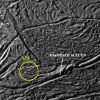
Enceladus-PIA11127.jpgBaghdad Sulcus56 visiteCaption NASA:"This Cassini image was the ninth 'skeet shoot' narrow-angle image captured during the Oct. 31, 2008 flyby of Saturn's moon Enceladus.
The source region for jet VII (see PIA08385) has been identified. The image was taken with the Cassini Spacecraft narrow-angle camera on Oct. 31, 2008, at a distance of approximately 6151 Km (about 3844 miles) from Enceladus and at a Sun-Enceladus-Spacecraft, or Phase, Angle of 75°.
Image scale is roughly 35 meters (115 feet) per pixel".MareKromium
|
|

Enceladus-PIA11133.jpgCrescent Enceladus (possible True Colors; credits: Lunar Explorer Italia)56 visiteCaption NASA:"On Oct. 5, 2008, just after coming within 25 kilometers (15.6 miles) of the surface of Enceladus, NASA's Cassini captured this stunning mosaic as the Spacecraft sped away from this geologically active moon of Saturn.
Craters and cratered terrains are rare in this view of the Southern Region of the moon's Saturn-facing Hemisphere. Instead, the surface is replete with fractures, folds, and ridges — all hallmarks of remarkable tectonic activity for a relatively small world. In this True Colors view, regions that appear blueish are thought to be coated with larger grains than those that appear white or gray.
Portions of the Tiger Stripe Fractures, or Sulci, are visible along the Terminator at lower right, surrounded by a circumpolar belt of mountains. The icy moon's famed jets emanate from at least 8 distinct Source Regions, which lie on or near the Tiger Stripes. However, in this view, the most prominent feature is Labtayt Sulci, the approximately one-kilometer (such as 0,6 miles) deep Northward-trending chasm located just above the center of the mosaic.
Near the top, the conspicuous ridges are Ebony and Cufa Dorsae. This mosaic was created from 28 images obtained at seven footprints, or pointing positions, by Cassini's narrow-angle camera. At each footprint, 4 images using filters sensitive to UltraViolet (UV), Visible (V) and InfraRed light (IR) - spanning wavelengths from 338 to 930 nanometers) were combined to create the individual frames. The mosaic is an orthographic projection centered at 64,49° South Lat. and 283,87° West Long., and it has an image scale of 196 Km (about 122,5 miles) per pixel. The original images ranged in resolution from 180 meters (594 feet) to 288 meters (950 feet) per pixel and were acquired at distances ranging from 30.000 to 48.000 Km (such as from about 18.750 to 30.000 miles) as the Spacecraft receded from Enceladus.
The view was acquired at a Sun-Enceladus-spacecraft, or phase, angle of 73°".MareKromium
|
|
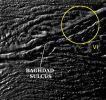
Enceladus-PIA11134.jpgBaghdad Sulcus56 visiteCaption NASA:"Like hunters sighting a clay duck flying fast in the sky, this mosaic of Cassini images was made from 'skeet shoot' narrow-angle images 1, 2, 3 and 4, all captured during the Oct. 31, 2008, flyby of Saturn's moon Enceladus.
The resolution of this mosaic is 12,3 meters (41 feet) per pixel and jet source VI (see also PIA08385) is identified in the upper right".MareKromium
|
|

Enceladus-PIA11139.jpgAxial Discontinuity on Enceladus54 visiteCaption NASA:"These two side-by-side images compare a "twisted" sea-floor spreading feature on Earth, known as an Offset Spreading Center (OSC), to a very similar looking twisted break, or Axial Discontinuity, in the Damascus Sulcus "Tiger Stripe" on Saturn’s moon Enceladus. The image of Enceladus was acquired by NASA’s Cassini Spacecraft imaging science sub-system during one of its four close targeted flybys of Enceladus in March, August and October 2008.
The image on the left shows a shaded relief map of bathymetry (or sonar-like topography) data along a spreading ridge on the East Pacific Rise near 9,5° North Lat. and 104° West Long.
On Earth, OSC's occur only along fast-spreading ridges - ones that spread faster than about 100 mm (such as 4") per year. They do not occur on slow-spreading ridges, like the famous Mid-Atlantic Ridge where spreading rates are often less than 20 mm (0,7") per year.
The Axial Discontinuity on Enceladus’ Damascus Sulcus, shown in the image on the right, twists in the same helical way that the OSC does on Earth. However, the morphological resemblance is no guarantee that both features are caused by fast spreading.
On Earth OSCs form when two nearly parallel spreading ridges lengthen along their ridge (or long) axes. As the lengthening tips of the ridges pass each other side-by-side in opposite directions, shear forces caused by tectonic spreading between them force the two tips to twist around each other. The twisting tip of each one eventually merges with the "neck" of the other in a "yin-yang" shaped pattern.
The result is an oval shaped basin that is surrounded by the twisted ridge tips.
On Enceladus, the twisted features have not produced an oval basin, but the pattern of the twist is very similar to the terrestrial OSC and probably similar tectonic shear forces, perhaps even tectonic spreading, resulted in this twisted shape. Note that the Enceladus image has been flipped right-to-left to make comparison to the sea-floor feature easier to see".MareKromium
|
|

Enceladus-PIA11558.jpgEnceladus, in the distance (Natural Colors; credits: Lunexit)134 visiteCaption NASA:"The Cassini Spacecraft looks past the illuminated side of Saturn's Rings to the brilliant moon Enceladus.
Although the moon's brightness may make it appear closer to the observer, Enceladus is actually farther from the Spacecraft than the Rings in this image. As Saturn's brightest, whitest satellite, Enceladus (about 504 Km, or approx. 313 miles across) has one of the most reflective surfaces (---> Albedo) in the Solar System.
The Rings have been brightened relative to the moon to enhance visibility. This view looks toward the sunlit side of the rings from about 5° below the Ring-Plane.
The image was taken in Visible Light with the Cassini Spacecraft wide-angle camera on June 25, 2009. The view was obtained at a distance of approx. 670.000 Km (about 416.000 miles) from Enceladus and at a Sun-Enceladus-Spacecraft, or Phase, Angle of 51°.
Image scale is roughly 40 Km (about 25 miles) per pixel".MareKromium
|
|

Enceladus-PIA11562.jpgEnceladus, in the distance (Natural Colors; credits: Lunexit)55 visiteCaption NASA:"Cassini Spacecraft looks toward the varied Surface of the Trailing Hemisphere of Saturn's moon Enceladus. North on Enceladus (about 504 Km, or approx. 313 miles across) is up. For a more detailed view of this Hemisphere, see also PIA08353.
The image was taken in Visible Light with the Cassini spacecraft narrow-angle camera on June 25, 2009. The view was acquired at a distance of approx. 594.000 Km (about 369.000 miles) from Enceladus and at a Sun-Enceladus-Spacecraft, or Phase, Angle of 66°.
Image scale is roughly 4 Km (about 2,5 miles) per pixel".MareKromium
|
|

Enceladus-PIA11601.jpgJust like a Pearl... (Natural Colors; credits: Lunexit)54 visiteCaption NASA:"The Cassini Spacecraft looks down at craters near the North Pole of Enceladus.
Cratered surfaces on Solar System moons indicate older terrains, while smooth surfaces are generally younger and therefore indicative of processes which eliminated the craters.
See also PIA08353 to learn more about the true nature of these surfaces and the processes at work on this geologically active moon.
The moon's North Pole lies on the Terminator to the right of the craters seen in this image. Lit Terrain seen here is on the anti-Saturn side and Trailing Hemisphere of Enceladus.
The image was taken in Visible Light with the Cassini Spacecraft narrow-angle camera on July 11, 2009. The view was obtained at a distance of approx. 472.000 Km (such as about 293.000 miles) from Enceladus and at a Sun-Enceladus-Spacecraft (or Phase) Angle of 57°.
Image scale is roughly 3 Km (a little less than 2 miles) per pixel".MareKromium
|
|

Enceladus-PIA11678.jpgEnceladus: North Polar Map54 visiteThe Northern and Southern Hemispheres of Enceladus are seen in these Polar Stereographic Maps, mosaicked from the best-available Cassini and Voyager clear-filter images. This image shows the North Polar Regions.
Each map is centered on one of the Poles and surface coverage extends to the Equator. Grid lines show Latitude and Longitude in 30-degree increments. The scale in the full-size versions of these maps is 110 meters (360 feet) per pixel.
These two maps show that the character of Terrains near the North Pole differs strongly from those near the South Pole. Terrain near the North Pole is among the most heavily cratered and oldest on the Surface of Enceladus.
The Northern Hemisphere map shows that a broad band of cratered terrain extends from the Equator on the Saturn-facing side (centered on 0-degrees Longitude), over the Pole and to the Equator on the anti-Saturn side (centered on 180-degrees Longitude). Terrains near the Equator and Mid-Latitudes on the Leading (90° West) and Trailing (270° West) sides of Enceladus are much less heavily cratered and are characterized by intense zones of fracturing and faulting.
As seen in the Southern Hemisphere map, the band of cratered terrain at 0 and 180° Longitude extends southward from the Equator. However, poleward of about 55° South Latitude, the cratered terrain is interrupted and replaced by a conspicuously fractured circumpolar terrain that is nearly devoid of impact craters.
In contrast to the very old North Polar Terrains, the South Circumpolar Terrains are among the youngest on the Surface of Enceladus.
Within the South Circumpolar Region is a group of prominent parallel "Stripes" made up of fractures that are delineated by relatively dark albedo markings flanking the sides of each fracture.
An interesting property of the parallel fracture system is that each appears to turn back at its westernmost segment as if it has been "bent" or "folded" into a hook-like curve. Similar patterns of folded or kinked fractures can be found throughout the region -- a unique feature of the South Polar Terrains.MareKromium
|
|
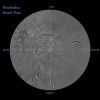
Enceladus-PIA11679.jpgEnceladus: South Polar Map60 visiteThe Northern and Southern Hemispheres of Enceladus are seen in these Polar Stereographic Maps, mosaicked from the best-available Cassini and Voyager clear-filter images. This image shows the South Polar Regions.
Each map is centered on one of the Poles and surface coverage extends to the Equator. Grid lines show Latitude and Longitude in 30-degree increments. The scale in the full-size versions of these maps is 110 meters (360 feet) per pixel.
These two maps show that the character of Terrains near the North Pole differs strongly from those near the South Pole. Terrain near the North Pole is among the most heavily cratered and oldest on the Surface of Enceladus.
The Northern Hemisphere map shows that a broad band of cratered terrain extends from the Equator on the Saturn-facing side (centered on 0-degrees Longitude), over the Pole and to the Equator on the anti-Saturn side (centered on 180-degrees Longitude). Terrains near the Equator and Mid-Latitudes on the Leading (90° West) and Trailing (270° West) sides of Enceladus are much less heavily cratered and are characterized by intense zones of fracturing and faulting.
As seen in the Southern Hemisphere map, the band of cratered terrain at 0 and 180° Longitude extends southward from the Equator. However, poleward of about 55° South Latitude, the cratered terrain is interrupted and replaced by a conspicuously fractured circumpolar terrain that is nearly devoid of impact craters.
In contrast to the very old North Polar Terrains, the South Circumpolar Terrains are among the youngest on the Surface of Enceladus.
Within the South Circumpolar Region is a group of prominent parallel "Stripes" made up of fractures that are delineated by relatively dark albedo markings flanking the sides of each fracture.
An interesting property of the parallel fracture system is that each appears to turn back at its westernmost segment as if it has been "bent" or "folded" into a hook-like curve. Similar patterns of folded or kinked fractures can be found throughout the region -- a unique feature of the South Polar Terrains.MareKromium
|
|
| 2245 immagini su 188 pagina(e) |
 |
|
|
|
|
43 | |
|
|
|
|





