Saturn: the "Ringed Beauty" and His Moons
|
|
|

Enceladus-PIA10355.jpgGas and Dust Jets Match Up!55 visiteCaption NASA:"Jets of high-density gas detected by Cassini's Ultraviolet Imaging Spectrograph on Saturn's moon Enceladus match the locations of dust jets determined from Cassini images, labeled here with Roman numerals. The spectrograph pinpointed the locations of individual gas streams in the plume in a "stellar occultation", which involves measuring the light of a star (in this case, Zeta Orionis), as it passed behind the plume from Cassini's viewpoint.
The blue line in this projection shows the path of the starlight through the plume, over the South Polar Region of Enceladus.
The instrument looked at the star across this path in the direction indicated by the short blue lines.
Some of the dust jets appear to merge together in stellar occultation data. The dimming of starlight labeled "a" was caused by dust jets V and VII. The dimming of starlight marked as feature "b" may be associated with dust jet I if the jet is not perfectly vertical.
Dimming of starlight labeled "c" corresponds to dust jet VI, and "d" is dust jet III, with dust jet II in between. The individual jets come from sources with an area of less than 300 by 300 meters (such as about 1000 feet square) - about the size of half a tennis court - probably stretched out rectangularly along the Tiger Stripes.
The new data indicate that the water molecules are blasting off from Enceladus at faster than 600 meters per second (about 1200 mph)".MareKromium
|
|

Enceladus-PIA10356.jpgWhat's in "Enceladus Plume"?57 visiteCaption NASA:"The lower panel is a Mass Spectrum that shows the chemical constituents sampled in Enceladus' plume by Cassini's Ion and Neutral Mass Spectrometer during its fly-through of the plume on Mar. 12, 2008.
Shown are the amounts, in atomic mass per elementary charge (Daltons [Da]), of Water Vapor, Methane, Carbon Monoxide, Carbon Dioxide, simple organics and complex organics identified in the plume".MareKromium
|
|
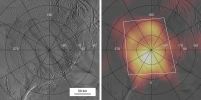
Enceladus-PIA10360.jpgStripes and Heat Map Side-by-Side67 visiteCaption NASA:"Cassini's March 12, 2008, flyby of Enceladus provided the best view yet of the heat radiation from the active South Pole of the satellite. These images summarize what was learned about the South Polar landscapes and heat radiation during the previous close flyby on July 15, 2005.
The left panel shows a map of the South Pole constructed from images taken by the Spacecraft's Imaging System. Four prominent fractures, informally called "Tiger Stripes", cut diagonally across the South Polar Region. In the right-hand panel, a July 2005 map of the south polar heat radiation, obtained by Cassini's Composite Infrared Spectrometer, is superimposed in false color on the visible images.
The observations revealed a prominent warm region centered on the South Pole, appearing yellow and orange in this view, which coincides with the locations of the tiger stripes. However, these data were taken from too far away from Enceladus (about 80.000 Km) to distinguish the fine details of the heat radiation.
The July 2005 flyby also included some scattered close-up snapshots by the Composite Infrared Spectrometer; these showed that the heat radiation was concentrated along the Tiger Stripe fractures, but those snapshots covered only a small fraction of the South Polar Region.
The white lines enclose the area covered by the much more detailed view of the South Pole obtained by the spectrometer during the March 12, 2008, flyby.
Numbers on the map show Latitude and Longitude".MareKromium
|
|

Enceladus-PIA10361-1.jpgJet Spots in Tiger Stripes58 visiteCaption NASA:"Heat radiating from the entire length of 150 Km (about 95 mile)-long fractures is seen in this best-yet heat map of the active South Polar Region of Saturn's ice moon Enceladus. The warmest parts of the fractures tend to lie on locations of the plume jets identified in earlier images, shown in the annotated version with yellow stars. The measurements were obtained by the Cassini Spacecraft's Composite Infrared Spectrometer from the spacecraft's close flyby of the moon on March 12, 2008.
Remarkably high temperatures, at least 180 Kelvin (such as -135 degrees Fahrenheit) were registered along the brightest fracture, named Damascus Sulcus, in the lower left portion of the image. For comparison, surface temperatures elsewhere in the South Polar Region of Enceladus are below 72 Kelvin (such as -330 degrees Fahrenheit).
Heat is escaping from Enceladus' interior along these warm fractures, dubbed "Tiger Stripes", which are also the source of the geysers that erupt from the Polar Region.
The infrared radiation was mapped at wavelengths between 12 and 16 microns. The infrared data, shown in false color, are superimposed on a grayscale image mosaic of the South Pole obtained by Cassini's cameras on July 14, 2005, during the previous close Enceladus flyby. Numbers on the map indicate Latitude and Longitude.
This new view shows that at least 3 of the South Polar fractures are active along almost their full lengths - the 4th one, on the right, was only partially covered by this scan. The level of activity varies greatly along the fractures. The warmest parts of the fractures tend to lie on locations of the plume jets identified in earlier images. The main "Tiger Stripe" fractures are not the only sources of heat, however; additional warm spots are seen in the upper right part of the scan.
The warm regions are probably concentrated within less than a few hundred meters (a few hundred yards) of the fractures, and their apparent width in this image results from the relatively low resolution of the infrared data.
This map was made by scanning the South Pole during the period from 16' to 37' (minutes) after closest approach to Enceladus, at a distance between 14.000 and 32.000 Km (about 8.700 and 20.000 miles) as Cassini rapidly receded from its close (50-Km or about 32-miles) flyby".MareKromium
|
|
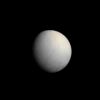
Enceladus-PIA10403.jpgIcy Oasis (MULTISPECTRUM-2; credits: Lunexit)57 visiteCaption NASA:"With its excess warmth, water ice jets and huge vapor plume laced with simple organic materials, Enceladus is an important part of the quest to understand environments compatible with the chemistry of life as we know it. The Sulci, or "Tiger Stripe" fractures, in the South Polar Region are visible at bottom -- the view here is parallel to the direction of the Sulci.
The view looks toward the anti-Saturn Hemisphere on the moon's Trailing Side. North on Enceladus is towards the top of the image.
This view is a composite of individual frames obtained using filters sensitive to ultraviolet (centered at 338 nanometers), green (centered at 568 nanometers) and infrared light (centered at 1002 nanometers).
The broad range of wavelengths exaggerates subtle color variations across the moon's surface.
The images were acquired with the Cassini spacecraft narrow-angle camera on May 11, 2008.
The view was obtained at a distance of approx. 739.000 Km (such as about 459.000 miles) from Enceladus and at Phase Angle of 36°.
Image scale is roughly 4 Km (about 2,5 miles) per pixel".MareKromium
|
|
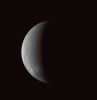
Enceladus-PIA10422.jpgCrescent Enceladus (MULTISPECTRUM-2; credits: Lunexit)79 visiteCaption NASA:"The Cassini Spacecraft observes the wrinkled surface of Enceladus.
The geologically active South Polar Region is visible at bottom.
This view looks toward the Saturn-facing side of Enceladus (about 504 Km, or 313 miles across). Lit terrain is on the moon's Leading Hemisphere. North is up and rotated 16° to the right.
The image was taken in visible green light with the Cassini Spacecraft narrow-angle camera on June 2, 2008. The view was obtained at a distance of approx. 285.000 Km (such as about 177.000 miles) from Enceladus and at a Sun-Enceladus-Spacecraft, or Phase, Angle of 108°.
Image scale is roughly 2 Km (a little more than 1 mile) per pixel".MareKromium
|
|
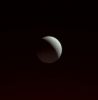
Enceladus-PIA10471.jpgDouble "Space-Lights" on Enceladus! (natural colors; credits: Lunexit)58 visiteCaption NASA:"As the Cassini Spacecraft began its August 2008 flyby of Enceladus, the spacecraft approached over the moon's cratered North Pole. Cassini acquired this view as the icy moon grew ever larger in its field of view.
In addition to the sunlit crescent at upper right, the faint glow at bottom indicates a secondary source of illumination: reflected sunlight from Saturn (a.k.a.: "Saturnshine").
The view looks toward high Northern Latitudes on Enceladus from a perspective of 71° North of the moon's Equator.
The North Pole is in shadow at center.
The image was taken in visible light with the Cassini Spacecraft narrow-angle camera on Aug. 11, 2008. The view was obtained at a distance of approx. 448.000 Km (such as about 278.000 miles) from Enceladus and at a Phase Angle of 113°.
Image scale at maximum resolution is approx. 3 Km (a little less than 2 miles) per pixel".MareKromium
|
|
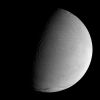
Enceladus-PIA10483.jpgThe Leading Hemisphere of Enceladus54 visiteCaption NASA:"During a distant flyby encounter with Enceladus, Cassini imaged the moon's wrinkled Leading Hemisphere.
At the scale visible here, this region of the surface is generally devoid of impact craters, suggesting that the terrain has been modified and renewed during the moon's history.
To the North lies a heavily cratered and presumably older Region. The sinuous boundary of the geologically active South Polar Region is seen at bottom. North on Enceladus is toward the top of the image.
The image was taken in visible green light with the Cassini Spacecraft narrow-angle camera on Sept. 30, 2007. The view was acquired at a distance of approx. 108.000 Km (such as about 67.000 miles) from Enceladus and at a Sun-Enceladus-Spacecraft, or phase, angle of 75°.
Image scale is 644 meters (2111 feet) per pixel".MareKromium
|
|
Enceladus-PIA10498.jpgNorthern Craters of Enceladus (natural colors; credits: Lunexit)57 visiteCaption NASA:"This image is part of an observation designed to view the moon's plume of icy particles at a moderately High Phase Angle.
The "Phase Angle" is the angle formed between the Sun, the target being imaged, and the Spacecraft, and it ranges from 0 to 180°. Tiny particles, like those in the plume, brighten substantially at high phase angles.
This view was taken from a vantage point 37° above the Equator of Enceladus (about 504 Km, or approx. 313 miles across). Reflected light from Saturn dimly illuminates the moon's dark side.
The image was taken in visible light with the Cassini Spacecraft narrow-angle camera on Sept. 17, 2008. The view was acquired at a distance of approx. 262.000 Km (such as about 163.000 miles) from Enceladus and at a Phase Angle of 140°.
Image scale is roughly 2 Km (5137 feet) per pixel".MareKromium
|
|
Enceladus-PIA10502.jpgIcy Plume in the Saturnshine! (natural colors; credits: Lunexit)54 visiteCaption NASA:"The active Surface Jets on Enceladus collectively form a brilliant, extended Plume that is made visible as sunlight scatters among the microscopic particles of ice.
The Plume is more easily seen with the Sun directly, or almost directly, behind Enceladus, as is the case here. The moon's surface is lit here by reflected light from Saturn.
The image was taken in visible light with the Cassini Spacecraft narrow-angle camera on Sept. 17, 2008. The view was obtained at a distance of approx. 235.000 Km (such as about 146.000 miles) from Enceladus and at a Sun-Enceladus-Spacecraft angle of 140°.
Image scale is approx. 1 Km (0,6 mile) per pixel".MareKromium
|
|
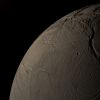
Enceladus-PIA10515.jpgEnceladus (natural colors; credits: Lunexit)54 visiteCaption NASA:"The Cassini Spacecraft acquired this view of Enceladus just after the Spacecraft passed within 25 Km (approx. 15 miles) of the surface on Oct. 9, 2008. Remarkably, only a handful of craters are visible in this view, indicating the relatively young age of this surface.
The image was taken in Visible Light with the Cassini Spacecraft narrow-angle camera on Oct. 9, 2008 at a distance of approx. 38.000 Km (about 24.000 miles) from Enceladus and at a Sun-Enceladus-Spacecraft, or Phase, Angle of 73°.
Image scale is 228 meters (746 feet) per pixel".MareKromium
|
|

Enceladus-PIA10562.jpgCrescent Enceladus55 visiteCaption NASA:"In the boundary between light and shadow on Enceladus, run the Anbar Fossae — a series of narrow, shallow depressions.
Like other features on this geologically active moon, the fossae are named after a location in The Arabian Nights. In this case, they are named after Anbar, Iraq.
Another Iraqi namesake, the Baghdad Sulcus, is one of several warm `Tiger Stripe' fractures at the moon's South Pole from which emanate heat and icy particles (see also PIA11114).
North is up in this image, and Julnar is the largest crater visible in the Northern Hemisphere. One of the women in The Arabian Nights lends her name to this crater which is about 20 Km (about 12 miles) wide.
Fewer craters mark the Southern Hemisphere because they have been erased by later tectonic forces.
The image was taken in Visible Light with the Cassini Spacecraft narrow-angle camera on Dec. 17, 2008. The view was obtained at a distance of approx. 385.000 Km (about 239.000 miles) from Enceladus and at a Phase Angle of 104°.
Image scale is roughly 2,5 Km (about 1,6 miles) per pixel".MareKromium
|
|
| 2245 immagini su 188 pagina(e) |
 |
|
|
|
|
41 | |
|
|
|
|





