Saturn: the "Ringed Beauty" and His Moons
|
|
|

Enceladus-PIA08386.jpgThe Blue Fountains of Enceladus (false colors; elab. NASA)61 visiteThis false-color view was created by combining 3 clear filter images taken at nearly the same time of PIA07759. This image product was then specially processed to enhance the individual jets that compose the plume (while PIA07759 was instead processed to reveal subtleties in the brightness of the overall plume that comprises the jets).
Some artifacts due to the processing are present in the image. The final product was colored as blue for dramatic effect.
The images were acquired with the Cassini spacecraft narrow-angle camera on Nov. 27, 2005 at a distance of approx. 148.000 Km (about 92.000 miles) from Enceladus and at a Sun-Enceladus-Spacecraft, or phase, angle of 161°.
Scale in the original images is about 880 meters (0,5 mile) per pixel.
This view has been magnified by a factor of two from the original images".MareKromium
|
|

Enceladus-PIA08500.jpgWhat's inside Enceladus?57 visiteCaption originale:"This graphic illustrates the interior of Saturn's moon Enceladus. It shows warm, low-density material rising to the surface from within, in its icy shell (yellow) and/or its rocky core (red). A NASA-funded study says Enceladus might have rolled or rotated itself to place this area of low density at the south pole. This finding is in the June 1, 2006, issue of the journal Nature.
This graphic uses parts of visible-light images taken by the Cassini spacecraft camera that have been modified for the purpose of showing the interior structure. Cassini's cameras captured a giant plume blasting icy particles into space".
|
|
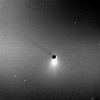
Enceladus-PIA08921.jpgCosmic Shadow54 visiteCaption NASA:"Blazing like an icy torch, the plume of Enceladus shines in scattered sunlight as the moon casts a shadow onto Saturn's E-Ring. Some of the tiny ice particles erupted from the moon's South Polar Region go into Saturn orbit, forming the doughnut-shaped ring, onto which the moon's shadow is cast in this view.
The shadow of Enceladus stretches away to the upper left at around the 10 o'clock position. The Sun-Enceladus-spacecraft, or phase, angle is 164° here, with the Sun being located toward the lower right. This means that Enceladus' shadow extends toward the Cassini spacecraft -- through part of the E-Ring.
Some of the bright dots in this heavily processed view are background stars. Others are due to cosmic ray hits on the camera detector.
The image was taken in visible light with the Cassini spacecraft narrow-angle camera on Aug. 11, 2006 at a distance of approx. 2.2 MKM (about 1,3 MMs) from Enceladus. Image scale is roughly 13 Km (about 8 miles) per pixel".MareKromium
|
|

Enceladus-PIA08954.jpgIcy Emanations...53 visiteCaption NASA:"Peeking over the crescent of Enceladus, the Cassini spacecraft views the towering plume of ice particles erupting from the moon's South Polar Region.
Multiple components of the overall plume are visible in this view of Enceladus.
The image was taken in visible light with the Cassini spacecraft narrow-angle camera on April 24, 2007 at a distance of approx. 188.000 Km (such as about 117.000 miles) from Enceladus and at a Sun-Enceladus-spacecraft, or phase, angle of 153°.
Image scale is roughly 1 Km (about 0,6 miles) per pixel".MareKromium
|
|
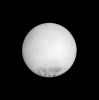
Enceladus-PIA08980.jpgThe South Polar "sulci" of Enceladus53 visiteCaption NASA:"Enceladus appears as a rather bland orb in this far-off snapshot, but the dark markings near its South Pole belie that assumption.
The markings, called "sulci", are long, roughly parallel fractures from which a spray of icy particles escapes into the void, forming Saturn's E-Ring.
This view looks toward the Saturn-facing Hemisphere on Enceladus. North is up.
The image was taken with the Cassini spacecraft narrow-angle camera on May 27, 2007 using a spectral filter sensitive to wavelengths of infrared light centered at 930 nanometers.
The view was acquired at a distance of approx. 615.000 Km (such as about 382.000 miles) from Enceladus and at a Sun-Enceladus-spacecraft, or phase, angle of 3°.
Image scale is roughly 4 Km (a little more than 2 miles) per pixel".MareKromium
|
|
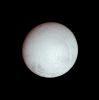
Enceladus-PIA09003.jpgEnceladus (true colors - elab. Lunexit)54 visiteCaption NASA:"This nearly equatorial view shows cratered regions on Enceladus in the central part of its Leading Hemisphere and high Northern Latitudes. Much of the rest of the geologically active moon is relatively crater free and covered by fractures and folds.
North on Enceladus is up.
The image was taken in polarized green light with the Cassini spacecraft narrow-angle camera on June 28, 2007 at a distance of approx. 293.000 Km (about 182.000 miles) from Enceladus.
Image scale is roughly 2 Km (a little more than 1 mile) per pixel".MareKromium
|
|

Enceladus-PIA09037.jpgActive Enceladus53 visiteOn Nov. 9, 2006, Cassini's Composite Infrared Spectrometer captured its first view of the Infrared Heat Radiation emanating from the "Tiger Stripe" fractures at the South Pole of Saturn's moon Enceladus (right) since the discovery of the hot spot 16 months earlier (left). The original discovery was made just before a close flyby of Enceladus on July 14, 2006, and coincided with the discovery of plumes of water-rich gas and ice particles jetting out of the Tiger Stripes. However, the spacecraft's orbit did not provide any good views of the South Pole for follow-up observations until November 2006.
The new observations were made from a range of 110.000 Km (68.350 miles), slightly more distant than the 80.000-Km range (49.700 miles) of the original observations.
Comparison of the two images shows that the South Polar Region continues to be active, and the distribution of temperatures there has changed little in 16 months.
The distribution of Heat Radiation suggests that most or all of the South Polar heat comes from the Tiger Stripes themselves, though the individual stripes are not resolved at the approximate 30-Km (19-mile) spatial resolution of these images.
The images show the intensity of Heat Radiation in the 10- to 16-micron wavelength range, translated into temperature and displayed in false color.
Peak South Polar temperature on both dates reached about 85 Kelvin (- 306 degr. Fahrenheit), averaged over the 30-Km (19-mile) spatial resolution of the data. However, the variation in brightness with wavelength, which is also measured by the Composite Infrared Spectrometer, reveals that the warm region includes small areas, possibly zones a few 100 mt (320 feet) wide along the length of the Tiger Stripes, that are at higher temperatures, reaching at least 130 Kelvin (- 225 degr. Fahrenheit) and perhaps much warmer still.
While the South Polar Tiger Stripes are almost certainly heated by energy from the moon's interior, daytime regions at low latitudes are warmed by sunlight to temperatures in the high 70s Kelvin (about - 320 degrees Fahrenheit).
The white numbers on the images show West Longitudes on Enceladus, which is 500 Km (310 miles) in diameter.
The dashed line shows the Terminator, the boundary between day and night.
The blotchy appearance of the cooler regions away from the South Pole, and of the sky beyond the globe of Enceladus, is an artifact resulting from the fact that apart from the Polar Hot Spot, the Composite Infrared Spectrometer can barely detect the very faint Heat Radiation from this very cold moon.MareKromium
|
|

Enceladus-PIA09209.jpgWarm-up on Enceladus54 visiteCaption NASA:"Plumes of water vapor and other gases escape at high velocity from the surface of Saturn's moon Enceladus, as shown in this artist concept.
The "shear heating" mechanism suggests that tidal forces acting on fault lines in the moon's icy shell cause the sides of the faults to rub back and forth against each other, producing enough heat to transform some of the ice into plumes of water vapor and ice crystals. Cold sub-surface ice (blue) becomes much warmer near the active fractures from which the plumes emanate.
Movement along the fault lines may be about half a meter (20") over the course of the 1,37-day tidal period of Enceladus around Saturn".MareKromium
|
|
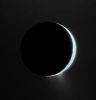
Enceladus-PIA09761.jpgThe "Fountains" of Enceladus (again)54 visiteCaption NASA:"With Enceladus nearly in front of the Sun from Cassini's viewpoint, its icy jets become clearly visible against the background.
The view here is roughly perpendicular to the direction of the linear "tiger stripe" fractures, or sulci, from which the jets emanate. The jets here provide the extra glow at the bottom of the moon. The general brightness of the sky around the moon is the diffuse glow of Saturn's E-Ring, which is an end product of the jets' material being spread into a "torus", or doughnut shape, around Saturn.
North on Enceladus is up and rotated 20° to the left.
The image was taken in visible light with the Cassini spacecraft narrow-angle camera on Sept. 30, 2007. The view was obtained at a distance of approx. 187.000 Km (such as about 116,000 miles) from Enceladus and at a Sun-Enceladus-spacecraft, or phase, angle of 157°.
Image scale is about 1 Km (apprx. 0,6 mile) per pixel".MareKromium
|
|
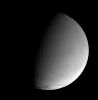
Enceladus-PIA09770.jpgThe "fresh" face of Enceladus57 visiteCaption NASA:"The Leading Hemisphere of Enceladus displays a remarkably fresh-looking surface in this recent Cassini view. At this resolution, only a few craters can be made out in this wrinkled region of the geologically active moon's surface.
A far more heavily cratered, and older, terrain region is visible to the North-West.
This view is centered on 15° North Latitude, 109° West Longitude.
North on Enceladus is up.
The image was taken in visible light with the Cassini spacecraft narrow-angle camera on Sept. 30, 2007. The view was acquired at a distance of approx. 108.000 Km (such as about 67.000 miles) from Enceladus and at a Sun-Enceladus-spacecraft, or phase, angle of 75°.
Image scale is roughly 646 meters (2.119 feet) per pixel".MareKromium
|
|
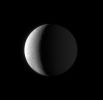
Enceladus-PIA09882.jpgEnceladus54 visiteCaption NASA:"The Cassini spacecraft acquired this view 15 hours before closest approach to Enceladus as the Spacecraft dove toward its thrilling March 2008 encounter with the ice-particle-spewing moon. The cratered terrain of the North is seen at top, and is even dimly visible on the moon's night side, which is lit by reflected sunlight coming from Saturn.
North on Enceladus (505 Km, or approx. 314 miles across) is up and rotated 22° to the left. The North Pole is tilted slightly toward Cassini.
The image was taken in visible green light with the Cassini spacecraft narrow-angle camera on March 12, 2008. The view was acquired at a distance of approx. 612.000 Km (about 380.000 miles) from Enceladus and at a Sun-Enceladus-Spacecraft, or Phase, angle of 114°.
Image scale is roughly 4 Km (about 2 miles) per pixel".MareKromium
|
|

Enceladus-PIA10354.jpgStellar Data on "Enceladus Plume"121 visiteCaption NASA:"New structure, density and composition measurements of Enceladus' water plume were obtained when the Cassini Spacecraft's Ultraviolet Imaging Spectrograph observed the star "Zeta Orionis" pass behind the plume Oct. 24, 2007, as seen in this frame.
Changes in the starlight as it dimmed while passing through the plume allowed the spectrograph to identify the plume's physical and chemical composition.
The spectrograph detected 4 high-density gas streams composed of Water Vapor. The density of the Water Vapor is twice that of the broad plume of gas that surrounds each jet.
This measurement confirms the theoretical analysis performed prior to the flyby that showed it was safe for Cassini to fly very closely past Enceladus, even through part of the plume, during the March 12, 2008 flyby".MareKromium
|
|
| 2245 immagini su 188 pagina(e) |
 |
|
|
|
|
40 | |
|
|
|
|





