Saturn: the "Ringed Beauty" and His Moons
|
|
|

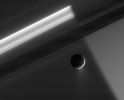
Enceladus-PIA08128.jpgIn-transit over Saturn's Terminator...62 visiteEnceladus hangs like a single bright pearl against the golden-brown canvas of Saturn and its icy Rings. Visible on Saturn is the Region where daylight gives way to dusk (--> crepuscolo). Above, the Rings throw thin shadows onto the Planet.
Images taken using red, green and blue spectral filters were combined to create this natural color view.
The images were taken using the Cassini spacecraft wide-angle camera on Jan. 17, 2006 at a distance of approx. 200.000 Km (about 100.000 miles) from Enceladus.
The image scale is approx. 10 Km (about 6 miles) per pixel.
|
|

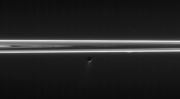
Enceladus-PIA08197.jpgIcy Plumes in the Ring-Shine61 visiteCaption NASA originale:"The plumes of Enceladus continue to gush icy particles into Saturn orbit, making this little moon one of a select group of geologically active bodies in the solar system.
Enceladus (505 Km, or 314 miles across) is seen here against the night side of Saturn. The extended exposure time used to image the plumes also makes the Southern Hemisphere, illuminated by Ring-Shine, appear bright.
The image was acquired in visible light with the Cassini spacecraft narrow-angle camera on May 4, 2006 at a distance of approx. 2,1 MKM (about 1,3 MMs) from Enceladus and 2,3 MKM (about 1,5 MMs) from Saturn. The image was taken at a Sun-Enceladus-spacecraft, or phase, angle of 159°. Image scale is roughly 13 Km (such as about 8 miles) per pixel on Enceladus".
|
|
Enceladus-PIA08199.jpgEnceladus' "Jets"!74 visiteCaption NASA originale:"An enhanced close-up view shows at least two distinct jets spraying a mist of fine particles from the South Polar Region of Enceladus. The particles in the plume scatter Sunlight most effectively at high Sun-Enceladus-spacecraft angles, or phase angles, making the plumes appear bright.
This image shows the night side of Saturn and the active moon against dark sky.
Some artifacts due to image compression and cosmic rays striking the camera's detector remain as "noise" in the image.
The image was acquired in polarized green light with the Cassini spacecraft narrow-angle camera on May 4, 2006 at a distance of approx. 2,1 MKM (about 1,3 MMs) from Enceladus and 2,3 MKM (about 1,4 MMs) from Saturn. The image was taken at a Sun-Enceladus-spacecraft, or phase, angle of 159°. Image scale is roughly 13 Km (about 8 miles) per pixel".
|
|
Enceladus-PIA08217.jpgThe "Sprayer" under the Rings69 visiteCaption originale:"Enceladus blasts its icy spray into space in this unlit-side Ring view that also features a tiny sliver of Rhea.
The South Polar Region of Rhea (dim.: 1.528 Km, or about 949 miles across) peeks out from beneath the Rings to the right of Enceladus (dim.: 505 Km, or about 314 miles across).
The image was taken in visible light with the Cassini spacecraft narrow-angle camera on June 9, 2006 at a distance of approx. 3,9 MKM (about 2,4 MMs) from Enceladus and 4,6 MKM (such as about 2,9 MMs) from Rhea. The Sun-Enceladus-spacecraft, or phase, angle is 161°. Image scale is about 23 Km (approx. 14 miles) per pixel on Enceladus".
|
|
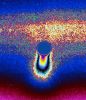
Enceladus-PIA08226.jpgThe "Fountains" of Enceladus63 visiteCaption NASA originale:"The ice-jets of Enceladus send particles streaming into space hundreds of kilometers above the South Pole of this spectacularly active moon. Some of the particles escape to form the diffuse E-Ring around Saturn.
This color-coded image was processed to enhance faint signals, making the contours and extent of the fainter, larger-scale component of the plume easier to see.
The bright strip behind and above Enceladus is the E-Ring, in which this intriguing body resides. The small round object at far left is a background star.
The image was taken in visible light with the Cassini spacecraft narrow-angle camera on March 24, 2006 at a distance of approx. 1,9 MKM (sucg as about 1,2 MMs) from Enceladus and at a Sun-Enceladus-spacecraft, or phase, angle of 162°. Image scale is about 11 Km (approx. 7 miles) per pixel".
|
|
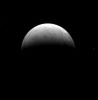
Enceladus-PIA08249.jpgEnceladus63 visiteCaption NASA:"Few large craters are to be found in the wrinkled terrain of Enceladus, where the surface has been reworked by geologic processes presumably resulting from the moon's inner warmth.
Cassini spied the bright crescent of Enceladus on July 23, 2006 at a distance of approx. 628.000 Km (about 391.000 miles).
The image was taken in visible light with the Cassini spacecraft narrow-angle camera at a Sun-Enceladus-spacecraft, or phase, angle of 103°. Image scale is roughly 4 Km (about 2 miles) per pixel".
|
|
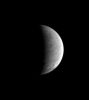
Enceladus-PIA08276.jpgEnceladus70 visiteCaption NASA originale:"Cassini spies the wrinkled, fractured and remarkably crater-poor terrain of Enceladus. Scientists are working to understand what causes the moon's surprising geologic activity (see also PIA07759).
North on Enceladus is up and rotated 20° to the left.
The image was taken in visible light with the Cassini spacecraft narrow-angle camera on Sept. 8, 2006 at a distance of approx. 560.000 Km (about 348.000 miles) from Enceladus and at a Sun-Enceladus-spacecraft, or phase, angle of 103°. Image scale is roughly 3 Km (a little less than 2 miles) per pixel".
|
|
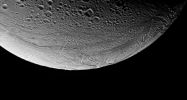
Enceladus-PIA08280.jpgThe active South Pole of Enceladus73 visiteCaption NASA originale:"The wrinkled border of Enceladus' South Polar Region snakes across this view, separating fresher, younger terrain from more ancient, cratered provinces.
This is the Region of Enceladus that is known to be presently geologically active. At right are clearly visible ridges and troughs thought to be caused (probably) by compressional stresses across the icy surface.
The image was taken in polarized green light with the Cassini spacecraft narrow-angle camera on Sept. 9, 2006 at a distance of approx. 66.000 Km (such as about 41.000 miles) from Enceladus and at a Sun-Enceladus-spacecraft, or phase, angle of 104°. Image scale is roughly 396 mt (about 1.300 feet) per pixel".
|
|

Enceladus-PIA08286.jpgCrescent Enceladus60 visiteCaption NASA originale:"A world whose mysteries are just coming to light, Enceladus has enchanted scientists and non-scientists alike. With its potential for near-surface liquid water, the icy moon may be the latest addition to the list of possible abodes for life (!).
The view was acquired about two-and-a-half hours after PIA08280, during one of the many encounters with Enceladus.
The image was taken using a combination of spectral filters sensitive to wavelengths of polarized ultraviolet light. The Cassini spacecraft narrow-angle camera acquired the view on Sept. 9, 2006 at a distance of approx. 141.000 Km (about 87.000 miles) from Enceladus and at a Sun-Enceladus-spacecraft, or phase, angle of 96°.
Image scale is roughly 850 mt (about 0,5 mile) per pixel".
|
|

Enceladus-PIA08354.jpgEnceladus (in false colors)64 visiteThe mosaic shows the anti-Saturnian Hemisphere of Enceladus -- the side that always faces away from Saturn.
This Region contains a number of tectonic and impact features and shows how these two geologic forces interact on Enceladus. The center left portion of this mosaic is dominated by Diyar Planitia.
Like Sarandib Planitia observed in the previous Enceladus flyby, the Region is characterized by low ridges and troughs. Throughout this Hemisphere, fractures of all sizes disrupt the previously existing cratered terrain and even the comparatively youthful Diyar Planitia.
Many of the younger fractures have blue-green walls, revealing coarse-grained water ice in the top layers of Enceladus' lithosphere, compared to the fine-grained ice that coats much of Enceladus' surface. The blue-green color is very similar to the coatings surrounding the South Polar "tiger stripes" (these appear greener than the features in the south polar mosaic released in 2005 due to the use of clear-filter images, instead of green, in that mosaic).
|
|

Enceladus-PIA08355.jpgCanyonland (HR)76 visiteFine topographic detail and color variations are revealed in this 11-image, false color mosaic taken during Cassini's 2nd close flyby of Saturn's moon Enceladus, on March 9, 2005.
This mosaic, a HR cropped section of the full-disk mosaic available in Fractured World, shows the center of the anti-Saturnian Hemisphere of Enceladus -- such as the side of Enceladus that always faces away from Saturn. The left portion of the mosaic is dominated by Diyar Planitia.
|
|

Enceladus-PIA08385.jpgThe sources of Enceladus' Fountains65 visiteCaption NASA:"This map of the South Polar Region of Enceladus shows the correlation between jet sources identified in Cassini imaging data and hot spots on the surface located by the Composite Infrared Spectrometer Instrument.
To identify jet source locations on the surface, imaging scientists carefully measured the locations and orientations of individual jets observed along the moon's limb in Cassini images taken from multiple viewing angles. For each jet measurement, the researchers then computed a curve, or ground track, on the surface of Enceladus along which that jet might lie. The ground tracks from all of the measurements made in the various images produced many intersections on this map. By considering the jet directions at every possible intersection, the researchers isolated 8 clusters of ground track intersections as jet sources.
The 8 identified jet source locations are labeled with yellow roman numerals. Composite Infrared Spectrometer hot spots are red boxes labeled with green capital letters.
The line-of-sight intersections indicating the measurements of each source in individual images are shown as colored diamonds.
White circles indicate the uncertainty in the locations of those sets of intersections.
The map is a polar stereographic projection of Cassini imaging data.
The 4 Tiger Stripe fractures, or sulci, are labeled here.
The South Pole is the dead center on the map.
Key longitudes are also labeled around the perimeter of the map".MareKromium
|
|
| 2245 immagini su 188 pagina(e) |
 |
|
|
|
|
39 | |
|
|
|
|





