| |

Saturn: the "Ringed Beauty" and His Moons
|
|
|
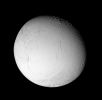
Enceladus-PIA07709.jpgEnceladus: a VERY active moon... (2)61 visiteWrinkles and cracks have reworked the surface of Enceladus, perhaps due to the influence of tidal stresses. The monochrome view also makes it clear that certain geological provinces on the moon have been altered by the activity, erasing ancient craters, while other places have retained much of the cratering record.
The terrain seen here is on the Trailing Hemisphere of Enceladus; North is up.
This image was taken using a near infrared spectral filter sensitive to wavelengths of light centered at 752 nnmts. The view was obtained using the Cassini spacecraft narrow-angle camera on Jan. 17, 2006 at a distance of approx. 153.000 Km (about 95.000 miles) from Enceladus and at a phase angle of 29°. Image scale is about 912 mt (such as approx. 2.994 feet) per pixel.
Nota: i 4 Giganti Gassosi (Giove, Saturno, Urano e Nettuno) sono mondi circondati da tante lune, alcune delle quali ancora geologicamente attive, a dispetto delle loro dimensioni e della enorme - e via-via crescente - distanza di questi Sistemi dal Sole. Pensate, p.e., ad Io ed Europa (per Giove); a Titano ed Encelado (per Saturno) ed infine ad Ariel (per Urano) e Tritone (per Nettuno). I piccoli mondi rocciosi, invece, hanno poche lune (o nessuna, come Venere e Mercurio) e queste lune NON sembrano - il dubitativo è d'obbligo - essere geologicamente attive. Il caso del Sistema Multiplo di Plutone va trattato a parte. Tutto ciò premesso, che cosa si può dedurre? Forse che la "Gioventù Geologica" di una piccolo pianeta roccioso (una "luna") dipende anche dalle caratteristiche del suo "Mondo Madre"? I 4 Giganti Gassosi emettono enormi quantitativi di radiazioni e posseggono caratteristiche tali da farli rassomigliare, ora più ed ora meno, a piccole "stelle mancate": questa circostanza potrebbe avere un peso?
|
|

Enceladus-PIA07758.jpgThe "Fountains" of Enceladus64 visiteRecent Cassini images of Saturn's moon Enceladus backlit by the sun show the fountain-like sources of the fine spray of material that towers over the South Polar Region. This image was taken looking more or less broadside at the "tiger stripe" fractures observed in earlier Enceladus images. It shows discrete plumes of a variety of apparent sizes above the limb of the moon.
|
|

Enceladus-PIA07759.jpgThe "Fountains" of Enceladus71 visite"...this greatly enhanced and colorized image shows the enormous extent of the fainter, larger-scale component of the plume..."
Nota: dal tenore del commento NASA, oltre ad una leggera sorpresa, non pare trasparire alcunchè. Allora: se abbiamo capito bene c'è qualcosa che viene "spruzzato" nel cielo dalla superficie di Encelado e che forma una sorta di "fontana" di corpuscoli che si disperdono nello spazio.
Qualcosa di incredibile e di assolutamente "alieno" (nel senso di lontano dal nostro modo di vedere e di immaginare le cose) sta accadendo, ma la NASA si limita a darci un commentino secco e asciutto, come la risposta ad un quesito di Scienze Planetarie che verrebbe data al Professore da uno studente non troppo preparato. Abbiamo letto, recentemente, della costante caduta di interesse da parte dell'opinione pubblica in generale e dei giovani in particolare verso lo Spazio e l'esplorazione del Sistema Solare. Onestamente, visto l'atteggiamento costantemente bolso di ESA e NASA, non ce ne meravigliamo...
|
|

Enceladus-PIA07760.jpgThe "Fountains" of Enceladus63 visiteA fine spray of small, icy particles emanating from the warm, geologically unique province surrounding the South Pole of Enceladus was observed in a Cassini narrow-angle camera image of the crescent moon taken on Jan. 16, 2005. Taken from a high phase angle of 148° - a viewing geometry in which small particles become much easier to see - the plume of material becomes more apparent in images processed to enhance faint signals.
Imaging scientists have measured the light scattered by the plume's particles to determine their abundance and fall-off with height. Though the measurements of particle abundance are more certain within 100 Km of the surface, the values measured there are roughly consistent with the abundance of water ice particles made by other Cassini instruments (reported in 09/2005) at altitudes as high as 400 Km above the surface.
At present, it is not clear if the plume particles emanating from the south pole arises because of water vapor escaping from warm ice that is exposed to the surface. Another possibility is that at some depth beneath the surface, the temperatures are hot enough for water to become liquid, which then, under pressure, escapes to the surface like a cold Yellowstone geyser.
The image at the left was taken in visible green light. A dark mask was applied to the moon's bright limb to make the plume feature easier to see.
The image at the right has been color-coded to make faint signals in the plume more apparent. Images of other moons, such as Tethys and Mimas, taken in the last 10 months from similar lighting and viewing geometries, and with identical camera parameters, were closely examined to demonstrate that the plume towering above Enceladus' south pole is real and not a camera artifact.
The images were acquired at a distance of about 209,400 kilometers (130,100 miles) from Enceladus. Image scale is about 1 kilometer (0.6 mile) per pixel.
|
|
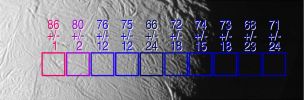
Enceladus-PIA07793.jpgEnceladus' surface temperatures (1)62 visiteThe exciting mystery of an active South Polar Region on Saturn's icy moon Enceladus continues to unfold as scientists make the correlation between geologically youthful surface fractures and unusually warm temperatures.
This view shows excess heat radiation from cracks near the moon's South Pole. These warm fissures are the source of plumes of dust and gas seen by multiple instruments on the Cassini spacecraft during its flyby of Enceladus on July 14, 2005, as described in a series of papers in the March 10, 2006, issue of the journal Science. This image shows two arrays of temperature readings across the surface of Enceladus, as measured by the Cassini Composite Infrared Spectrometer (CCIS), superimposed on images of the surface taken simultaneously by the Imaging Science Subsystem. Surface temperatures in Kelvin, derived from the intensity of infrared radiation detected by the composite infrared spectrometer, are shown along with their formal uncertainties, although true uncertainties for temperatures below about 75 Kelvin (minus 325 degrees Fahrenheit) are not easily described by a single number.
|
|
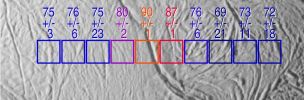
Enceladus-PIA07794.jpgEnceladus' surface temperatures (2)77 visiteEnhanced thermal emission is seen in the vicinity of the prominent "Tiger Stripe" fissures discovered by the imaging cameras.
In these images, the excess emission is most strongly seen in the left-most composite Infrared Spectrometer field of view, which includes a fissure near the end of one of the Tiger Stripes. The peak temperatures, 86 and 90 Kelvin (such as about -305 and -298 Fahrenheit) respectively, are averages over the Composite Infrared Spectrometer field of view, and other composite Infrared Spectrometer data suggest that much higher temperatures, up to at least 145 Kelvin (such as -199 Fahrenheit), occur in narrow zones a few hundred meters wide along the Tiger Stripe fissures.
The 1st image is centered near long. 135° W. and lat. 65° S. and each square from the composite infrared spectrometer field of view is about 17,5 Km (approx. 10,9 miles) across.
The 2nd image was taken nearly 3 times closer to Enceladus and is centered near long. 120° W, lat. 82° S.
|
|
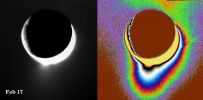
Enceladus-PIA07798.jpgEnceladus' active South Pole (1)66 visitePlumes of icy material extend above the Southern Polar Region of Enceladus, as imaged by the Cassini spacecraft in February 2005. The monochrome view is presented along with a color-coded version on the right. The latter reveals a fainter and much more extended plume component.
Images like these are being analyzed by scientists as they seek to explain the processes that could be producing such incredible features. As reported in the journal Science on March 10, 2006, imaging scientists believe that the plumes are geysers erupting from pressurized subsurface reservoirs of liquid water above 273 degrees Kelvin (0° C.).
Another plume view was taken 1 month earlier and looks broadside at the moon's prominent "Tiger Stripe" fractures. In the January view, the plume appears to have a single component. The February view looks along the Tiger Stripe fractures and reveals both a large and a small component to the plume; the smaller, fainter component is separated from the main plume by about 100 Km.
|
|
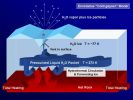
Enceladus-PIA07799.jpgEnceladus' Geysers Model66 visiteAs Saturn's active moon Enceladus continues to spew icy particles into space, scientists struggle to understand the mechanics of what is going on beneath the fractured south polar terrain. This graphic illustrates key aspects of the model proposed by the Cassini imaging science team in a paper published in the journal Science on March 10, 2006.
The model shows how proposed underground reservoirs of pressurized liquid water above 273 degrees Kelvin (0° Celsius) could fuel geysers that send jets of icy material into the skies above the moon's south pole. In the graphic, the vent to the surface pierces one of the "tiger stripe" fractures seen in Cassini views of the Southern Polar Terrain. Temperatures increase with depth.
Some combination of internal radioactive decay and flexing--perhaps concentrated within the tiger stripe fractures and brought about by the particular characteristics of Enceladus' orbit--is implicated as the source of the heat creating the liquid reservoirs. However, it is not yet clear how the deep interior of Enceladus functions, nor whether the moon is fully differentiated (separated into layers, with rock at the center and ice outside).
|
|

Enceladus-PIA07800-br500.jpgEnceladus (1)70 visiteA masterpiece of deep time and wrenching gravity, the tortured surface of Saturn's moon Enceladus and its fascinating ongoing geologic activity tell the story of the ancient and present struggles of one tiny world. This is a story that is recounted by imaging scientists in a paper published in the journal Science on March 10, 2006.
The enhanced color view of Enceladus seen here is largely of the Southern Hemisphere and includes the South Polar terrain at the bottom of the image.
Ancient craters remain somewhat pristine in some locales, but have clearly relaxed in others. Northward-trending fractures, likely caused by a change in the moon's rate of rotation and the consequent flattening of the moon's shape, rip across the southern hemisphere. The South Polar terrain is marked by a striking set of 'blue' fractures and encircled by a conspicuous and continuous chain of folds and ridges, testament to the forces within Enceladus that have yet to be silenced.
|
|

Enceladus-PIA07800f-1~0.jpgEnceladus (2) - detail mgnf and HR62 visiteThe global mosaic of Enceladus was created from 21 false-color frames taken during the Cassini spacecraft's close approaches to Enceladus on March 9 and July 14, 2005. Images taken using filters sensitive to ultraviolet, visible and infrared light (spanning wavelengths from 338 to 930 nnmts) were combined to create the individual frames.
The mosaic is an orthographic projection centered at 46,8° South Lat. and 188° West Long. and has an image scale of 67 mt (about 220 feet) per pixel. The original images ranged in resolution from 67 mt per pixel to 350 mt were taken at distances ranging from 11.100 to 6.300 Km from Enceladus.
|
|

Enceladus-PIA07800f-2.jpgEnceladus (3) - detail mgnf and HR103 visiteEncelado è dunque "vivo e vegeto" e, dalla sua gelida superficie, in area Sud Polare, ciclopici geysers spruzzano (ma lo fanno continuativamente o di quando in quando?) fango, vapore e cristalli di ghiaccio d'acqua verso lo spazio che circonda questa piccola Luna.
Alla NASA, come potete vedere nel Modello "Cold Geyser", sono convinti che queste "fontane" trovino la loro origine in un sottosuolo NON attivo - in senso geologico - ma "caldo" (per motivi ancora da chiarire), il quale agirebbe come una sorta di "miccia" (o iniettore) su grandi sacche d'acqua (le cosiddette water pockets, contenenti acqua allo stato liquido, a circa 0°C, ed in pressione) le quali, una volta giunte ad ebollizione, spingono fanghi, cristalli d’acqua e vapore acqueo attraverso degli stretti condotti (vents) che, dalle profondità del pianeta, arrivano sino alla superficie (posta sul fondo delle Tiger Stripes) e quindi si aprono verso lo spazio circum-enceladiano, consentendo lo sfogo di quanto emerso e mantenendo l’intero sistema in un sostanziale equilibrio.
Ora, anche ammettendo che questo modello esplicativo delle "Fontane di Encelado" abbia una qualche attendibilità e sostanza, ci domandiamo: dato che Encelado è una luna molto piccola e che le sue "riserve d'acqua" (water-pockets) devono essere – logicamente – molto piccole, non è irragionevole supporre che tali geysers abbiano una vita – tutto sommato – molto breve e che, una volta finita l'acqua, finirà anche il fenomeno delle fontane di fango, ghiaccio e vapore. La logica direbbe questo.
Tuttavia, a quanto si deduce osservando la superficie di Encelado (la quale sembra proprio "fresca e giovane") dobbiamo invece supporre che un siffatto fenomeno stia andando avanti da ere.
Deduzioni (e domande): allora l'acqua delle water-pockets di Encelado si riforma, nel tempo?
E, se si (come la logica ci farebbe supporre), quest'acqua da dove viene?
Forse l’intero Encelado si sta “sciogliendo”, precipitando i ghiacci di superficie nel sottosuolo dove vengono scaldati, quindi liquefatti ed infine “sparati” nello spazio?
Oppure i geysers di Encelado si sono attivati "recentemente", ed è solo per questo che essi stanno vivendo questa stagione di splendore?
E se la risposta a questo ultimo quesito fosse "si", che cosa avrebbe innescato il riscaldamento delle viscere del pianeta?
Forse un'attività solare anomala e particolarmente intensa (la stessa che, secondo alcuni, sta aiutando Marte a scaldarsi)?
O magari la causa del fenomeno è nelle ondate di radiazioni che arrivano costantemente da Saturno?
I Giganti Gassosi, in fondo, in qualità di “stelline mancate”, non potrebbero operare come “riscaldatori” dei minuscoli corpi che li circondano?
Non è in fondo questa la costruzione che ha fatto pensarea molti Scienziati e Ricercatori – sin dagli Anni ’80 – che alcune Lune Gioviane potrebbero essere “mantenute in vita” proprio dall’energia termica (e non solo) che gli perviene dal loro Pianeta-Genitore e non certo dal Sole (troppo lontano)?
Conclusione: creare “modelli” interpretativi dei fenomeni anomali è, come avete notato, relativamente semplice. Analizzare le implicazioni proprie di ciascun modello, invece, non lo è affatto.
Noi, in fondo, possiamo anche permetterci, di tanto in tanto, di “inventarci un modello” e di proporlo (anche se non siamo scienziati, abbiamo comunque una testa e qualche capacità di ragionamento logico); ma quando ci accorgiamo che i nostri modelli, in fondo, hanno le stesse (purtroppo deboli e fortemente speculative) basi dei modelli NASA...Allora un pizzico di perplessità ci coglie.
Non credete?!?
|
|
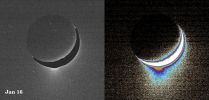
Enceladus-PIA07801.jpgEnceladus' active South Pole (2)75 visiteThese images were taken with the Cassini spacecraft narrow-angle camera at a distance of approximately 209.400 Km (about 130.100 miles) from Enceladus at a phase angle of 148°. The image scale is about 1,3 Km (0,8 mi) per pixel.
The mosaic is an orthographic projection centered at 46,8° South Lat. and 188° West Long. and has an image scale of 67 mt (about 220 feet) per pixel. The original images ranged in resolution from 67 mt per pixel to 350 mt (about 1.150 feet) per pixel and were taken at distances ranging from 11.100 to 61.300 Km from Enceladus.
|
|
| 2245 immagini su 188 pagina(e) |
|
|
|
|
|
38 | |
|
|
|
|
|
|





