Saturn: the "Ringed Beauty" and His Moons
|
|
|

Enceladus-PIA06566_modest.jpgEnceladus - Diyar Planitia - from approx. 672.000 Km89 visiteCaption NASA originale:"Cassini's closest look yet at bright, icy Enceladus was captured in this view, centered on the moon's trailing hemisphere. It shows some of the linear features in the terrain of the Diyar Planitia region. Enceladus is 499 Km (310 mi) across.
The image was taken in visible light with the Cassini spacecraft narrow angle camera on Dec. 14, 2004, at a distance of 672.000 Km (417.600 miles) from Enceladus and at a phase angle of 32°. The image scale is about 4 Km (2,5 miles) per pixel. The image has been magnified by a factor of two and contrast enhanced to aid visibility".
|
|

Enceladus-PIA06579.jpgCrescent Enceladus, the brightest gem of Saturn's System65 visiteCaption NASA originale:"In the dim light of the outer Solar System, Cassini gazed back at Saturn's brightest gem: the moon Enceladus. The icy little world presents only a slim crescent in this natural color view. Cassini has now matched the best spatial resolution on Enceladus achieved by NASA's Voyager spacecraft, and will soon have excellent coverage of the moon (at more than 10 times the resolution in this image), following a flyby planned for February 17.
When seen from its day side, Enceladus (499 Km across) has one of the brightest and whitest surfaces in the Solar System. Since it reflects most of the sunlight that strikes it, the temperature there remains at a chilly -200°C (-330° Fahrenheit).
In this view, Cassini was pointed at the leading hemisphere of Enceladus, which was in darkness at the time. The image has been rotated so that north on Enceladus is up".
|
|

Enceladus-PIA06581_modest.jpgEnceladus: getting closer...71 visiteCaption NASA originale:"This Cassini image of Saturn's moon Enceladus shows a region containing bizarre, wrinkled terrain. Enceladus is covered with bright water ice. The part of its surface visible here appears to be largely free of craters - indicating that it is geologically young (NOTA LUN-EX-IT: la mancanza di crateri non è solo indice di "gioventù geologica"; essa può anche essere dipendente dal fatto - improbabile ma da NON escludersi a-priori - che taluni processi geologici sìano ancora in corso!
Il tutto senza escludere la possibilità - anch'essa remota ma non assurda - che Encelado sia stata una "luna fortunata" e bombardata in misura inferiore rispetto alle altre...).
The first close imaging of this moon will be done by Cassini in February 2005 and should reveal many surprises. Enceladus has a diameter of 499 Km (310 miles). This view shows primarily the leading hemisphere of Enceladus and it was taken from a distance of 367.000 Km. Resolution in the original image was about 2 Km per pixel".
|
|

Enceladus-PIA06581_modest.jpgEnceladus (natural colors)63 visitePrimo esperimento di elaborazione/colorizzazione Lunar Explorer Italia su Enceladus (la "Luna di Neve").
A diversa colorazione corrisponde diversa albedo; la dominante scelta è celeste, con sub-toni grigi, azzurri e bianchi.MareKromium
|
|

Enceladus-PIA06597.jpgEnceladus and Tethys66 visiteCaption NASA originale:"In this unusual view, Cassini captured two icy moons of Saturn, Tethys and Enceladus, in a single narrow-angle frame. Little detail is visible on the surface of bright Enceladus, but battered Tethys shows many craters and the huge canyon system, Ithaca Chasma. Tethys has a diameter of 1.071 Km (approx. 665 miles) across, while Enceladus is 505 Km (approx. 314 miles) across.
The image was taken in visible light with the Cassini spacecraft narrow-angle camera on Jan. 29, 2005, at a distance of approx. 3,7 MKM (approx. 2,3 MMs) from Tethys and 3,5 MKM (approx. 2,2 MMs) from Enceladus. Resolution in the original image was 22 Km (approx. 14 miles) per pixel on Tethys and 21 Km (approx. 13 miles) per pixel on Enceladus. The image has been contrast-enhanced and magnified by a factor of two to aid visibility".
|
|

Enceladus-PIA06628.jpgEnceladus from 1,1 MKM65 visiteCaption NASA originale:"Saturn's bright moon Enceladus hovers here, in front of the Rings darkened by Saturn's shadow.
This view is from less than 1° beneath the Ring plane. If seen from directly beneath the Rings, the planet's giant shadow would appear as an elongated half-ellipse; the acute viewing angle makes the shadow look more like a strip here. The dark shadow first takes a bite out of the rings at the right, where the distant, outermost ring material appears to taper and fade. Ring features visible in this image from the outer ring edge inward include: the A-Ring, the Cassini Division and the B-Ring. The C-Ring is the darker region that dominates the Rings here. The 2 gaps visible near the center and below the left of the center are the Titan Gap, about 77.800 Km from Saturn and an unnamed gap about 75.800 Km from the planet. The image was taken in visible light with the Cassini spacecraft narrow-angle camera on March 7, 2005, at a distance of approx. 1,1 MKM from Enceladus, at a phase angle of 30°".
|
|

Enceladus-PIA06653.jpgPink Rings and Enceladus, in "natural colors"64 visiteCaption NASA originale:"Saturn's icy moon Enceladus hovers above Saturn's exquisite Rings in this color view from Cassini.
The Rings, made of nearly pure water ice, have also become somewhat contaminated by meteoritic dust during their history, which may span several hundred million years. Enceladus shares the Rings' nearly pure water ice composition, but appears to have eluded dust contamination through resurfacing processes that scientists are still trying to fully understand. Dust affects the Rings' color, while differences in brightness are attributable to varying particle sizes and concentrations. The images for this natural color view were taken with the Cassini spacecraft narrow-angle camera on April 5, 2005, at a distance of approximately 2,2 MKM (approx. 1,4 MMs) from Saturn through red, green and blue spectral filters. The image scale is 13 Km (about 8 miles) per pixel".
|
|

Enceladus-PIA07370.jpgThe atmosphere of Enceladus65 visiteCaption NASA originale:"The graphic shows the magnetic field observed by Cassini along its trajectory plotted in a vector form. Even though the spacecraft altitude was almost 500 Km (310 miles) at closest approach and the flyby was upstream of the moon (where the interaction is expected to be weaker) Cassini's magnetometer observed bending of the magnetic field consistent with its draping around a conducting object, which indicates that the Saturnian plasma is being diverted away from an extended atmosphere".
|
|

Enceladus-PIA07459.jpgEnceladus in infrared84 visiteCaption NASA originale:"This infrared color image of Enceladus was obtained by the Cassini visual infrared mapping spectrometer on March 9, 2005, when the Cassini spacecraft was 9.145 Km away from Enceladus.
Enceladus shows substantial differences in composition or, more likely, particle size on its surface. Redder areas correspond to larger grain sizes, and appear to be correlated with craters and ridged regions. The surface of Enceladus is nearly pure water ice; no other components have been identified yet. The middle of the image is located at the equator near a longitude of 210°.
The image is about 100 Km square and it shows the ratio of reflected light at 1,34 and 1,52 microns, wavelengths that are not visible to the human eye".
|
|

Enceladus-PIA07619.jpgEnceladus over the B-Ring64 visiteOriginal caption:"The moon Enceladus seems to hover above the outer reaches of Saturn's B-Ring. Below and to the right of Enceladus, four faint bands lie in the center of the dark Cassini Division.
Recently, scientists have speculated that the particles that make up the dense B and A-Rings might be more like fluffy snowballs than hard ice cubes. The conclusion is based on temperature data obtained by the Cassini spacecraft.
Enceladus' diameter is about 505 Km (such as approx. 314 miles). The icy moon is on the near side of the Rings in this view.
This image was taken in visible light with the Cassini spacecraft narrow-angle camera on Sept. 15, 2005, at a distance of approx. 2,3 MKM (1,4 MMs) from Enceladus.
The image scale is 14 Km (approx. 9 miles) per pixel on Enceladus".
|
|

Enceladus-PIA07694.jpgThe "Young Face" of Enceladus60 visiteOriginal caption:"For Enceladus, wrinkles mean the opposite of old age. This view of a crescent Enceladus shows a transition zone between a wrinkled and presumably younger Region of terrain and an older, more heavily cratered Region. The moon's geologically active Southern Polar Region is seen on the left.
The lit terrain shown here is on the side of Enceladus that faces away from Saturn.
The image was taken in visible light with the Cassini spacecraft narrow-angle camera on Dec. 24, 2005 at a distance of approx. 108.000 Km (such as about 67.000 miles) from Enceladus, at a Sun-Enceladus-spacecraft angle of 102°.
Image scale is roughly 646 mt (about 2.118 feet) per pixel".
|
|
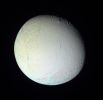
Enceladus-PIA07708.jpgEnceladus: a VERY active moon... (1)62 visiteA false color look reveals subtle details on Enceladus that are not visible in natural color views. The now-familiar bluish appearance (in false color views) of the Southern "Tiger Stripes" features and other relatively youthful fractures is almost certainly attributable to larger grain sizes of relatively pure ice, compared to most surface materials.
On the Tiger Stripes, this coarse-grained ice is seen in the colored deposits flanking the fractures as well as inside the fractures. On older fractures in other areas of Enceladus, the blue ice mostly occurs on the exposed wall scarps.
The color difference across the moon's surface (a subtle gradation from upper left to lower right) could indicate broad-scale compositional differences across the moon's surface. It is also possible that the gradation in color is due to differences in the way the brightness of Enceladus changes toward the limb, a characteristic which is highly dependent on wavelength and viewing geometry.
|
|
| 2245 immagini su 188 pagina(e) |
 |
|
|
|
|
37 | |
|
|
|
|





