Saturn: the "Ringed Beauty" and His Moons
|
|
|

Enceladus-PIA06209.jpgEnceladus' "crispy & fractured" surface (false colors)55 visiteExtending through the center of this image is a system of rifts 3 Km wide and lanes of grooved terrain 20 Km wide, which separate 2 distinct geological provinces. To the right of the boundary is older, cratered terrain - a region peppered with craters ranging from 10 Km in diameter, down to craters near the limit of resolution. The region is believed to be old because it has accumulated a relatively high density of impact craters over time and the topography is soft and muted, suggesting that it is covered by a layer of particulate materials. The cratered terrain is cut crosswise by numerous faults and fractures ranging in width from hundreds of meters to a few Km. On the left side of the scene are grooved, icy plains. This broad, relatively flat region is scored by an extensive band of parallel grooves that appear to subdivide the surface into narrow lanes approx. 1 Km wide. The low abundance of impact craters and crisp relief on topographic features here imply that this region is geologically much younger than the cratered terrain at the right.
|
|

Enceladus-PIA06210.jpgEnceladus' "crispy & fractured" surface (false colors)55 visiteTo human eyes, Enceladus appears almost completely white, but false color reveals intriguing details. This view is a composite of images taken using filters sensitive to ultraviolet (centered at 338 nnmts), green (centered at 568 nnmts), and near-infrared (centered at 930 nnmts) light and has been processed to accentuate subtle color differences. The uppermost surface of these terrains appears uniformly grey in this picture, suggesting that they are covered with materials of homogeneous composition and grain size. However, the walls of many of the fractures appear to be somewhat bluer than typical surface materials. It is possible that the difference in color identifies outcrops of solid ice on the walls of fractures, or ice with different grain-sizes, compared to powdery surface materials. It is also possible that the color identifies some compositional difference between buried ice and ice at the surface. The surface is peppered with craters of all sizes, from the 21-Km diameter crater at the top of the image, down to tiny craters near the limit of resolution. The prominent crater at the top contains a central, domelike structure more than 11 kilometers (7 miles) in diameter. The dome, the crater -- and indeed the entire scene -- is sliced by a complex network of fractures ranging in width from hundreds of meters in some places, to over three kilometers (2 miles) in others.
|
|
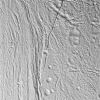
Enceladus-PIA06215.jpgCracks on Enceladus (and possible Anomaly)55 visiteCaption NASA originale:"This view of Enceladus shows an area that has undergone a very intriguing sequence of events. The craters here are subdued, as seen elsewhere on Enceladus and most, but not all, are older than the fractures. Fracturing has occurred at a wide variety of scales, from the wide rift running through the center of the image to much narrower sets of shorter fractures that crosscut the craters (and each other) to the left. This region is a transition from cratered to wrinkled terrain. Westward (left) of the central rift that divides the 2 regions are relatively parallel grooves and ridges that are reminiscent of terrain on Jupiter's large moon Ganymede. Very few craters are seen in this area of Enceladus. Right of the large rift the terrain becomes more cratered, although the craters are quite degraded. A prominent fracture runs North-South to the center of the image".
Nota: guardate bene che cosa c'è all'interno di questo crepaccio, in alto, proprio a ridosso del bordo superiore del frame!
|
|
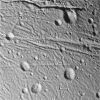
Enceladus-PIA06217.jpgCracks on Enceladus (and possible Anomaly)56 visiteCaption NASA originale:"During its very close flyby of Enceladus on March 9, 2005, Cassini took HR images of the icy moon that are helping scientists interpret the complex topography of this intriguing little world. This scene is an icy landscape that has been scored by tectonic forces. Many of the craters in this terrain have been heavily modified, such as the 10-Km-wide crater near the upper right that has prominent North-South fracturing along its northeastern slope".
Nota: è fortemente probabile che proprio al termine della frattura che taglia il frame nel suo margine superiore (Dx di chi guarda) vi sia una sorta di monolito (o comunque una struttura simile ad un pilastro) ad ore 1 del piccolo cratere che "chiude" il crepaccio (si nota, oltre all'ombra del bordo nord del cratere, anche l'ombra - MOLTO lunga! - di questo curioso rilievo).
Scherzo della prospettiva o un "nuovo monolito" (dopo le Lunar Spires - o Cuspidi di Blair - ed il Monolito di Phobos)?
|
|

Enceladus-PIA06250.jpgZooming-in on Enceladus55 visiteCaption NASA originale:"The tortured Southern Polar terrain of Enceladus appears strewn with great boulders of ice in these 2 fantastic views - the Highest Resolution images obtained so far by Cassini of any world.
This comparison view consists of a wide-angle camera image (left) for context, and a HR narrow-angle camera image (right). The 2 images were acquired at an altitude of approx. 208 Km, as Cassini made its closest approach yet to Enceladus. The wide-angle view shows what appears to be a geologically youthful, tectonically fractured terrain.
In the narrow-angle view, some smearing of the image due to spacecraft motion is apparent. Both of these views were acquired as Enceladus raced past Cassini's field of view near the time of closest approach. At the time, the imaging cameras were pointed close to the moon's limb (edge), rather than directly below the spacecraft. This allowed for less 'motion blur' than would have been apparent had the cameras pointed straight down. Thus, the terrain imaged here was actually at a distance of 319 kilometers (198 miles) from Cassini".
|
|
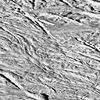
Enceladus-PIA06251.jpgEnceladus from about 208 Km56 visiteThis wide-angle view is one of the highest resolution images yet acquired by Cassini and shows what appears to be a geologically youthful, tectonically fractured terrain.
The image was taken during Cassini's very close flyby of Enceladus on July 14, 2005, from a distance of approx. 208 Km (such as about 129 miles) above Enceladus. Resolution in the image is about 37 mt (or 121 feet) per pixel. The image's contrast has been enhanced to improve the visibility of surface features.
|
|

Enceladus-PIA06252.jpgEnceladus from about 208 Km54 visiteThe tortured southern polar terrain of Enceladus appears strewn with great boulders of ice in this fantastic view, one of the best HR images obtained so far by Cassini of any world.
Some smearing of the image due to spacecraft motion is apparent in this scene, which was acquired as Enceladus raced past Cassini's field of view near the time of closest approach. At the time, the imaging cameras were pointed close to the moon's limb, rather than directly below the spacecraft. This allowed for less motion blur than would have been apparent had the cameras pointed straight down. Thus, the terrain imaged here was actually at a distance of 208 Km from Cassini.
At this fine scale, the surface is dominated by ice blocks between 10 and 100 mt across. The origin of these icy boulders is enigmatic: scientists are interested in studying the sizes and numbers of the blocks in this bizarre scene and in understanding whether terrain covered with boulders is common on Enceladus.
|
|

Enceladus-PIA06254-br500.jpgEnceladus (false-colors mosaic)57 visiteFrom afar, Enceladus exhibits a bizarre mixture of softened craters and complex, fractured terrains. This large mosaic of 21 narrow-angle camera images has been arranged to provide a full-disk view of the anti-Saturn hemisphere of Enceladus. This mosaic is a false-color view that includes images taken at wavelengths from the ultraviolet to the infrared portion of the spectrum and is similar to another, LR false-color view obtained during the flyby. In false-color, many long fractures on Enceladus exhibit a pronounced difference in color (represented here in blue) from the surrounding terrain. A leading explanation for the difference in color is that the walls of the fractures expose outcrops of coarse-grained ice that are free of the powdery surface materials that mantle flat-lying surfaces.
The original images in the false-color mosaic range in resolution from 350 to 67 mt per pixel (distance range from about 11.000 up to 61.000 Km).
|
|

Enceladus-PIA06433.jpgThe heat inside Enceladus...55 visiteThis image shows the warmest places in the South Polar Region of Enceladus. The unexpected temperatures were discovered by Cassini's Composite Infrared Spectrometer during a close flyby on July 14, 2005. The image shows how these temperatures correspond to the prominent, bluish fractures dubbed "Tiger Stripes". Such "warm" temperatures (91 and 89° Kelvin - about minus 296 and minus 299° Fahrenheit - are unlikely to be due to heating of the surface by the feeble sunlight striking Enceladus' South Pole. They are a strong indication that internal heat is leaking out of Enceladus and warming the surface along these fractures. Evaporation of this relatively warm ice probably generates the cloud of water vapor detected above Enceladus' South Pole by several other Cassini instruments. Scientists are unsure how the internal heat reaches the surface. The process might involve liquid water, slushy brine, or soft but solid ice.
|
|

Enceladus-PIA06443.jpgThe biggest "Geyser" in the Solar System: the Enceladus' Fountain58 visiteDuring a non-targeted flyby by the Cassini spacecraft of Enceladus on Nov. 26, 2005, the Cassini's Visual and Infrared Mapping Spectrometer (VIMS) measured the spectrum of the plumes originating from the South Pole of the icy moon. The instrument captured a very clear signature of small ice particles in the plume data, at the 2,9 micron wavelength. This image of Enceladus, taken with the VIMS, shows not only the plume over the South Pole, but also the dark side of the moon, silhouetted against a foggy background of light from the E-Ring.
The bottom graph shows the measurements of the spectrum, of this background light. It shows a very similar signature of small ice particles to that in the plumes, confirming earlier expectations that Enceladus is indeed the source of the E-Ring.
Preliminary analyses suggest that the average size of the particles in the plume is about 10 microns (or 1/100.000 of a meter). The particles in the E-Ring are about 3 times smaller.
The sunlit surface of Enceladus itself, visible as a thin crescent at the bottom of the image, is also composed of water ice, but with a much larger grain size than the plume.
|
|

Enceladus-PIA06531_modest.jpgEnceladus55 visiteCaption NASA originale:"The image shows the trailing hemisphere of Enceladus, which is the side opposite the moon's direction of motion in its orbit. Enceladus is 499 Km across.
The image was taken in visible light with the Cassini spacecraft narrow angle camera on Oct. 27, 2004, at a distance of about 766.000 Km from Enceladus and at a Sun-Enceladus-spacecraft, or phase, angle of 34 degrees. The image scale is 4,6 Km per pixel".
|
|

Enceladus-PIA06547_modest.jpgEnceladus in visible light55 visiteCaption NASA originale:"Hints of the curving linear grooves that crisscross bright, icy Enceladus are just discernible in this image captured by the Cassini spacecraft. Enceladus is almost entirely composed of water ice and has a surface as bright as snow. Its diameter is 499 Km (310 miles).
This view shows principally the leading hemisphere of Enceladus. The image was taken in visible light with the Cassini spacecraft narrow angle camera on Nov. 1, 2004, at a distance of 1,8 MKMs from Enceladus and at a Sun-Enceladus-spacecraft, or phase, angle of 108°. North is up. The image scale is about 11 Km (or 7 miles) per pixel. The image has been magnified by a factor of two and contrast enhanced to aid visibility of surface features".
|
|
| 2245 immagini su 188 pagina(e) |
 |
|
|
|
|
36 | |
|
|
|
|





