Saturn: the "Ringed Beauty" and His Moons
|
|
|
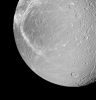
Dione-PIA12608.jpgDione66 visiteCaption NASA:"Wispy Terrain winds across the Trailing Hemisphere of Saturn's moon Dione in this Cassini view taken during the Spacecraft's Jan. 27, 2010 non-targeted Fly-By.
Cassini came within about 45.000 Km (approx. 28.000 miles) of the moon during this Fly-By, but this image was acquired at a distance of approx. 137.000 Km (about 85.000 miles) from Dione.
This view looks toward the anti-Saturn Side and Trailing Hemisphere of Dione. North on Dione is up.
The image was taken in Visible Light with the Cassini Spacecraft narrow-angle camera on Jan. 27, 2010. The view was obtained at a Sun-Dione-Spacecraft, or Phase, Angle of 38°.
Image scale is about 819 meters (2687 feet) per pixel".MareKromium
|
|
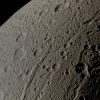
Dione-PIA12663.jpgDione (Absolute Natural Colors; credits for the additional process. and color.: Dr Paolo C. Fienga - Lunexit Team)67 visiteCaption NASA:"The Cassini Spacecraft swooped in for a close-up of the cratered, fractured surface of Saturn's moon Dione in this image taken during the Spacecraft's Jan. 27, 2010, non-targeted Fly-By.
Cassini came within about 45.000 Km (approx. 28.000 miles) of the moon during the Fly-By, and this image was acquired at a distance of approx. 46.000 Km (about 29.000 miles).
This view looks toward the Leading Hemisphere of Dione. North on Dione is up. The image was taken in Visible Light with the Cassini Spacecraft narrow-angle camera.
The view was acquired at a Sun-Dione-Spacecraft, or Phase, Angle of 108°. Image scale is roughly 270 meters (886 feet) per pixel".MareKromium
|
|

Dione-PIA12711.jpgA beautiful crescent Dione (with a "Small Companion", maybe...)91 visiteCaption NASA:"A thin crescent of highly Cratered Terrain is illuminated on Saturn's third largest moon, Dione. Lit Terrain seen here is on the Saturn-facing side of Dione. North is up.
The image was taken in Visible Light with the Cassini Spacecraft narrow-angle camera on May 17, 2010.
The view was acquired at a distance of approx. 394.000 Km (about 245.000 miles) from Dione and at a Sun-Dione-Spacecraft, or Phase, Angle of 151°.
Image scale is roughly 2 Km (about 1,2 miles) per pixel".MareKromium
|
|

Dione-PIA12729-PCF-LXTT.jpgDione (Natural Colors; credits for the additional process. and color.: Dr Paolo C. Fienga - Lunexit Team)100 visitenessun commentoMareKromium
|
|

Dione-PIA12740-PCF-LXTT.jpgFlying over Dione's "Wisps" (Absolute Natural Colors; credits for the additional process. and color.: Dr Paolo C. Fienga - Lunexit Team)90 visiteCaption NASA:"The Cassini Spacecraft looks across the Surface of Saturn's moon Dione and details the so-called "Wispy" Terrain first chronicled by the Voyager probe.
This Fractured Terrain covers the Trailing Hemisphere of Dione (which is about 1123 Km, or approx. 698 miles across). This view is centered on Terrain at approx. 53° North Latitude and 209° West Longitude.
The image was taken in Visible Light with the Cassini Spacecraft narrow-angle camera on Oct. 17, 2010. The view was acquired at a distance of approx. 61.000 Km (about 38.000 miles) from Dione and at a Sun-Dione-Spacecraft, or Phase, Angle of 32°. Image scale is roughly 363 meters (1190 feet) per pixel".MareKromium
|
|

Dione-PIA12743.jpgErulus Crater (Absolute Natural Colors; credits for the additional process. and color.: Dr Paolo C. Fienga - Lunexit Team)85 visiteCaption NASA:"The Cassini spacecraft snapped this shot of cratered Dione as it flew by the Saturnian moon on Oct. 17, 2010. The large crater at the center of the image is Erulus, which is about 120 Km, or approx. 75 miles, across. This view looks toward the Southern Latitudes of the Leading Hemisphere of Dione.
The image was taken in Visible Light with the Cassini Spacecraft narrow-angle camera. The view was acquired at a distance of approximately 41.000 Km (such as about 25.000 miles) from Dione and at a Sun-Dione-Spacecraft, or Phase, Angle of 53°.
Image scale is roughly 240 meters (787 feet) per pixel".MareKromium
|
|

Dione-PIA12752.jpgWispy Terrain on Dione (Absolute Natural Colors; credits for the additional process. and color.: Dr Paolo C. Fienga - Lunexit Team)289 visiteCaption NASA:"Wispy Terrain reflects Sunlight brightly in the lower left of this Cassini image of the Northern Latitudes of Saturn's moon Dione.
These "Wisps" are actually Fractures located on the Trailing Hemisphere of Dione. Lit Terrain seen here is between the Trailing Hemisphere and the Saturn-facing Side of Dione. North is up.
The image was taken in Visible Light with the Cassini spacecraft narrow-angle camera on Dec. 20, 2010. The view was obtained at a distance of approx. 107.000 Km (66.447 miles) from Dione and at a Sun-Dione-Spacecraft, or Phase, Angle of 109°. Image scale is roughly 640 meters (2100 feet) per pixel".MareKromium
|
|

Dione-PIA14628-PCF-LXTT-IPF.jpgLarge Rayed Crater on Dione (Absolute Natural Colors; credits for the additional process. and color.: Dr Paolo C. Fienga/Lunar Explorer Italia/Italian Planetary Foundation)99 visiteThe NASA - Cassini Spacecraft looks at an example of a Rayed Crater located on the Leading Hemisphere of the Saturnian moon Dione. The Rayed Crater is in the upper-left of the image and its Rays (made by Ejecta ---> such as by Rocky Material, belonging to Dione, that was lifted up and thrown away in every direction at the time of the Impact) show up as brighter material ("brighter" if compared to the Albedo of the Surface that surrounds it) which emanates from the Crater itself.
This view, as we said hereabove, looks toward the Leading Hemisphere of Dione (which is approx. 700 miles, such as about 1125 kilometers across). North on Dione is up and rotated 12 degrees to the left. The image was taken in Visible Light with the NASA - Cassini Spacecraft Narrow-Angle Camera on July 23, 2012. The view was acquired at a distance of approximately 260.000 miles (such as about 418.000 kilometers) from Dione and at a Sun-Dione-Spacecraft (or Phase) Angle of 5°. Image scale is about 2 miles (such as a little more than 3 kilometers) per pixel.
This frame (which is an Original NASA - Cassini Spacecraft image published on the NASA - Planetary Photojournal with the ID n. PIA 14628) has been additionally processed and then colorized in Absolute Natural Colors (such as the colors that a human eye would actually perceive if someone were onboard the NASA - Cassini Spacecraft and then looked outside, towards the Saturnian moon Dione), by using an original technique created - and, in time, dramatically improved - by the Lunar Explorer Italia Team. Different colors, as well as different shades of the same color, mean, among others, the existence of different Elements present on the Surface of Dione, each having a different Albedo (---> Reflectivity) and Chemical Composition.MareKromium
|
|

Dione-PIA17126-PCF-LXTT-IPF.jpgRomulus and Friends (Absolute Natural Colors; credits for the additional process. and color.: Dr Paolo C. Fienga/Lunar Explorer Italia/IPF)83 visiteLike their semi-divine namesakes, Dione's twin Impact Craters Romulus and Remus (just above-right of the center) stand together while Dido, the larger Impact Crater showing a magnificent and impressive Central Peak, lies to the South/East, on the lower left Limb of Dione and almost half-way on top of the Terminator. The lit Terrain seen here is on the Saturn-facing Hemisphere of Dione and North is up.
The image was taken in Visible Light with the NASA - Cassini Spacecraft Narrow-Angle Camera on April 28, 2013. The view was obtained at a distance of approximately 870.000 miles (such as a little more than 1,4 Million KiloMeters) from Dione and at a Sun-Dione-Cassini Spacecraft, or Phase, Angle of 77°. Image scale is roughly 5 miles (a little more than 8 Km) per pixel.
This frame (which is an Original NASA - Cassini Spacecraft b/w frame published on the NASA - Planetary Photojournal with the ID n. PIA 17126) has been additionally processed, contrast enhanced, magnified to aid visibility of the Surface details and then colorized, according to an educated guess carried out by Dr Paolo C. Fienga/LXTT/IPF, in what they should be its Absolute Natural Colors (such as the colors that a human eye would actually perceive if someone were onboard the NASA - Cassini Spacecraft and then looked outside, towards the Saturnian moon Dione), by using an original technique created - and, in time, dramatically improved - by the Lunar Explorer Italia Team. Different colors, as well as different shades of the same color, mean, among others, the existence of different Elements present on the Surface of Dione, each having a different Albedo (---> Reflectivity) and Chemical Composition.
Note: it is possible (but we, as IPF, have no way to be one-hundred-percent sure of such a circumstance), that the actual luminosity of Dione - as it is in this frame - would appear, to an average human eye, a little bit lower than it has been shown (or, better yet: interpreted) here.MareKromium
|
|

Dione-W00065777-79-EB-PCF-LXTT.jpgCrescent Dione (Natural Colors; credits for the additional process. and color.: Elisabetta Bonora and Paolo C. Fienga - Lunexit Team)76 visitenessun commentoMareKromium
|
|
Dione_Tethys-N00144184-N00144203-N00144746-N00144765.gifNight Passengers (GIF-Movie; credits: Dr G. Barca)67 visitenessun commentoMareKromium
|
|
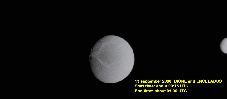
Dione_and_Enceladus-N00119781-N00119798.gifRush! (GIF-Movie; credits: Elisabetta Bonora)87 visitenessun commentoMareKromium
|
|
| 2243 immagini su 187 pagina(e) |
 |
|
|
|
|
21 | |
|
|
|
|








