Saturn: the "Ringed Beauty" and His Moons
|
|
|
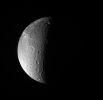
Dione-PIA09886~0.jpgJaniculum Dorsa70 visiteCaption NASA:"The Cassini spacecraft looks down, almost directly at the North Pole of Dione. The feature just left of the Terminator at bottom is Janiculum Dorsa, a long, roughly North-South trending ridge.
Lit terrain seen here is on the anti-Saturn and trailing sides of Dione (1126 Km, or approx. 700 miles across).
This image was taken with the Cassini spacecraft narrow-angle camera on March 22, 2008 using a spectral filter sensitive to wavelengths of ultraviolet light centered at 338 nanometers. The view was acquired at a distance of approx. 650.000 Km (about 404.000 miles) from Dione and at a Sun-Dione-Spacecraft, or phase, angle of 99°.
Image scale is roughly 4 Km (about 2 miles) per pixel".MareKromium
|
|

Dione-PIA10409.jpgDione (MULTISPECTRUM-2; credits: Lunexit)77 visiteCaption NASA:"The bright fractures on Dione's Trailing Side slice across terrain that is darker than the rest of the surface. Cassini scientists are working to understand the nature of the dark material that appears to coat the surfaces of several of Saturn's moons. Only after the Cassini Spacecraft began imaging Dione did they realize that the prominent "streaks" shown here are fractures on the surface.
Lit terrain seen here is on the Saturn-Facing Side of Dione. North is up.
The image was taken in visible light with the Cassini spacecraft narrow-angle camera on May 17, 2008. The view was acquired at a distance of approx. 873.000 Km (such as about 543.000 miles) from Dione and at a Phase Angle of 47°.
Image scale is roughly 5 Km (a little less than 3 miles) per pixel".MareKromium
|
|
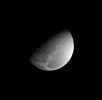
Dione-PIA10431.jpgDione65 visiteCaption NASA:"This Cassini Spacecraft view, taken from a vantage point 64° above Dione's Equator, looks down onto the bright fractures that cover the moon's Trailing Side. The fractures crisscross a region of terrain that is significantly darker than the rest of the moon's surface. Dione is approx. 1123 Km (about 698 miles) across.
The image was taken in visible light with the Cassini spacecraft narrow-angle camera on June 15, 2008. The view was obtained at a distance of approx. 601.000 Km (such as about 374.000 miles) from Dione and at a Sun-Dione-Spacecraft, or Phase, Angle of 76°. Image scale is roughly 4 Km (a little more than 2 miles) per pixel".MareKromium
|
|
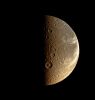
Dione-PIA10458.jpgDione (possible True Colors; credits: Lunexit)64 visiteCaption NASA:"Bright, wispy-looking fractures reach across the rugged, icy landscape of Dione (see PIA06163 for a close-up view of Dione's icy canyons). The medium-sized crater Dido, with its prominent central peak, sits just right of the Terminator, below center.
This view looks toward the Saturn-facing Side of Dione. North is toward the top and rotated 6° to the left.
The image was taken in visible light with the Cassini Spacecraft narrow-angle camera on July 21, 2008. The view was acquired at a distance of approx 290.000 Km (such as about 180.000 miles) from Dione and at a Sun-Dione-Spacecraft, or Phase, Angle of 89°.
Image scale is roughly 2 Km (a little more than 1 mile) per pixel".MareKromium
|
|

Dione-PIA10496.jpgThe Bright Canyons of Dione77 visiteCaption NASA:"Dione's defining feature, the fractures on its Trailing Side, shine brilliantly in this Cassini Spacecraft view.
The view was acquired from a position 33° South of the moon's Equator. Lit terrain seen here is on the Trailing Side of Dione (approx. 1123 Km, or about 698 miles across). North is up and rotated 8° to the right.
The image was taken in visible light with the Cassini spacecraft narrow-angle camera on Sept. 11, 2008. The view was obtained at a distance of approximately 833,000 kilometers (517,000 miles) from Dione and at a Phase Angle of 67°. Image scale is about 5 Km (a little more than 3 miles) per pixel.
The image was taken with the Cassini Spacecraft wide-angle camera on Aug. 26, 2008 using a spectral filter sensitive to wavelengths of infrared light centered at 752 nanometers.
The view was acquired at a distance of approx. 397.000 Km (about 246.000 miles) from Saturn.
Image scale is roughly 20 Km (about 13 miles) per pixel".MareKromium
|
|

Dione-PIA10500.jpgCross-Worlds: the Answer!69 visiteRicordate la sequenza (intitolata, appunto, Cross-Worlds) che pubblicammo qualche settimana fa (era il 14 Settembre 2008, per l'esattezza) e che ci mostrava (ovviamente nell'ottica di CASSINI) Dione mentre eclissava un'altra Luna non identificata?
Noi ipotizzammo che si potesse trattare di Mimas o di Encelado. La NASA, oggi, tramite il suo Planetary Photojournal, ci ha risposto: si trattava di Encelado.
Un grazie alla NASA (che, quando vuole, sa anche rispondere) ed un 6+ a noi perchè, anche se non siamo riusciti ad identificare con sicurezza assoluta la seconda luna "misteriosa" in transito, siamo stati comunque abbastanza bravi dal ridurre la rosa dei "candidati" a due soli Corpi Celesti.
Insomma...Non male!MareKromium
|
|
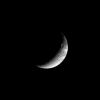
Dione-PIA10577.jpgCrescent Dione82 visiteCaption NASA:"This high-phase view of Dione shows the great contrast between the highly reflective "wisps" and the surrounding terrain. These wispy lines are geologically young fractures exposing the icy surface of the moon.
Lit terrain seen here is on the Trailing Hemisphere of Dione (about 1123 Km, or approx. 698 miles, across). North on Dione is up.
The view was acquired from a position 39° South of the moon's Equator. The image was taken in Visible Light with the Cassini Spacecraft narrow-angle camera on Dec. 26, 2008. The view was obtained at a distance of approx. 789.000 Km (about 490.000 miles) from Dione and at a Sun-Dione-spacecraft, or Phase, Angle of 124°
Image scale is roughly 5 Km (about 3 miles) per pixel".MareKromium
|
|

Dione-PIA11471.jpgCosmic "Smile"...158 visiteCaption NASA:"Only a sliver of Dione is visible as the Cassini Spacecraft looks at the dark side of the moon. In a high-phase viewing geometry like the one in which this picture was taken, the Sun and the Spacecraft are on nearly opposite sides of the moon. Here, only a narrow crescent reflects light forward toward Cassini's camera. The outline of a crater is just visible in the Southern Hemisphere.
This view looks toward the Leading Hemisphere of Dione. North on Dione is up and rotated 2° to the right. The image was taken in Visible Light with the Cassini Spacecraft narrow-angle camera on Feb. 25, 2009.
The view was acquired at a distance of approx. 484.000 Km (such as about 301.000 miles) from Dione and at a Sun-Dione-Spacecraft, or Phase, Angle of 166°.
Image scale is roughly 3 Km (a little less than 2 miles) per pixel".MareKromium
|
|

Dione-PIA11532.jpgWispy Dione66 visiteCaption NASA:"The Cassini Spacecraft looks toward the wispy, fractured terrain of the Trailing Hemisphere of the moon Dione.
To learn more about Dione's "Wisps", see also PIA08960.
Lit Terrain seen here is on the Trailing Hemisphere of Dione (about 1123 Km, or approx. 698 miles across). North on Dione is up and rotated 29° to the right.
The image was taken in visible light with the Cassini Spacecraft narrow-angle camera on May 26, 2009. The view was acquired at a distance of approx. 1,3 MKM (about 808.000 miles) from Dione and at a Sun-Dione-Spacecraft, or Phase, Angle of 35°.
Image scale is roughly 8 Km (about 5 miles) per pixel".MareKromium
|
|
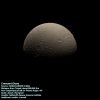
Dione-PIA11546.jpgCrescent Dione (Natural Colors; credits: Lunexit)65 visiteCaption NASA:"A large Impact Basin dominates the high Southern Latitudes of Saturn's moon Dione (see also PIA09821 to learn more from a similar image). Lit Terrain seen here is on the anti-Saturn side of Dione (such as the side that never faces Saturn). North on Dione is on the left and rotated 14° towards the upper side of the moon.
The image was taken in Visible Green Light with the Cassini Spacecraft narrow-angle camera on May 25, 2009.
The view was acquired at a distance of approx. 680.000 Km (such as about 420.000 miles) from Dione and at a Sun-Dione-Spacecraft, or Phase, Angle of 68°.
Image scale is 4 Km (about 2,5 miles) per pixel".MareKromium
|
|
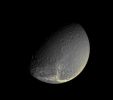
Dione-PIA11565.jpgDione67 visiteCaption NASA:"The Cassini Spacecraft looks down on the North Pole of Dione and the fine fractures that cross its Trailing Hemisphere.
The North Pole of Dione lies on the Terminator between shadow and light, about halfway down the left side of the image. This view is centered at 66° North Lat. and 224° West Long.
Lit terrain seen here is on the Trailing Hemisphere and anti-Saturn side of Dione. To learn more about Dione's fractures, see PIA09764.
The image was taken in Visible Light with the Cassini Spacecraft narrow-angle camera on July 11, 2009. The view was obtained at a distance of approx. 429.000 Km (such as about 267.000 miles) from Dione and at a Sun-Dione-Spacecraft, or Phase, Angle of 67°.
Image scale is roughly 3 Km (a little less than 2 miles) per pixel".MareKromium
|
|

Dione-PIA12529.jpgCrescent Dione (possible Natural Colors; credits: Dr Paolo C. Fienga - Lunexit Team)75 visiteCaption NASA:"The tortured Terrain of Saturn's moon Dione is documented in this Cassini Spacecraft image.
The wispy fractures on the moon's Trailing Hemisphere can be seen on the left of the image, and Cratered Terrain on the moon's anti-Saturn side dominates the center of the image. North on Dione is up.
The image was taken in Visible Light with the Cassini Spacecraft narrow-angle camera on Nov. 23, 2009. The view was acquired at a distance of approx. 896.000 Km (such as about 557.000 miles) from Dione and at a Sun-Dione-Spacecraft, or Phase, Angle of 81°.
Image scale is roughly 5 Km (a little more than 3 miles) per pixel".MareKromium
|
|
| 2243 immagini su 187 pagina(e) |
 |
|
|
|
|
20 | |
|
|
|
|








