Saturn: the "Ringed Beauty" and His Moons
|
|
|
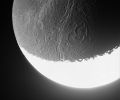
Dione-PIA08266.jpgThe Night-Side of Dione, in the Saturnshine64 visiteCaption NASA originale:"Cassini whizzed past Dione on Aug. 16, 2006, capturing this slightly motion-blurred view of the moon's fractured and broken landscape in reflected light from Saturn. The motion blur is a result of the long exposure time used to capture dim light from the moon's night side.
The many canyons on Dione rip through more ancient craters. Some medium-sized craters, like the one right of center, have several others overprinted onto them. This view shows southern terrain on the moon's Trailing Hemisphere. The gleaming, sunlit crescent is overexposed at bottom. North is up.
The image was taken in visible light with the Cassini spacecraft narrow-angle camera at a distance of approx. 157.000 Km (about 98.000 miles) from Dione and at a Sun-Dione-spacecraft angle of 129°.
Image scale is about 935 mt (roughly 3.067 feet) per pixel".
|
|

Dione-PIA08293.jpgThe "wrinkled Face" of Dione71 visiteCaption NASA:"Bright fractures creep across the surface of icy Dione. This extensive canyon system is centered on a region of terrain that is significantly darker than the rest of the moon. Part of the darker terrain is visible at right.
Lit terrain in this view is on the Saturn-Facing Hemisphere of Dione.
North is up and rotated 8° to the left.
The image was taken in visible light with the Cassini spacecraft narrow-angle camera on Sept. 25, 2006 at a distance of approx. 677.000 Km (such as 421.000 miles) from Dione and at a Sun-Dione-spacecraft, or phase, angle of 62°.
Image scale is roughly 4 Km (about 2,5 miles) per pixel".
|
|

Dione-PIA08839.jpgThe "fractured face" of Dione74 visiteCaption NASA:"The fractured terrain so distinctive to Dione curves away toward the South in this view, which looks down at the moon's Northern Hemisphere.
Lit terrain in this view is on the Saturn-Facing Hemisphere of Dione.
The image was taken in visible light with the Cassini spacecraft narrow-angle camera on Nov. 22, 2006 at a distance of approx. 943.000 Km (about 586.000 miles) from Dione and at a Sun-Dione-spacecraft, or phase, angle of 109°.
Image scale is roughly 6 Km (a little less than 4 miles) per pixel".MareKromium
|
|
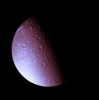
Dione-PIA08856.jpgDione's Terminator (false colors - elab. Lunexit)66 visitenessun commentoMareKromium
|
|

Dione-PIA08938.jpgThe South Polar Regions of Dione65 visiteCaption NASA:"The Cassini spacecraft takes in the crater-strewn surface near Dione's South Pole in this natural color view. Long fractures slice across the surface here, as on other parts of the moon. Previous Cassini imaging investigations have shown that the canyons seen here do not appear to have the bright, presumably youthful, walls seen in fractures nearer the Equator.
Images taken using red, green and blue spectral filters were combined to create this natural color view. The images were taken in visible light with the Cassini spacecraft narrow-angle camera on April 8, 2007 at a distance of approx. 268.000 Km (such as about 166.000 miles) from Dione and at a Sun-Dione-spacecraft, or phase, angle of 92°.
Image scale is roughly 2 Km (5249 feet) per pixel".MareKromium
|
|

Dione-PIA09764.jpgThe "spiderweb like" streaks on Dione69 visiteCaption NASA:"Bright, wispy fractures streak across Dione's trailing side. Following the Voyager flybys of the early 80s, scientists considered the possibility that the streaks were bright material extruded by cryovolcanism. A quarter-century later, Cassini's close passes and sharp vision showed these features to be a system of braided canyons with bright walls.
North on Dione is up.
The image was taken in visible light with the Cassini spacecraft wide-angle camera on Sept. 30, 2007. The view was acquired at a distance of approx. 45.000 Km (such as about 28.000 miles) from Dione and at a Sun-Dione-spacecraft, or phase, angle of 36°.
Image scale is roughly 3 Km (about 2 miles) per pixel".MareKromium
|
|

Dione-PIA09772.jpgThe "Face" of Dione (HR)76 visiteCaption NASA:"Canyons slink southward on Dione, while bright-walled craters gleam in the Sun. (...) This view is centered on 9° North Latitude and 51° West Longitude.
North on Dione is up.
The image was taken in polarized green light with the Cassini spacecraft narrow-angle camera on Sept. 30, 2007. The view was acquired at a distance of approx. 197.000 Km (such as about 122.000 miles) from Dione and at phase angle of 25°.
Image scale is roughly 1 Km (about 0,6 mile) per pixel".MareKromium
|
|

Dione-PIA09801.jpgWhite Scars...76 visiteCaption NASA:"The Cassini spacecraft catches a glimpse of the bright fractures that adorn the Trailing Side of icy Dione.
North on Dione (1126 kilometers, or about 700 miles across) is up.
The image was taken in visible light with the Cassini spacecraft narrow-angle camera on Nov. 18, 2007. The view was obtained at a distance of approx. 1 MKM (such as about 623.000 miles) from Dione and at a Sun-Dione-spacecraft, or phase, angle of 45°.
Image scale is roughly 6 Km (about 4 miles) per pixel".MareKromium
|
|

Dione-PIA09821.jpgDione (HR)64 visiteCaption NASA:"The Cassini spacecraft surveys the Southern Hemisphere on Dione's anti-Saturn side, spying a broad impact basin near bottom.
Most of the medium-sized craters visible here have pointed central peaks, owing to the rebound of material following the craters' initial formation.
(in this picture) North on Dione is up.
The image was taken in visible light with the Cassini spacecraft narrow-angle camera on Dec. 19, 2007. The view was obtained at a distance of approx. 240.000 Km (such as about 149.000 miles) from Dione and at a Sun-Dione-spacecraft, or phase, angle of 44°.
Image scale is roughly 1 Km (about 0,6 mile) per pixel".MareKromium
|
|

Dione-PIA09838.jpgDione (MULTISPECTRUM-2; credits: Lunexit)64 visiteCaption NASA:"The Cassini Spacecraft looks down from high latitude over Dione and the system of wispy fractures that coats the moon's Trailing Side.
This view looks toward Dione from 43° above the Equator. North is up.
The image was taken in visible light with the Cassini Spacecraft narrow-angle camera on Jan. 14, 2008. The view was acquired at a distance of approx. 938.000 Km (such as about 583.000 miles) from Dione and at a Sun-Dione-Spacecraft angle of 54°.
Image scale is roughly 6 Km (a little less than 4 miles) per pixel".MareKromium
|
|
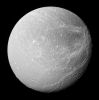
Dione-PIA09861.jpgDione75 visiteCaption NASA:"This southerly view of Dione shows enormous canyons extending from Mid-Latitudes on the Trailing Hemisphere, at right, to the moon's South Polar Region.
This view looks toward the Saturn-facing side of Dione (about 1126 Km, or 700 miles across) and is centered on 22° South Latitude, 359° West Longitude. North on Dione is up; the moon's south pole is seen at bottom.
The image was taken in visible light with the Cassini spacecraft narrow-angle camera on Feb. 8, 2008. The view was obtained at a distance of approx. 211.000 Km (such as about 131.000 miles) from Dione and at a Sun-Dione-Spacecraft, or phase, angle of 20°.
Image scale is roughly 1 Km (0,6 mile) per pixel".MareKromium
|
|
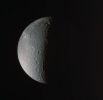
Dione-PIA09886.jpgThe North Polar Regions of Dione (True Colors; credits: Lunexit)74 visiteCaption NASA:"The Cassini Spacecraft looks down, almost directly at the North Pole of Dione. The feature just left of the Terminator at the bottom is Janiculum Dorsa, a long, roughly North-South trending ridge. Lit terrain seen here is on the anti-Saturn and Trailing Sides of Dione.
The image was taken with the Cassini spacecraft narrow-angle camera on March 22, 2008 using a spectral filter sensitive to wavelengths of UV light centered at 338 nanometers. The view was acquired at a distance of approx. 650.000 Km (about 404.000 miles) from Dione and at a Sun-Dione-Spacecraft angle of 99°.
Image scale is roughly 4 Km (about 2 miles) per pixel".MareKromium
|
|
| 2243 immagini su 187 pagina(e) |
 |
|
|
|
|
19 | |
|
|
|
|








