| |

Saturn: the "Ringed Beauty" and His Moons
|
|
|

The_Rings-PIA11663.jpgShadow of a "Vertical Structure" in the "F"-Ring71 visiteCaption NASA:"Cassini spies a shadow cast by a vertically extended structure or object in the F-Ring in this image taken as Saturn approaches its August 2009 Equinox.
The structure can be seen as a bulge near the bright core of the Ring on the right of the image. Imaging scientists are working to understand the origin of structures such as this one, but they think this image shows the shadow of what appears to be a vertically extended object in the core of the "F"-Ring.
The second (bottom) version of the image has been brightened to enhance the visibility of the Ring and shadow. Background stars appear elongated in the image because of the camera's exposure time.
This view looks toward the sunlit side of the Rings, from about 54° below the Ring-Plane.
The image was taken in Visible Light with the Cassini Spacecraft narrow-angle camera on June 9, 2009. The view was obtained at a distance of approx. 592.000 Km (about 368.000 miles) from Saturn and at a Sun-Saturn-Spacecraft, or Phase, Angle of 97°. Image scale is roughly 3 Km (a little less than 2 miles) per pixel".MareKromium
|
|

The_Rings-PIA11664.jpgSpiral Corrugation across the C and D-Rings81 visiteCaption NASA:"Alternating light and dark bands, extending a great distance across Saturn’s D and C-Rings, are shown here in these Cassini images taken one month before the Planet’s August 2009 Equinox.
The C-Ring stretches across the upper left and middle of the image. The D-Ring is barely visible amid the noise in the lower right of the image.
The periodic brightness variations in the Rings have a subtler, narrow appearance in this mosaic of three Cassini images than other larger features of the Rings, such as the Columbo Gap which appears as a black arc on the left of the center frame of the mosaic. These brightness variations are almost certainly caused by the changing slopes in the rippled Ring-Plane, much like the corrugations of a tin roof.
Although previous Cassini observations (see PIA08325) had revealed corrugations in the D-Ring extending over 500 miles (about 800 Km), this image shows these features extending for 6200 miles (about 10.000 Km) into the C-Ring.
Later Equinox images revealed the true dimension of this Corrugation, extending completely across the C ring, right up to the inner B-Ring edge for a total breath of about 17.000 Km (approx. 11.000 miles) -- see PIA11670 and PIA11671.
This and other new imagery supports earlier evidence that something dramatic happened in the early 1980s to initiate this feature.
In 2006, imaging scientists speculated that a collision with a comet or asteroid may have disturbed the D-Ring. That explanation seems less likely now that this and other new images show the effect spread over a much broader radial range, extending right up to the inner B-Ring. Scientists continue to investigate the cause of this disturbance.
Whatever caused the corrugation apparently tilted a vast region of the inner rings relative to Saturn’s gravitational field in a relatively short period of time during the early 1980s. In the intervening years, the natural tendency for inclined orbits to systematically and slowly wobble at different rates, depending on their distance from Saturn, has created a tightly wound spiral corrugation in the Ring-Plane.
This view looks toward the unilluminated side of the Rings from about 24° above the Ring-Plane.
The D-Ring has been brightened relative to C-Ring to enhance visibility.
The images were taken in Visible Light with the Cassini Spacecraft narrow-angle camera on July 11, 2009. The view was acquired at a distance of approx. 470.000 Km (about 292.000 miles) from Saturn and at a Phase Angle of 25°.
Image scale is roughly 2 Km (about 1,25 miles) per pixel".MareKromium
|
|

The_Rings-PIA11665.jpgSmall Object in the "B"-Ring73 visiteCaption NASA:"The Cassini Spacecraft captured this image of a small object in the outer portion of Saturn's "B"-Ring casting a shadow on the Rings as Saturn approaches its August 2009 Equinox.
This new moonlet, situated about 300 miles (approx. 480 Km), inward from the outer edge of the "B"-Ring, was found by detection of its shadow which stretches 25 miles, or about 41 Km, across the Rings.
The shadow length implies the moonlet is protruding about 660 feet, or 200 meters, above the Ring-Plane.
If the moonlet is orbiting in the same plane as the ring material surrounding it, which is likely, it must be about 1300 feet, or 400 meters, across.
This object is not attended by a Propeller feature, unlike the band of moonlets discovered in Saturn's "A"-Ring earlier by Cassini (see PIA07792 and PIA06196). The "A"-Ring moonlets, which have not been directly imaged, were found because of the propeller-like narrow gaps on either side of them that they create as they orbit within the Rings. The lack of a propeller feature surrounding the new moonlet is likely because the "B"-Ring is dense, and the ring material in a dense ring would be expected to fill in any gaps around the moonlet more quickly than in a less dense region like the mid-"A"-Ring. Also, it may simply be harder in the first place for a moonlet to create propeller-like gaps in a dense ring.
Straw-like patterns of clumping ring material are also visible along the edge of the outer "B"-Ring near the right of this image. See PIA09855 to learn more about these features.
This image and others like it (see PIA11656 and PIA11659) are only possible around the time of Saturn's Equinox which occurs every half-Saturn-year (equivalent to about 15 Earth years). The illumination geometry that accompanies Equinox lowers the Sun's angle to the Ring-Plane and causes out-of-plane structures to cast long shadows across the Rings.
This view looks toward the sunlit side of the Rings from about 42° below the Ring-Plane. Background stars are visible on the right of the image. They appear elongated by the camera's exposure time.
The image was taken in Visible Light with the Cassini Spacecraft narrow-angle camera on July 26, 2009. The view was obtained at a distance of approx. 296.000 Km (such as about 184.000 miles) from Saturn and at a Sun-Saturn-Spacecraft, or Phase, Angle of 120°.
Image scale is roughly 1 Km (4680 feet) per pixel".MareKromium
|
|

The_Rings-PIA11666.jpgFrom "F" to "A"!66 visiteCaption NASA:"A vertically extended Structure or Object in Saturn's "F"-Ring casts a shadow long enough to reach the "A"-Ring in this Cassini image taken just days before Planet's August 2009 Equinox.
The structure can be seen as a bulge within the bright core of the "F"-Ring on the left of the image. The structure rises far enough above the Ring-Plane for the shadow to be cast across the Roche Division and onto the "A"-Ring. The shadow is barely visible stretching across the top right quadrant of the image. The shadow appears very faint here because this view looks toward the unlit side of the Rings.
This image and others like it (see PIA11662 and PIA11663) are only possible around the time of Saturn's equinox which occurs every half-Saturn-year (equivalent to about 15 Earth years). The illumination geometry that accompanies equinox lowers the sun's angle to the ring plane and causes out-of-plane structures to cast long shadows across the Rings.
Exact equinox at Saturn begins August 11, 2009, and lasts about 4 days. Shadows have grown longer as those days draw near. Cassini's cameras have spotted not only the predictable shadows of some of Saturn's moons (see PIA11657), but also the shadows of newly revealed Vertical Structures in the Rings themselves (see PIA11654).
The "A"-Ring in the first (top) image has been brightened relative to "F"-Ring to enhance visibility of the ring and shadow. The entire image in the second (bottom) version has been contrast enhanced. Bright specks in the image are background stars.
This view looks toward the unilluminated side of the Rings from about 28° above the Ring-Plane.
The image was taken in Visible Light with the Cassini Spacecraft narrow-angle camera on July 30, 2009. The view was obtained at a distance of approx. 1,8 MKM (about 1,1 MMs) from Saturn and at a Sun-Saturn-Spacecraft, or Phase, Angle of 96°.
Image scale is roughly 10 Km (a little more than 6 miles) per pixel".MareKromium
|
|
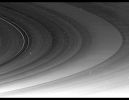
The_Rings-PIA11671.jpgInner B-Ring "Terminus" and Spiral Corrugation69 visiteCaption NASA:"This mosaic of Cassini images, part of a larger mosaic of images captured just hours before exact Equinox at Saturn, shows that the "Spiral Corrugation" in the Planet’s Inner Rings continues right up to the inner B-Ring: an unexpected result that scientists are working to understand.
The inner B-Ring boundary is visible on the right. The C-Ring’s Maxwell Gap, demarcated by two bright arcs in this view, is on the left.
The larger mosaic shows a gently undulating pattern stretching from the D-Ring to inner B-Ring (see PIA11670).
An earlier mosaic, captured in June, showed the corrugation extending only as far as the middle of the C-Ring (see PIA11664).
The periodic brightness variations in this corrugation are most likely caused by the changing slopes in the rippled Ring-Plane, much like the corrugations of a tin roof. Although previous Cassini observations (see PIA08325) had revealed corrugations in the D-Ring extending over 500 miles (about 800 Km), this image now shows these features extending beyond their origin in the D-Ring for 11.000 miles (approx. 17.000 Km) into the C-Ring.
This new imagery supports earlier evidence that something happened in the early 1980s to generate this feature.
In 2006, imaging scientists speculated that a collision with a comet or asteroid may have disturbed the D-Ring. That explanation seems less likely now that this new image shows the effect spread over a much broader radial range, extending completely across the C-Ring, and scientists are continuing to investigate the cause of this disturbance.
Whatever created the corrugation apparently tilted a vast region of the Inner Rings relative to Saturn’s gravitational field in a relatively short period of time during the early 1980s.
In the intervening years, the natural tendency for inclined orbits to systematically and slowly wobble at different rates, depending on their distance from Saturn, has created a tightly wound spiral corrugation in the Ring-Plane.
This view and others like it are only possible around the time of Saturn’s Equinox which occurs every half-Saturn-year (equivalent to about 15 Earth years). Exact Equinox is when the Sun is directly overhead at the Equator. The illumination geometry that accompanies equinox lowers the Sun’s angle to the Ring-Plane, significantly darkens the Rings and causes out-of-plane structures to cast long shadows across the Rings.
Cassini’s cameras have spotted not only the predictable shadows of some of Saturn’s moons (see PIA11657), but also the shadows of newly revealed vertical structures in the Rings themselves (see PIA11665).
This view looks toward the southern side of the Rings from about 4° below the Ring-Plane. Background stars are visible shining through the Rings, and the image has not been cleaned to remove Cosmic Rays, which struck the camera’s detector during the exposures.
The image was taken in Visible Light with the Cassini Spacecraft narrow-angle camera on Aug. 10, 2009. The view was acquired at a distance of approx. 888.000 Km (about 552.000 miles) from Saturn and at a Sun-Saturn-Spacecraft, or Phase, Angle of 157°.
Image scale is roughly 5 Km (a little more than 3 miles) per pixel".MareKromium
|
|

The_Rings-PIA11674.jpgRocky-Rain on the Rings80 visiteCaption NASA:"The bright Streaks visible in these Cassini images taken during Saturn’s August 2009 Equinox are exciting evidence of a constant rain of interplanetary projectiles onto the Planet’s Rings.
Objects, each estimated to be one meter (3 feet) in size and traveling tens of kilometers per second (tens of thousands of miles per hour), likely smashed into the Rings and created elevated clouds of tiny particles that have been sheared out, or elongated and tilted, by orbital motion into bright streaks.
The image on the left shows an impact in the A-Ring. The Streak stretches from the right of the image to the middle, and it does not quite follow the arc of the Rings. The brightest part of that Streak is about 5000 Km (approx. 3100 miles) long (its azimuthal dimension) and about 200 Km (approx. 120 miles) wide (its radial extent, tip to tip) in this image.
The image on the right shows an impact into the C-Ring. This Streak is much smaller than the A-Ring Streak, and it appears on the right of the image. The brightest part of this Streak is approx. 200 Km (about 120 miles) long (its azimuthal dimension) and approx. 10 Km (about 6 miles) wide (its radial dimension, tip to tip) in this image.
By the brightness and dimensions of the Streaks, scientists estimate the impactor sizes at roughly one meter (3 feet), and the elapsed time since impact at one to two days. These Equinox data lend more confidence to a Cassini imaging observation made in 2005 of similar Streaks seen in the C-Ring (see PIA11675).
All together, these observations constitute the visual confirmation of a long-held belief that bits of interplanetary debris continually rain down on Saturn’s Rings and contribute to the Rings’ erosion and evolution.
Although the phase angle of these images is not the best for seeing clouds of small particles, these ejecta clouds are easily seen because very little sunlight is falling on the Rings during the exceedingly low Sun-angle condition prevalent during the four days surrounding exact Saturn Equinox.
Exact Equinox is when the sun is directly overhead at the Equator. A cloud of dust rising above the dark Ring-Plane is more directly catching the Sun’s rays, and is hence well lit and easily visible by contrast.
When the Ring background is at its usual brightness, impacts such as these are very difficult to detect.
The view of the A-Ring Streak on the left looks toward the northern side of the Rings from about 20° above the Ring-Plane. The image was taken in Visible Light with the Cassini Spacecraft narrow-angle camera on Aug. 13, 2009. The view was obtained at a distance of approx. 1,2 MKM (about 746.000 miles) from Saturn and at a Phase Angle of 87°.
Image scale is 7 kilometers (4 miles) per pixel.
The view of the C-Ring Streak on the right looks toward the southern side of the Rings from about 22° below the RingPlane. The image was taken in Visible Light with the Cassini Spacecraft narrow-angle camera on Aug. 11, 2009. The view was obtained at a distance of approx. 263.000 Km (about 164.000 miles) from Saturn and at a Phase Angle of 135°.
Image scale is roughly 1 Km (4007 feet) per pixel".MareKromium
|
|

The_Rings-PIA12512.jpgThe "E-Ring"69 visiteCaption NASA:"The Cassini Spacecraft takes a look at Saturn's diffuse E-Ring which is formed from icy material spewing out of the South Pole of the moon Enceladus (see PIA08921 to learn more about how Enceladus creates the E-Ring). The E-Ring is seen nearly edge-on from slightly above the Northern Side of Saturn's Ring-Plane.
The image was taken in Visible Light with the Cassini Spacecraft wide-angle camera on Oct. 23, 2009. The view was acquired at a distance of approx. 2,5 MKM (such as about 1,6 MMs) from Saturn.
Image scale is roughly 149 Km (approx. 92 miles) per pixel".MareKromium
|
|

The_Rings-PIA12518.jpgWithin the Rings (Natural Colors; credits: NASA/JPL/Space Science Institute)71 visiteCaption NASA:"Saturn's moon Epimetheus casts a shadow across the colourful Rings of Saturn, in this image taken before the Planet's August 2009 Equinox.
Epimetheus (approx. 113 Km, or about 70 miles across) is visible as a small dot at the center of the bottom of the image.
The novel illumination geometry that accompanies Equinox lowers the Sun's angle to the Ring-Plane, significantly darkens the Rings, and causes out-of-plane structures to look anomalously bright and cast shadows across the Rings. These scenes are possible only during the few months before and after Saturn's Equinox, which occurs only once in about 15 Earth years. Before and after Equinox, Cassini's cameras have spotted not only the predictable shadows of some of Saturn's moons (see PIA11657), but also the shadows of newly revealed Vertical Structures in the Rings themselves (see PIA11665).
Images taken using red, green and blue spectral filters were combined to create this Natural Color view. This view looks toward the southern, sunlit side of the Rings from about 39° below the Ring-Plane.
The images were obtained with the Cassini Spacecraft wide-angle camera on June 8, 2009 at a distance of approx. 725.000 Km (about 450.000 miles) from Saturn.
Image scale is roughly 40 Km (about 25 miles) per pixel".MareKromium
|
|

The_Rings-PIA12766.jpgClump or Impact in the F-Ring107 visiteCaption NASA:"A bright Clump of material within Saturn's tenuous F-Ring stands out near the center top of this Cassini Spacecraft image. This view looks toward the southern, unilluminated side of the Rings from about 1° below the Ring-Plane.
The image was taken in Visible Light with the Cassini Spacecraft narrow-angle camera on Oct. 16, 2010. The view was acquired at a distance of approx. 320.000 Km (about 199.000 miles) from the F-Ring. Image scale is roughly 2 Km (1,242 mile) per pixel".MareKromium
|
|

The_Rings-PIA12820.gifTilting Saturn's Rings (a Computer Animation by NASA/JPL/Cornell)180 visiteCaption NASA:"This animated graphic shows in a series of three images how Saturn's Rings, after they became tilted relative to Saturn's Equatorial Plane, would have transformed into a Corrugated Ring.
Images taken after Saturn's August 2009 equinox from NASA's Cassini Spacecraft revealed alternating light and dark bands extending from Saturn's D-Ring, completely across the C-Rg, and right up to the inner B-Rg Ege. These brightness variations are almost certainly caused by the changing slopes in the rippled Rng-Plane, much like the corrugations of a tin roof.
This series of images shows how such a vertical corrugation can be produced from an initially inclined ring by the natural tendency for inclined orbits to wobble systematically and slowly at different rates, depending on their distance from Saturn. The top image shows a simple inclined ring (the central planet is omitted for clarity), while the lower two images show the same ring at two later times, where the ring particles' wobbling orbits have sheared this inclined sheet into an increasingly tightly-wound spiral corrugation.
Cassini images show the corrugation extends for about 19.000 Km (11.799 miles). Based on detailed studies of this structure, scientists conclude that a broad swath of the Rings became suddenly tilted in the early 1980s, likely because Cometary Debris crashed into them.
The corrugation's radial extent implies that the impacting material was a dispersed cloud of debris instead of a single object. The corrugation's amplitude of about 2 to 20 meters (7 to 60 feet) indicates that the debris' total mass was around 1 Trillion Kg (or 1 Billion Metric Tons)".
MareKromium
|
|

The_Rings-Shadow-N00127580.jpgEclipsing the Rings (1)84 visiteL'impressione iniziale? C'è un (gigantesco!) UFO nei pressi dell'Anello "B" di Saturno!
La realtà? Si tratta dell'ombra, affusolata, di una delle tante lune del Gigante Anellato (onestamente non abbiamo idea di quale sia, ma ci sembra logico pensare ad una Luna Pastore e, vista la forma dell'ombra, a Prometeo od Epimeteo) che, con il suo passaggio davanti al Sole, sta creando e provocando una splendida eclissi su una modestissima porzione degli Anelli di Saturno.
Insomma: "la Natura al lavoro"!MareKromium
|
|

The_Rings-Shadow-N00127581.jpgEclipsing the Rings (2)91 visitenessun commentoMareKromium
|
|
| 2243 immagini su 187 pagina(e) |
|
|
|
|
|
|
|
184 | |
|
|
|
|








