Saturn: the "Ringed Beauty" and His Moons
|
|
|

The_Rings-PIA11489.jpgShadow on the Rings (Natural Colors; credits: Lunar Explorer Italia)70 visitenessun commentoMareKromium
|
|

The_Rings-PIA11498.jpgShadow on the Rings (Natural Colors; credits: Lunar Explorer Italia)71 visiteCaption NASA:"The partial shadow of the moon Tethys demonstrates the variations in density across Saturn's Rings.
As the Cassini Spacecraft looks toward the unilluminated side of the Rings from about 37° above the Ring-Plane, part of Tethys' shadow is seen lying across the A-Ring and Cassini Division. The densest part of the A-Ring and the denser B-Ring let neither sunlight nor the darkness of Tethys' shadow pass through to the Spacecraft's camera, so the moon's shadow appears cut off. The B-Ring instead appears brightly lit here from Saturnshine. Tethys is not shown.
As Saturn approaches its August 2009 Equinox, the planet's moons cast shadows onto the Rings. (...)
The image was taken in Visible Light with the Cassini Spacecraft wide-angle camera on April 17, 2009. The view was obtained at a distance of approx. 1,3 MKM (about 808.000 miles) from Saturn and at a Phase Angle of 120°.
Image scale is roughly 75 Km (about 47 miles) per pixel".MareKromium
|
|
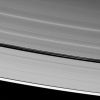
The_Rings-PIA11502.jpgEncke Ringlets79 visiteAlthough Saturn's moon Pan is absent from this image of the A-Ring's Encke Gap, the moon's handiwork is still displayed.
The two ringlets seen in the gap are maintained by the gravitational action of Pan (about 28 Km, or approx. 17 miles across). To learn more about this process, see also PIA07528.
The point of light near the bottom of the image is a star.
This view looks toward the unilluminated side of the Rings from about 41° above the Ring-Plane. The image was taken in Visible Light with the Cassini Spacecraft narrow-angle camera on April 17, 2009. The view was obtained at a distance of approx. 1,3 MKM (about 808.000 miles) from Saturn and at a Sun-Saturn-Spacecraft, or Phase, Angle of 115°.
Image scale is roughly 8 Km (about 5 miles) per pixel.MareKromium
|
|

The_Rings-PIA11504.jpgGravity-induced "Ondulations"71 visiteCaption NASA:"Saturn's moon Daphnis gives a scalloped look to the edge of the A-Ring as the moon orbits within the Keeler Gap.
Daphnis is the bright spot in the narrow gap near the center of the image. Since the gap is not much larger than the moon, the small moon's gravity is great enough to perturb the particles in the Ring and create the wavelike patterns seen here. See also PIA09850 to learn more.
This view looks toward the unilluminated side of the Rings from about 61° above the Ring-Plane. The image was taken in Visible Light with the Cassini Spacecraft narrow-angle camera on April 30, 2009. The view was acquired at a distance of approx. 1,5 MKM (such as about 932.000 miles) from Daphnis and at a Sun-Daphnis-Spacecraft, or Phase, angle of 73°.
Image scale is roughly 9 Km (a little less than 6 miles) per pixel".MareKromium
|
|

The_Rings-PIA11539.jpgShadowing the "Gap"...70 visiteCaptin NASA:"The shadow of the moon Tethys is cast onto Saturn's "A"-Ring, almost blanketing the Enke Gap.
The novel illumination geometry created as Saturn approaches its August 2009 Equinox allows moons orbiting in or near the plane of Saturn's equatorial rings to cast shadows onto the Rings.
These scenes are possible only during the few months before and after Saturn's Equinox which occurs only once in about 15 Earth years. To learn more about this special time and to see a movie of a moon's shadow moving across the rings, see PIA11651 and PIA11660.
This view looks toward the sunlit side of the Rings from about 29° below the Ring-Plane. The image was taken in Visible Light with the Cassini Spacecraft narrow-angle camera on May 25, 2009. The view was acquired at a distance of approx. 759.000 Km (about 472.000 miles) from Saturn and at a Sun-Saturn-spacecraft, or Phase, angle of 56°.
Image scale is roughly 4 Km (about 2,5 miles) per pixel".MareKromium
|
|

The_Rings-PIA11544.jpgShadows on the "B"-Ring (Natural Colors; credits: Lunar Explorer Italia)81 visiteCaption NASA:"The shadow of the moon Epimetheus stretches across the B-Ring in this image taken by Cassini as Saturn approaches its 2009 Equinox. The novel illumination geometry created as Saturn approaches its August 2009 Equinox allows moons orbiting in or near the plane of Saturn's Equatorial Rings to cast shadows onto the Rings.
These scenes are possible only during the few months before and after Saturn's Equinox, which occurs only once in about 15 Earth years.
This view looks toward the sunlit side of the rings from about 42° below the Ring-Plane.
The image was taken in Visible Light with the Cassini Spacecraft narrow-angle camera on June 8, 2009. The view was obtained at a distance of approx. 700.000 Km (about 435.000 miles) from Saturn and at a Sun-Saturn-Spacecraft, or Phase, Angle of 129°.
Image scale is roughly 4 Km (about 2,5 miles) per pixel".MareKromium
|
|

The_Rings-PIA11545.jpgCrooked Shadow (Natural Colors; credits: Lunexit)83 visiteCaption NASA:"The shadow of the moon Mimas strikes the F-Ring at a different angle than the angle at which it is cast on the A-Ring, illustrating differences in the vertical heights of the Rings in this image taken as Saturn approaches its August 2009 Equinox.
The novel illumination geometry that accompanies Equinox lowers the Sun's angle to the Ring-Plane and causes out-of-plane structures to cast long shadows across the Rings. These scenes are possible only during the few months before and after Saturn's Equinox, which occurs only once in about 15 Earth years. To learn more about this special time and to see movies of moons' shadows moving across the Rings, see PIA11651 and PIA11660.
Pan (about 28 Km, or approx. 17 miles across) orbits in the Encke Gap and is visible on the left of the image. The brightness in the lower left of the image is lens flare, a radially extending artifact that results from light being scattered within the camera optics. The shadow of Saturn cuts across the lower right of the image. Two stars can be seen through the Rings. Other bright spots in this image are also background stars.
This view looks toward the unilluminated side of the Rings from about 52° above the Ring-Plane. The image was taken in Visible Light with the Cassini Spacecraft wide-angle camera on June 15, 2009. The view was obtained at a distance of approx. 1,8 MKM (about 1,1 MMs) from Saturn and at a Sun-Saturn-Spacecraft, or Phase, angle of 90°. Image scale is roughly 103 Km (about 64 miles) per pixel".MareKromium
|
|
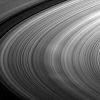
The_Rings-PIA11587.jpgSpokes on the B-Ring69 visiteCaption NASA:"Saturn's B-Ring shows off bright Spokes in the middle of this image taken at high phase.
This image was captured at a Phase Angle of 119°. To learn more about these ghostly radial markings, see PIA10567 and PIA11144.
This view looks toward the northern, sunlit side of the Rings from about 10° above the Ring-Plane. The image was taken in Visible Light with the Cassini Spacecraft narrow-angle camera on Aug. 20, 2009. The view was acquired at a distance of approx. 2,3 MKM (such as about 1,4 MMs) from Saturn.
Image scale is roughly 13 Km (about 8 miles) per pixel".MareKromium
|
|

The_Rings-PIA11600.jpgShadows on the Islands...69 visiteCaption NASA:"The shadows cast by Daphnis' attendant edge waves create a dark, jagged pattern on the A-Ring in this image taken as Saturn approached its August 2009 Equinox.
Daphnis (approx. 8 Km, or about 5 miles across) is a bright dot in the Keeler Gap of the A-Ring just below the center of the image. The moon has an inclined orbit, and its gravitational pull perturbs the orbits of the particles forming the Keeler Gap's edges and sculpts both edges into waves having both horizontal (radial) and out-of-plane components. Material on the inner edge of the gap orbits faster than the moon so that the waves there lead the moon in its orbit. Material on the outer edge moves slower than the moon, so waves there trail the moon. (See also PIA11656 to learn more about this process)
The novel illumination geometry that accompanies Equinox lowers the Sun's angle to the Ring-Plane, significantly darkens the Rings, and causes out-of-plane structures to look anomalously bright and cast shadows across the Rings. These scenes are possible only during the few months before and after Saturn's Equinox, which occurs only once in about 15 Earth years. Before and after Equinox, Cassini's cameras have spotted not only the predictable shadows of some of Saturn's moons (see also PIA11657), but also the shadows of newly revealed vertical structures in the Rings themselves (see, for example, the frame PIA11665).
This view looks toward the Northern, unilluminated side of the Rings, from about 36° above the Ring-Plane.
The image was taken in Visible Light with the Cassini Spacecraft narrow-angle camera on July 28, 2009. The view was obtained at a distance of approx. 1 MKM (about 621.000 miles) from Daphnis.
Image scale is roughly 6 Km (a little less than 4 miles) per pixel".MareKromium
|
|

The_Rings-PIA11658.jpgA Shadow's Traverse81 visiteCaption NASA:"Mimas' shadow traverses the sunlit side of Saturn's Rings in this mosaic showcasing the unusual sights seen at Saturn as the Planet approaches its August 2009 Equinox.
The novel illumination geometry created as the Saturnian System approaches Equinox allows moons orbiting in or near the plane of Saturn's Equatorial Rings to cast shadows onto the Rings. These scenes are possible only during the few months before and after Saturn's Equinox which occurs only once in about 15 Earth years.
Twenty images, each taken 3' and 36" apart, were combined to create this mosaic. Contiguous images were stitched together to create the mosaic showing the whole swath of the Rings across which the moon's shadow passed.
At the beginning of the sequence, the shadow starts on the bright B-Ring. It crosses the darker Cassini Division and then moves to the A-Ring. At the end, the edge of the shadow just catches the edge of the A-Ring, next to blackness of the Roche Division separating the A-Ring from the thin F-Ring.
These images have been processed, and background stars have been removed. To see a movie and mosaic of Mimas' shadow moving across the unlit side of the Rings, see PIA11660.
This view looks toward the sunlit side of the Rings from about 32° below the Ring-Plane. The images were taken in Visible Light with the Cassini Spacecraft narrow-angle camera on April 9, 2009. The view was obtained at a distance of approx. 1,1 MKM (such as about 684.000 miles) from Saturn and at a Sun-Saturn-Spacecraft, or Phase, Angle of 55°.
Image scale is roughly 6 Km (a little less than 4 miles) per pixel".MareKromium
|
|

The_Rings-PIA11659.jpgShadow from the Dark Side91 visiteCaption NASA:"The shadow of Saturn's moon Tethys seems to disappear as it crosses the Planet's Rings, demonstrating variations in the density of particles across the Rings themselves.
These images, which were combined to create a mosaic and a movie, show Saturn's A-Ring on the left, the Cassini Division in the middle and dense outer B-Ring on the right.
The Cassini Spacecraft looks toward the unilluminated side of the Rings in these frames from about 49° above the Ring-Plane.
The densest parts of the B-Ring do not let much sunlight pass through to the Spacecraft's camera. Consequently, one might expect these dense areas to appear dark because they are on the Dark Side of the Rings and also because the moon's shadow is draped across them. However, these dense areas may appear brighter than expected in this geometry most likely from Saturnshine reflecting from them: denser regions should look brighter in Saturnshine than other regions. As a result, the moon's shadow appears cut off and diminished in these areas.
Seventeen images, each taken about 2' and 17" apart, were combined to create this mosaic. Contiguous images were stitched together to create the mosaic showing the whole swath of the Rings across which the moon's shadow passed. Tethys itself is not shown.
The novel illumination geometry created as the Saturnian System approaches Equinox allows moons orbiting in or near the plane of Saturn's Equatorial Rings to cast shadows onto the Rings. These scenes are possible only during the few months before and after Saturn's Equinox which occurs only once in about 15 Earth years. To see similar movie and mosaic of Mimas' shadow moving across the unlit side of the Rings, see PIA11660.
These images have been processed, and background stars have been removed.
The images were taken in Visible Light with the Cassini Spacecraft narrow-angle camera on April 29, 2009. The view was acquired at a distance of approx. 1,3 MKM (such as about 808.000 miles) from Saturn and at a Sun-Saturn-Spacecraft, or Phase, Angle of 52°.
Image scale is roughly 8 Km (about 5 miles) per pixel".MareKromium
|
|

The_Rings-PIA11662.jpgAnother "Vertical Structure" in the "F"-Ring66 visiteCaption NASA:"As Saturn approaches its August 2009 Equinox, a shadow is cast by a narrow, vertically extended feature in the F-Ring.
Scientists are working to understand the origin of structures such as this one, but they think this image may show the shadow of an object on an inclined orbit which has punched through the F-Ring and dragged material along in its path.
The second (bottom) version of the image has been brightened to enhance the visibility of the ring and shadow. Background stars appear elongated in the image because of the camera's exposure time.
This image and others like it (see PIA11663) are only possible around the time of Saturn's Equinox which occurs every half-Saturn-year (equivalent to about 15 Earth years). The illumination geometry that accompanies Equinox lowers the Sun's angle to the Ring-Plane and causes out-of-plane structures to cast long shadows across the Rings. Cassini's cameras have spotted not only the predictable shadows of some of Saturn's moons (see PIA11657), but also the shadows of newly revealed vertical structures in the Rings themselves (see PIA11654).
This view looks toward the unilluminated side of the Rings from about 27° above the RingPlane.
The image was taken in Visible Light with the Cassini Spacecraft narrow-angle camera on June 11, 2009. The view was acquired at a distance of approx. 866.000 Km (about 538.000 miles) from Saturn and at a Sun-Saturn-Spacecraft, or Phase, Angle of 30°. Image scale is roughly 5 Km (a little more than 3 miles) per pixel".MareKromium
|
|
| 2243 immagini su 187 pagina(e) |
 |
|
|
|
|
|
183 | |
|
|
|








