Saturn: the "Ringed Beauty" and His Moons
|
|
|

The_Rings-PIA10561.jpgSpokes in the Rings of Saturn (Natural Colors; credits: Lunar Explorer Italia)71 visiteCaption NASA:"On November 2008 Cassini snapshot showcases a classic view of the triangular shape typical of many of the spokes in Saturn's outer B-Ring. Small particles in the Ring compose the Spokes and these wedge-shaped patterns seem to be appearing more often as Saturn approaches Equinox.
The moons Pan, Pandora and Janus are also visible. Janus is the farthest outside the Rings. Pandora orbits outside the faint F-Ring. Pan is near the top right of the image and can be seen as a faint sphere cutting a path in the thin black strip of the Encke Gap in the A-Ring.
This view looks toward the sunlit side of the rings from about 12° below the Ring-Plane.The image was taken in visible light with the Cassini Spacecraft wide-angle camera on Nov. 10, 2008 at a distance of approx. 1 MKM (about 639.000 miles) from Saturn and at a Phase Angle of 29°.
Image scale is roughly 58 Km (about 36 miles) per pixel".MareKromium
|
|
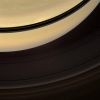
The_Rings-PIA10563.jpgThe Rings of Saturn (Natural Colors; credits: NASA/JPL/Space Science Institute)83 visiteCaption NASA:"Shadows cast onto Saturn by its Rings, visible here as dark bands, move steadily towards the Equator and grow thinner as Equinox approaches.
The Sun will cross Saturn's Ring-Plane on Aug. 10, 2009. Color variations between clouds in the Northern Hemisphere are more apparent than those in the Southern Hemisphere, which seems relatively bland, as Spring arrives in the North and Fall in the South.
Images taken using red, green and blue spectral filters were combined to create this natural color view. The images were acquired with the Cassini spacecraft wide-angle camera on Nov. 22, 2008 at a distance of approx. 859.000 Km (about 533.000 miles) from Saturn and at a Phase Angle of 56°.
Image scale is roughly 48 Km (about 30 miles) per pixel".MareKromium
|
|

The_Rings-PIA10571.jpgThe core of the F-Ring (Natural Colors; credits: Lunar Explorer Italia)71 visiteCaption NASA:"Structure in the tenuous F-Ring can be seen in this image of the ring's bright core.
Much of the structure in the F-Ring is created by its two shepherding moons: Prometheus (about 86 Km, or approx. 53 miles across) and Pandora (about 81 Km, or approx. 50 miles across).
The image was taken in Visible Light with the Cassini Spacecraft narrow-angle camera on Dec. 8, 2008.
The view, which looks down from about 70° above the Ring-Plane toward the unilluminated side of the Rings, was acquired at a distance of approx. 613.000 Km (about 381.000 miles) from Saturn and at a Sun-Saturn-Spacecraft, or Phase, Angle of 77°.
Image scale is roughly 3 Km (a little less than 2 miles) per pixel".MareKromium
|
|

The_Rings-PIA11142.jpgSaturn's Rings: the whole System82 visitenessun commentoMareKromium
|
|

The_Rings-PIA11144.jpgSpokes (natural - but enhanced - colors; credits: Lunar Explorer Italia)114 visiteCaption NASA:"Dark Spokes dance around Saturn's B-Ring in this image taken with Cassini's wide-angle camera.
As Saturn nears Equinox (which will occur in August 2009) and the Sun angle on the Ring-Plane decreases, Spokes become common sights in Cassini images, just as they were in Voyager images. The Planet's orbital period is 29,5 years, so Saturn has nearly made one complete trip around the Sun since the flybys of the two Voyager Spacecraft (1980 and 1981), allowing Cassini to closely match Voyager's viewing geometry.
The Spokes appear dark against Saturn's B-Ring at low phase angles because the particles within them scatter light more efficiently in the forward direction (meaning away from Cassini) than the surrounding larger ring particles. In the opposite viewing geometry, at high phase angles, spokes appear bright relative to surrounding ring particles (See PIA07807).
MareKromium
|
|

The_Rings-PIA11452.jpgSpokes in the B-Ring (Natural Colors; credits: Lunar Explorer Italia)70 visiteCaption NASA:"As Cassini sped around Saturn, the Spacecraft turned to snap this image of bright Spokes giving chase around the B-Ring.
These radial markings are appearing more often as Saturn approaches Equinox (August 2009) (see also PIA11144).
This view looks toward the sunlit side of the rings from about 31° below the Ring-Plane.
The image was taken in visible light with the Cassini Spacecraft wide-angle camera on Feb. 2, 2009. The view was acquired from a distance of approx. 578.000 Km (such as about 359.000 miles) from Saturn and at a Sun-Saturn-Spacecraft, or Phase, Angle of 144°.
Image scale is roughly 30 Km (about 20 miles) per pixel".MareKromium
|
|

The_Rings-PIA11462.jpgGhostly Spokes (Natural Colors; credits: Lunar Explorer Italia)123 visiteCaption NASA:"Faint, ghostly Spokes dapple the dark side of Saturn's A-Ring as the Planet's shadow makes a sharp diagonal cut across this image from Cassini.
The image was taken in Visible Light with the Cassini Spacecraft wide-angle camera on April 30, 2008.
This view looks toward the unilluminated side of the rings from about 26° above the Ring-Plane. The view was obtained at a distance of approx. 316.000 Km (such as about 196.000 miles) from Saturn and at a Sun-Saturn-Spacecraft, or Phase, Angle of 147°. Image scale is roughly 15 Km (about 9 miles) per pixel".MareKromium
|
|
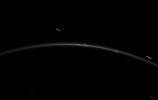
The_Rings-PIA11467.jpgMoonlet in the "G"-Ring82 visiteCaption NASA:"The faint "G"-Ring surrounding Saturn offers up a glimpse of its newfound tiny moonlet. The moonlet is near the center of this image.
A long exposure of 46" was required to capture the light from this tiny object and "G"-Ring, so the moonlet and a few stars have been smeared by motion, the stars showing up as short diagonal dashes.
The moonlet has also been smeared and appears to be a short vertical dash that is aligned with the Ring.
In August 2008 Cassini scientists spotted this moonlet, dubbed S/2008 S 1. It orbits in an arc, or partial ring, within the "G"-Ring. Imaging team scientists estimated the moonlet's diameter at about half a kilometer (one-third mile). For earlier images of this moonlet, see PIA11148.
This view looks toward the unilluminated side of the Rings from about 14° above the Ring-Plane. The image was taken in Visible Light with the Cassini Spacecraft narrow-angle camera on Feb. 20, 2009. The view was acquired at a distance of approx. 1,2 MKM (about 746.000 miles) from Saturn. Image scale is roughly 7 Km (a little more than 4 miles) per pixel".MareKromium
|
|
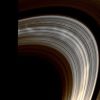
The_Rings-PIA11470.jpgMorning Spokes (Natural Colors; credits: Lunar Explorer Italia)80 visiteCaption NASA:"Bright spokes emerge from behind the shadow of the Planet and into sunlight in this view from the Cassini Spacecraft.
Saturn's long shadow covers the left side of the image. This view looks toward the sunlit side of the Rings from about 22° below the Ring-Plane.
The image was taken in visible light with the Cassini Spacecraft wide-angle camera on Feb. 26, 2009. The view was acquired at a distance of approx. 821.000 Km (about 510.000 miles) from Saturn and at a Sun-Saturn-Spacecraft, or Phase, Angle of 150°.
Image scale is roughly 46 Km (about 29 miles) per pixel".MareKromium
|
|

The_Rings-PIA11483.jpgShadows on the Rings93 visite...EccoVi un altro esempio delle "gigantesche navi spaziali" che si muoverebbero attraverso gli Anelli di Saturno, secondo il Dr Bergrun...
In realtà è soltanto la lunga ombra della luna saturniana Tethys la quale, all'avvicinarsi dell'Equinozio, si stende sugli Anelli del Gigante Gassoso, dando l'impressione - ma solo ad un osservatore completamente disattento - della esistenza di un vascello scuro a forma di fuso che si muove attraverso gli Anelli "F" ed "A".
Caption NASA:"Joining other moons in heralding the coming of Saturn's August 2009 Equinox, the moon Tethys casts its shadow across Saturn's F-Ring and part of the A-Ring.
The penumbra, or outer non-opaque part of Tethys' shadow, has intersected the A-ring. Only around the time of Equinox are the shadows of the moons cast onto Saturn's Rings. For an animation of the moon Epimetheus casting a shadow on the A-Ring, see also PIA11651.
The image on the left was taken in Visible Light with the Cassini Spacecraft wide-angle camera on March 20, 2009. The image on the right was taken with the narrow-angle camera at nearly the same time. Tethys itself is not visible in these images, but the small moon Prometheus can be seen between the F and A-Rings in the top of the wide-angle camera image.
This view looks toward the unilluminated side of the Rings from about 37° above the Ring-Plane. The view was obtained from a distance of approx. 880.000 Km (about 547.000 miles) from Saturn and at a Sun-Saturn-Spacecraft, or Phase, Angle of 124°.
Image scale is roughly 49 Km (about 31 miles) per pixel in the wide-angle image. In the narrow-angle camera image, the scale is roughly 5 Km (a little more than 3 miles) per pixel".MareKromium
|
|

The_Rings-PIA11484.jpgShadow on the Rings80 visiteCaption NASA:"The shadow of the moon Mimas extends elegantly across Saturn's A and F-Rings. As Saturn approaches its August 2009 Equinox, the Planet's moons cast shadows onto the rings. To learn more about this special time and to see a movie of a moon's shadow moving across the Rings, see also PIA11651. Two background stars are visible in the image. Mimas is not shown.
This view looks toward the sunlit side of the rings from about 62° below the Ring-Plane. The image was taken in Visible Light with the Cassini Spacecraft narrow-angle camera on April 7, 2009. The view was acquired at a distance of approx. 1,1 MKM (such as about 684.000 miles) from Saturn and at a Sun-Saturn-Spacecraft, or Phase, Angle of 101°.
Image scale is roughly 6 Km (a little more than 4 miles) per pixel".MareKromium
|
|

The_Rings-PIA11486.jpgShadow on the Rings (Natural Colors; credits: Lunar Explorer Italia)71 visiteCaption NASA:"Saturn's moon Tethys casts a wide shadow over the Planet's "F" and "A"-Rings.
Tethys itself is not visible in this image. As Saturn approaches its August 2009 Equinox, the planet's moons cast shadows onto the Rings. To learn more about this special time and to see a movie of a moon's shadow moving across the Rings, see also PIA11651.
This view looks toward the sunlit side of the rings from about 36° below the Ring-Plane.
The image was taken in Visible Light with the Cassini Spacecraft wide-angle camera on April 21, 2009. The view was obtained at a distance of approx. 1,1 MKM (such as about 684.000 miles) from Saturn and at a Sun-Saturn-Spacecraft, or Phase, Angle of 142°.
Image scale is roughly 63 Km (about 39 miles) per pixel".MareKromium
|
|
| 2243 immagini su 187 pagina(e) |
 |
|
|
|
|
182 | |
|
|
|
|








