Saturn: the "Ringed Beauty" and His Moons
|
|
|

The_Rings-PIA10423.jpgSpooky Spokes! (MULTISPECTRUM; credits: Lunexit)77 visiteCaption NASA:"As they wheel about the Planet, Saturn's sunlit Rings often exhibit dark, radial markings called "spokes". Spokes are seen only in the broad B-Ring, and can also appear bright in certain viewing geometries.
This view looks toward the sunlit side of the Rings from about 11° below the Ring-Plane.
Pandora (about 81 kilometers, or approx. 50 miles across) is a speck above the Rings at left. The Planet's shadow darkens the Ring-Plane at lower right.
The image was taken in visible light with the Cassini Spacecraft wide-angle camera on June 3, 2008. The view was acquired at a distance of approx. 1 MKM (about 636.000 miles) from Saturn and at a Sun-Saturn-Spacecraft, or Phase, Angle of 19°.
Image scale is roughly 61 Km (approx. 38 miles) per pixel".MareKromium
|
|

The_Rings-PIA10426.jpgThe C-Ring and the Upper Atmosphere of Saturn (MULTISPECTRUM-2; credits: Lunexit)77 visiteCaption NASA:"Saturn's C-Ring emerges from behind the Planet's hazy limb. This view looks toward the sunlit side of the Rings from about 15° below the Ring-Plane.
The image was taken in visible light with the Cassini Spacecraft narrow-angle camera on June 17, 2008. The view was obtained at a distance of approx. 937.000 Km (such as about 582.000 miles) from Saturn.
Image scale is roughly 5 Km (a little more than 3 miles) per pixel".MareKromium
|
|

The_Rings-PIA10442.jpgModern Art? (natural colors; credits: Lunexit)71 visiteCaption NASA:"This bizarre scene shows the cloud-streaked limb of Saturn in front of the Planet's B-Ring. The Ring's image is warped near the limb by the diffuse gas in Saturn's Upper Atmosphere.
For additional examples of this effect, see PIA09810, PIA07521 and PIA06656.
This view looks toward the sunlit side of the Rings, from about 31° below the Ring-Plane. North on Saturn is up.
The image was taken with the Cassini spacecraft narrow-angle camera on June 24, 2008 using a spectral filter sensitive to wavelengths of infrared light centered at 750 nanometers. The view was acquired at a distance of approx. 657.000 Km (about 408,000 miles) from Saturn.
Image scale is roughly 4 Km (about 2,5 miles) per pixel".MareKromium
|
|

The_Rings-PIA10446.jpgIn the Sunlight... (natural colors; credits: NASA)79 visiteCaption NASA:"Saturn's icy Rings shine in scattered sunlight in this view, which looks toward the unilluminated northern side of the Rings from about 15° above the Ring-Plane. The Sun currently illuminates the Rings from the South. Some of the sunlight not reflected from the Rings' southern face is scattered through the countless particles, setting the Rings aglow. The inner F-Ring shepherd moon Prometheus (86 Km, or about 53 miles across at its widest point) appears at lower left.
Images taken using red, green and blue spectral filters were combined to create this natural color view. Bright clumps of material in the narrow F-Ring moved in their orbits between each of the color exposures, creating a chromatic misalignment in several places that provides some sense of the continuous motion within the Ring System.
The images were obtained with the Spacecraft wide-angle camera on July 4, 2008 at a distance of approx. 1,2 MKM (about 770.000 miles) from Saturn. The Phase Angle was 28°.
Image scale is roughly 70 Km per pixel".MareKromium
|
|

The_Rings-PIA10454.jpgOut of the Darkness (natural colors; credits: NASA)71 visiteCaption NASA:"Saturn's rings burst out of shadow and curve gracefully around the Planet.
Prometheus (86 Km, or 53 about miles across at its widest point) appears as a bright speck touching the inside of the narrow F-Ring. Atlas (30 Km, or approx. 19 miles across at its widest point) is also visible, faintly, upward and to the left of Prometheus, just outside the A-Ring edge. Saturn's shadow cuts across the Rings at top right.
Several dark, narrow spokes are faintly visible near the B-Ring ansa, left of center.
This view looks toward the unilluminated side of the Rings from about 13° above the Ring-Plane. Images taken using red, green and blue spectral filters were combined to create this natural color view. The images were obtained with the Cassini Spacecraft wide-angle camera on July 4, 2008 at a distance of approx. 1,2 MKM (about 775.000 miles) from Saturn.
Image scale is roughly 71 Km (about 44 miles) per pixel".MareKromium
|
|

The_Rings-PIA10470.jpgGravitational Interactions or just Evidence of a recent Collision?72 visiteCaption NASA:"The three bright, finger-like jets of material seen here suggest that a small object has collided with the core of Saturn's F-Ring. Cassini Spacecraft imaging scientists have shown that the F-Ring shepherd moon Prometheus influences the structure of the Ring in 2 ways: 1) by creating streamer-channel features as it closely approaches (and partially passes into) the Ring (see PIA08397) and 2) by perturbing the orbits of small objects within the F-Ring Region which then exert their own influence on nearby Ring particles, as seen here.
These small, embedded objects could be temporary clumps of particles, but scientists think at least one of the objects could be a more permanent moonlet.
This view looks toward the sunlit side of the Rings from about 40° below the Ring-Plane. The image was taken in visible light with the Cassini Spacecraft narrow-angle camera on Aug. 20, 2008. The view was obtained at a distance of approx. 685.000 Km (such as about 426.000 miles) from Saturn and at a Phase Angle of 40°.
The image scale is about 5 Km per pixel".MareKromium
|
|

The_Rings-PIA10518.jpgJust like a "Ribbon"...72 visiteCaption NASA:"The ever-changing F-Ring appears as wisps of smoke in this image taken downstream of the Shepherd Moon, Prometheus.
The image was taken in Visible Light with the Cassini Spacecraft narrow-angle camera on Oct. 23, 2008 at a distance of approx. 437.000 Km (about 272.000 miles) from Saturn and at a Sun-Saturn-Spacecraft Angle of 89°.
Image scale is roughly 2 Km (a little more than 1 mile) per pixel".
Nota Lunexit: un sincero Grazie alla NASA per aver pubblicato questa immagine la quale risolve - diremmo in via definitiva - il dubbio che era nato a proposito del possibile fenomeno di distorsione ottica imputabile ad un campo gravitazionale (e/o magnetico) di grande portata ed estremamente vicino a Cassini.MareKromium
|
|

The_Rings-PIA10524.jpgFaint Ring Arcs in the G-Ring (possible True Colors; credits: Lunar Explorer Italia)130 visiteCaption NASA:"This low elevation image shows the G-Ring Arc recently discovered by Cassini. This faint arc of material is maintained by a gravitational interaction with the moon Mimas.
The image was taken in Visible Light with the Cassini Spacecraft narrow-angle camera on Oct. 20, 2008 at a distance of approx. 1,2 MKM (about 736.000 miles) from Saturn and at a Sun-Saturn-Spacecraft angle of 23°. Image scale is roughly 7 Km (such as about 4 miles) per pixel".
Nota Lunexit: il chiarore che si percepisce sulla Sx del frame è un effetto dovuto alla luce intensa che proviene da Saturno stesso (per riprendere con simile dettaglio il debole Anello "G", infatti, l'obiettivo di Cassini è - molto probabilmente - stato tenuto aperto per un tempo superiore ai 10 secondi, così leggermente sovraesponendo il frame sul suo lato più prossimo a Saturno; un altro elemento che ci permette di dire che la "posa" è stata pari o superiore alla decina di secondi la potete trovare nelle numerose "star-trails", che costellano il cielo intorno all'Anello "G").MareKromium
|
|

The_Rings-PIA10525.jpgSpokes in the "B-Ring" (possible True Colors; credits: Lunar Explorer Italia)87 visiteCaption NASA:"Broad, dark spokes in the B-Ring are clearly seen in this image of Saturn's Rings. The spokes are finally becoming quite common, as they were during the Voyager flybys. These observations and others like it seem to support the idea that the spokes become most prominent near the Saturnian Equinox. Also visible in this image is the moon Janus off beyond the Rings.
The image was taken in visible light with the Cassini Spacecraft wide-angle camera on Oct. 19, 2008 at a distance of approx. 1,1 MKM (such as about 628.000 miles) from Saturn and at a Phase Angle of 29°.
Image scale is roughly 57 Km (about 35 miles) per pixel".MareKromium
|
|

The_Rings-PIA10529.jpgThe "Good Shepherds"105 visiteCaption NASA:"The moons Pan and Daphnis cruise through the Encke and Keeler gaps, respectively.
The edge waves used to discover Daphnis can be seen here as the brightening on either side of the moon. And although the edge waves Pan raises in the Encke Gap are not visible here, the wakes caused by Pan's disturbance of the Rings are clearly visible.
The image was taken in visible light with the Cassini Spacecraft narrow-angle camera on Oct. 20, 2008 at a distance of approx. 1,2 MKM (such as about 742.000 miles) from Pan and at a Sun-Pan-Spacecraft, or Phase, Angle of 29°.
Image scale is roughly 7 Km (about 4 miles) per pixel".MareKromium
|
|
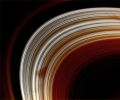
The_Rings-PIA10550.jpgA "Ghost" in the B-Ring (True - but strongly enhanced - Colors; credits: Lunar Explorer Italia)110 visiteCaption NASA:"The ghostly features in Saturn's B-Ring called "Spokes" are making an appearance again as the Cassini Spacecraft continues its tour of the Saturn System.
These dusty features on the Rings are often wedge-shaped, as this one is, with the inner portions of the Spoke being wider than the outer portions due to electromagnetic effects on the dust particles.
The image was taken in Visible Light with the Cassini Spacecraft wide-angle camera on Nov. 26, 2008 at a distance of approximately 922,000 kilometers (573,000 miles) from Saturn and at a Sun-Saturn-Spacecraft, or Phase, Angle of 39°.
Image scale is roughly 52 Km (about 32 miles) per pixel".MareKromium
|
|

The_Rings-PIA10556.jpgFantastic View (possible True Colors; credits: Lunar Explorer Italia)68 visiteCaption NASA:"Three of Saturn's satellites are visible in this snapshot from the Cassini Spacecraft. Janus (approx. 179 Km, or about 111 miles across) is in the top left of the image. Pandora (approx. 81 Km, or about 50 miles across) is just outside the F-Ring and Pan (approx. 28 Km, or about 17 miles across) is the small moon that has cut a path inside the Rings below the center of the image.
This view looks toward the unilluminated side of the Rings from about 27° above the Ring-Plane. The image was taken in visible light with the Cassini Spacecraft wide-angle camera on Dec. 7, 2008 using clear filters: CL1 (635 nm) and CL2 (635 nm). It was obtained from a distance of approx. 1 MKM (such as about 641.000 miles) from Pan and at a Sun-Pan-Spacecraft, or Phase, Angle of 33°. Image scale is roughly 62 Km (about 38 miles) per pixel".MareKromium
|
|
| 2243 immagini su 187 pagina(e) |
 |
|
|
|
|
181 | |
|
|
|
|








