Saturn: the "Ringed Beauty" and His Moons
|
|
|
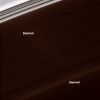
The_Rings-PIA08990.jpgStartrails through the D-Ring70 visiteCaption NASA:"Faint features in Saturn's innermost ring, the D-Ring, are brought into view in this strongly contrast-enhanced Cassini image. A few background stars are visible through the sheer ring as squiggly star trails.
The inner region of the C-Ring is seen at upper left. The faint diagonal wedge shape on the left side of the image was caused by stray light in the camera optics. The view looks toward the sunlit side of the Rings from about 18° below the Ring-Plane.
The image was taken in visible light with the Cassini spacecraft narrow-angle camera on June 12, 2007 at a distance of approx. 238.000 Km (about 148.000 miles) from Saturn.
Image scale is roughly 1 Km (0,6 miles) per pixel".MareKromium
|
|
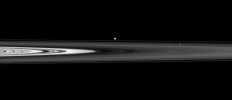
The_Rings-PIA08997.jpgOther "Brothers in the Night": Pan and Pandora80 visiteCaption NASA:"The Cassini spacecraft skims past Saturn's Ring-Plane at a low angle, spotting two ring moons on the far side.
Pan (26 Km, or about 16 miles across) sits within the Encke Gap right of center. Beyond the F-Ring hovers Pandora (84 Km, or approx. 52 miles across).
This view looks toward the unilluminated side of the Rings from less than 1° above the Ring-Plane.
The image was taken in visible light with the Cassini spacecraft narrow-angle camera on June 14, 2007 at a distance of approx. 1,6 MKM (about 1 MMs) from Saturn. Image scale is roughly 10 Km (about 6 miles) per pixel".MareKromium
|
|

The_Rings-PIA08999.jpgSidelong View77 visiteCaption NASA:"Saturn's enchanting rings display crisply defined edges and strong contrast on their unilluminated side. Atlas (32 Km, or about 20 miles across) sits on the far side of the Rings above center, between the "A" and "F" Rings. This view was acquired from about 1° above the Ring-Plane.
The image was taken in visible light with the Cassini spacecraft narrow-angle camera on June 21, 2007 at a distance of approx. 2,4 MKM (about 1,5 MMs) from Atlas. Image scale is roughly 14 Km (about 9 miles) per pixel".MareKromium
|
|
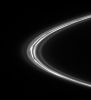
The_Rings-PIA09782.jpgPrometheus' Trail70 visiteCaption NASA:"Seen here is the end result of the process that occurs every time the moon Prometheus closely approaches Saturn's F-Ring. The moon cuts a dark channel in the ring's inner edge that then shears out over successive orbits, giving the inner edge of the ring the grooved appearance seen here.
This process is described in detail, along with a movie of Prometheus creating one of the streamer/channel features, in Soft Collision.
The view is toward the sunlit side of the Rings from about 3° below the Ring-Plane.
The image was taken in visible light with the Cassini spacecraft narrow-angle camera on Oct. 25, 2007. The view was acquired at a distance of approx. 624.000 Km (such as about 388000 miles) from Saturn and at a Sun-Ring-Spacecraft, or phase, angle of 23°.
Image scale is roughly 3 Km (about 2 miles) per pixel".MareKromium
|
|

The_Rings-PIA09824.jpgThe Golden Rings of Saturn and some of His Moons... - (natural colors; credits: NASA)80 visiteCaption NASA:"A color portrait of Saturn's sunlight-scattering Rings hosts a group of several moons.
Enceladus (505 Km, or 314 miles across) is visible at top. At bottom, in increasing distance from the Rings, are Pandora (84 Km, or 52 miles across), Janus (181 Km, or 113 miles across) and Mimas (397 Km, or 247 miles across).
This view looks toward the unilluminated side of the Rings from about 10° above the Ring-Plane. Saturn's shadow can be seen on the Rings at upper left.
Images taken using red, green and blue spectral filters were combined to create this composite color view.
The images were taken with the Cassini spacecraft wide-angle camera on Dec. 22, 2007. The view was acquired at a distance of approx. 1,8 MKM (such as about 1,1 MMs) from Saturn. Image scale is about 110 Km (approx. 68 miles) per pixel". MareKromium
|
|

The_Rings-PIA09860.jpgRings Aglow (natural colors; credits: NASA)71 visiteCaption NASA:"Saturn's softly glowing Rings shine in scattered Sunlight. The B-Ring presents a remarkable difference in brightness between the near and far arms (bottom and top of the image, respectively). The strong variation in brightness could be due to the presence of wake-like features in the B-Ring.
This view looks toward the unilluminated side of the Rings from about 5° above the Ring-Plane. Images taken using red, green and blue spectral filters were combined to create this natural color view. The images were acquired at a distance of approx. 574.000 Km (about 357.000 miles) from Saturn.
At the center of the image, the Sun-Ring-Spacecraft Angle - or Phase Angle - is 114°, and the image scale is roughly 34 Km (about 21 miles) per pixel in the radial, or outward from Saturn, direction".
Nota Lunexit: ATTENZIONE! La NASA, riteniamo con questo frame, ha finalmente iniziato a fornire qualche dettaglio in più allorchè vengono comunicate al Pubblico delle info le quali, in sè, e laddove non adeguatamente precisate, finivano con il dire poco: si tratta del punto di riferimento del frame considerato per il calcolo dell'Angolo di Fase (che è il suo centro) e la direzione di riferimento del frame in ordine alla Scala pixel/Km. Non male, considerato che avevamo iniziato proprio noi, circa tre anni fa, a dare informazioni contestuali di supporto a svariati frames NASA-CASSINI (non queste info, comunque).MareKromium
|
|

The_Rings-PIA09894.jpgThe A-Ring in 16:9 (natural colors + MULTISPECTRUM; credits: Lunexit)93 visiteCaption NASA:"Spiral density waves in Saturn's A-Ring reveal the gravitational signatures of distant moons as they subtly tug on the countless particles orbiting in the Ring-Plane.
Resulting from a process called orbital resonance, a spiral density wave is a spiral-shaped massing of particles that tightly winds many times around the Planet. Thus, the wave patterns seen here represent successive windings of each wave, like a close-up view of a watch spring.
Ring scientists can read these patterns, learning from them how quickly the Rings are spreading and the amount of mass contained in a region.
This view looks toward the sunlit side of the Rings from about 42° below the Ring-Plane. The image was taken in visible light with the Cassini spacecraft narrow-angle camera on April 1, 2008. The view was obtained at a distance of approx. 268.000 Km (about 167.000 miles) from Saturn.
Image scale is roughly 1 Km (0,6 miles) per pixel".MareKromium
|
|
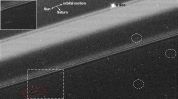
The_Rings-PIA10079.jpgSaturnian "Propellers" (context frame)72 visiteThe Cassini spacecraft captures 8 new propeller-like features within Saturn's A-Ring in what may be the propeller "hot zone" of Saturn's Rings.
Propeller features form around small moonlets that are not massive enough to clear out ring material, but are still able to pull smaller ring particles into a shape reminiscent of an airplane propeller. Scientists believe that propellers represent moonlet wakes, which are denser than the surrounding ring material and appear bright in the images.
Propellers were first discovered in Cassini images taken during Saturn orbit insertion in 2004. This new image is from a more extensive study of the full A-Ring and provides evidence that these features are not distributed evenly as previously thought, but are instead grouped in a 3000 Km-wide (about 1860 mile) Propeller Belt.
The largest propeller seen here is noted in the white dashed box, and it indicates the presence of a 150-meter (490-foot) moonlet. The size is inferred from the radial separation of the propeller wings. The propeller is seen in another image and is shown in the upper left box.
The reappearance of the propellers clearly demonstrates their orbital motion.MareKromium
|
|
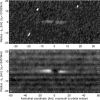
The_Rings-PIA10080.jpgSaturnian "Propellers" (extra-detail mgnf)84 visiteThis set of Cassini spacecraft images shows a close-up view of 2 propeller structures in Saturn's A-Ring. These images are part of a large view that captures eight new propeller-like features in what may be the propeller "hot zone" of Saturn's Rings. Propellers were first discovered in Cassini images taken during Saturn orbit insertion in 2004.
Propellers form around small moonlets that are not massive enough to clear out ring material, but are still able to push the ring particles into a shape reminiscent of an airplane propeller.
These pictures show 2 new propellers close up (one centered on each image). These images were put together from images in the Planetary Data System, a web site which archives and distributes scientific data from NASA planetary missions.
The image on the top shows a propeller induced by a 150-meter (490-foot) moonlet.
Smaller bright spots in the image are artifacts. The image on the bottom shows another propeller located just outside of the Encke Gap. Fine horizontal stripes seen in the image are wakes induced by the moon Pan.
In the top clear-filter image, taken during a stellar occultation on Aug. 20, 2005, the Cassini spacecraft narrow-angle camera observed the unlit side of the Rings, with a phase angle of 126°. The images were taken at 1 minute intervals with 0,05" exposure time. Image resolution is 1 Km (0,6 miles) per pixel.
The bottom clear-filter image was taken few hours later with 2" exposure time. Image resolution is roughly 1,5 Km (a little less than 1 mile) per pixel. MareKromium
|
|
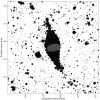
The_Rings-PIA10083.jpgFrom "Clump" to "Moonlet"75 visiteCaption NASA:"This is a computer simulation of the final stage of the growth of a "clump" in Saturn's Rings. The gravity from a hypothesized moonlet (solid gray sphere in frame center) has collected smaller ring particles (black) to form a temporary aggregation. The particles shown in the simulation are from centimeters to meters (su ch as inches to yards) across. The gray moonlet is 61 meters (200 feet) across". MareKromium
|
|

The_Rings-PIA10408.jpg"Spiral Density Wave" in the B-Ring (MULTISPECTRUM; credits: Lunexit)95 visiteCaption NASA:"This High-Resolution view shows, at left, a Spiral Density Wave (SDW) in Saturn's inner B-Ring. A SDW is a spiral-shaped massing of particles that tightly winds many times around the Planet. These waves decrease in wavelength with increasing distance from the Planet.
Scientists use images like this one to understand the mass of the Rings and the collisional dynamics of the Ring Particles.
The view looks toward the sunlit side of the Rings from about 50° below the Ring-Plane. The image was taken in visible light with the Cassini Spacecraft narrow-angle camera on May 10, 2008. The view was obtained at a distance of approx. 279.000 Km (sich as about 173.000 miles) from Saturn.
Image scale is roughly 1 Km (0,6 mile) per pixel".MareKromium
|
|

The_Rings-PIA10419.jpgOn the edge... (MULTISPECTRUM-2; credits: Lunexit)92 visiteCaption NASA:"This detailed look at Saturn's A-Ring captures Daphnis in the narrow Keeler Gap. The small moon creates complex wave patterns in the gap edges that Cassini scientists are working to understand. To the right of the Keeler Gap, the outer A-Ring edge is significantly brighter than the rest of the Ring.
This view looks toward the unilluminated side of the Rings, from about 32° above the Ring-Plane. Daphnis is about 8 Km (approx. 5 miles) wide.
The image was taken in visible light with the Cassini Spacecraft narrow-angle camera on May 31, 2008. The view was acquired at a distance of approx. 1 MKM (about 629.000 miles) from Saturn.
Image scale is roughly 6 Km (about 4 miles) per pixel".MareKromium
|
|
| 2243 immagini su 187 pagina(e) |
 |
|
|
|
|
180 | |
|
|
|
|








