Saturn: the "Ringed Beauty" and His Moons
|
|
|

The_Rings-PIA08306.jpgThe A and B-Rings (and the Cassini Division) in natural colors (Credits: NASA/JPL/Space Science Institute)96 visiteThe Rings are awash in subtle tones of gold and cream in this view which shows the outer B-Ring, the Cassini Division and the inner part of the A-Ring. In this viewing geometry, the brightest feature in the Cassini Division is the recently discovered diffuse Ringlet near the outer edge of the Division.
The diffuse Ringlet has a distinctive bluish cast.
The color of the Rings appears more golden than earlier in the mission because of the viewing geometry here - increased scattering in the Rings is brought about by the high phase angle and the view being toward the Rings' unlit side. This view looks toward the unlit side of the rings from about 30° above the Ring-Plane.
Images taken using red, green and blue spectral filters were combined to create this natural color view. The images were acquired by the Cassini spacecraft narrow-angle camera on Sept. 29, 2006 at a distance of approx. 1,8 MKM (about 1,13 MMs) from Saturn. Image scale is roughly 11 Km (about 7 miles) per pixel.
|
|

The_Rings-PIA08389_fig1.jpgThe Rings64 visiteA scan across Saturn's incredible halo of ice rings yields a study in precision and order. This natural color mosaic was acquired by the Cassini spacecraft as it soared 39 degrees above the unilluminated side of the Rings.
Major named gaps are labeled at the top. The main rings themselves, along with the F-Ring, are labeled at the bottom, along with their inner and outer boundaries.
The view combines 45 images -- 15 separate sets of red, green and blue images -- taken over the course of about 2,5 hours, as Cassini scanned across the Rings.
The images in this view were obtained on May 9, 2007, at a distance of approx. 1,1 MKM (about 700,000 miles) from Saturn. Image scale in the radial (horizontal) direction is about 6 Km (approx. 4 miles) per pixel.MareKromium
|
|

The_Rings-PIA08825.jpgBright "things" in the Sky of Saturn72 visiteCaption NASA:"Saturn's shadow cloaks the faint D-Ring at the bottom of this image. Observations of the shadow boundary, like this one, enable scientists to clearly detect and measure the brightness of diffuse and faint Ring features like the inner part of the D-Ring. Such brightness measurements are often difficult to make, but the shadow region provides a very dark standard against which to compare the D-Ring, as the only brightness in the shadow is provided by the background of space.
The bright specks across the scene, both in the bright Rings and in the shadow, are either stars or cosmic ray hits on the camera's detector. This view looks toward the unlit side of the rings from about 42° above the Ring-Plane.
The image was taken in visible light with the Cassini spacecraft wide-angle camera on Nov. 12, 2006. Cassini was then at a distance of approx. 1,4 MKM (about 900.000 miles) from Saturn and at a phase angle of 152°.
Image scale is roughly 8 Km (5 miles) per pixel".MareKromium
|
|
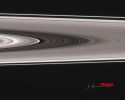
The_Rings-PIA08827.jpgMimas and the Rings65 visiteCaption NASA:"A recently discovered diffuse ringlet shines brightly in the Cassini Division as Mimas cruises past at bottom. Most of the main Rings are comprised of particles ranging from marble-size to house-size. In contrast, the brightness of this ringlet (seen right of center) when viewed at a high phase angle (the Sun-Saturn-Spacecraft angle) indicates it contains a large quantity of microscopic particles, which were likely generated by the disruption of a larger body. Such an event was probably recent, since this ringlet was not observed by the Voyager spacecraft in 1980 and 1981.
This view looks toward the lit side of the Rings from about 1° below the Ring-Plane. Mimas, which is in the foreground between Cassini and the Rings, is 397 Km (about 247 miles) wide. See PIA08330 and PIA08331 for other views of the new ringlet.
The image was taken in visible light with the Cassini spacecraft wide-angle camera on Nov. 18, 2006 and from a phase angle of 140°. Cassini was then at a distance of about 1,2 MKM (about 800.000 miles) from Saturn. Image scale is roughly 7 Km per pixel".MareKromium
|
|

The_Rings-PIA08834.jpgThe Rings65 visiteCaption NASA:"The contrast is sharp between the outer portion of the A-Ring edge and the Ring's main body. One explanation for this is that the outer A-Ring region contains smaller particles (around 1 cm or 0,4" in radius) than the main rings, allowing more opportunities for light scattering before it scatters toward the camera.
Ringlets in the Encke Gap and flanking the bright F-Ring core are clearly visible here.
This view looks toward the lit side of the Rings from about 4° below the Ring-Plane.
The image was taken with the Cassini spacecraft narrow-angle camera using a spectral filter sensitive to wavelengths of infrared light centered at 752 nanometers on Nov. 7, 2006. Cassini was then at a distance of approx. 1,1 MKM (about 700.000 miles) from Saturn and at a Sun-Saturn-spacecraft, or phase, angle of 140°.
Image scale on the sky at the distance of Saturn is about 6 Km (a little less than 4 miles) per pixel".
|
|

The_Rings-PIA08836.jpgThe Rings' texture66 visiteCaption NASA:"This close-up of the inner edge of the Cassini Division shows an enormous amount of structure, including a grainy texture in the bright outer B-Ring material near the gap edge.
An extreme enhancement of the original image, presented at right, reveals the grainy region with greater clarity.
This view looks toward the lit side of the rings from about 54° below the Ring-Plane.
The image was taken in visible light with the Cassini spacecraft narrow-angle camera on Nov. 8, 2006 at a distance of approx. 378.000 Km (about 235.000 miles) from Saturn and at a Sun-Saturn-spacecraft, or phase, angle of 68°.
Image scale is roughly 2 Km (a little more than 1 mile) per pixel".
|
|

The_Rings-PIA08837.jpgThe Rings (in natural colors)66 visiteCaption NASA:"Saturn's sunlit Rings gleam in the blackness as two icy moons cruise past in the foreground.
Enceladus is a small crescent near upper left; Janus is a speck above the F-Ring, near center. Janus was brightened slightly for visibility.
This view looks toward the lit side of the Rings from about 5° below the Ring-Plane.
This image was taken in visible red light with the Cassini spacecraft wide-angle camera on Nov. 7, 2006, at a distance of approx. 1,1 MKM (about 700.000 miles) from Saturn and at a Sun-Saturn-Spacecraft, or phase, angle of 139°.
Image scale on the sky at the distance of Saturn is roughly 63 Km (about 39 miles) per pixel".
|
|
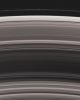
The_Rings-PIA08840.jpgThe Main Ring-System69 visiteCaption NASA originale:"This expansive view takes in most of Saturn's main Ring System, from the outer C-Ring to the narrow and knotted-looking F-Ring. The broad brightness plateaus in the C-Ring (at bottom) transform into the more densely populated (and thus darker in this viewing geometry) B-Ring. The Rings' appearance becomes brighter and smoother beyond the bands of the Cassini Division, in the A-Ring. This view looks toward the unlit side of the Rings from about 49° above the Ring-Plane.
The image was taken in visible blue light with the Cassini spacecraft wide-angle camera on Nov. 21, 2006 at a distance of approx. 539,000 Km (about 335.000 miles) from Saturn and at a Sun-Saturn-spacecraft, or phase, angle of 98°.
Image scale is 29 kilometers (18 miles) per pixel".MareKromium
|
|

The_Rings-PIA08845.jpgThe strange appearence of the F-Ring79 visiteCaption NASA:"The striated appearance of the F-Ring is immediately apparent in the region of the ring that trails behind the moon Prometheus. The F-Ring is characterized here by dark gores that stretch inward toward the planet and forward in the direction of motion.
This image has been expanded in the horizontal direction by a factor of 5 in order to make radial variations more prominent.
The curvature of the Rings is also exaggerated by the horizontal stretch.
The exterior flanking ringlets (to the right of the bright ring core) are not disturbed by Prometheus to the great degree seen in the inner ringlets. This view looks toward the unlit side of the Rings from about 31° above the Ring-Plane.
The image was taken in visible light with the Cassini spacecraft narrow-angle camera on Nov. 25, 2006 at a distance of approx. 1,7 MKM (about 1,1 MMs) from Saturn and at a phase angle of 162°. Scale in the original image is roughly 10 km per pixel".MareKromium
|
|

The_Rings-PIA08846.jpgLights through the Rings...64 visiteCaption NASA:"With the Sun directly behind Cassini, the spacecraft spies the Opposition Surge in Saturn's inner A-Ring. The opposition effect becomes visible from this special viewing geometry. (...)
This view looks toward the Rings from about 11° below the Ring-Plane.
The image was taken in visible light with the Cassini spacecraft wide-angle camera on Dec. 2, 2006 at a distance of approx. 287.000 Km (178.000 miles) from Saturn. Image scale is roughly 17 Km (about 11 miles) per pixel".
|
|

The_Rings-PIA08855.jpgMulticolored Rings...76 visiteCaption NASA:"Both luminous and translucent the C-Ring sweeps out of the darkness of Saturn's shadow and obscures the Planet at lower left.
The Ring is characterized by broad, isolated bright areas, or "plateaux", surrounded by fainter material. This view looks toward the unlit side of the Rings from about 19° above the Ring-Plane. North on Saturn is up. The dark, inner B-Ring is seen at lower right.
The image was taken in visible light with the Cassini spacecraft wide-angle camera on Dec. 15, 2006 at a distance of approx. 632.000 Km (about 393.000 miles) from Saturn and at a phase angle of 56°.
Image scale is roughly 34 Km (about 21 miles) per pixel".
Nota: il sistema di elaborazione in "colori naturali" non è cambiato ma, come vedete Voi stessi, i colori di Saturno sono (leggermente) mutati. Come mai? La risposta, a nostro parere, deve essere rinvenuta nel tipo di filtraggio utilizzato dalla NASA per l'ottenimento dell'immagine originale in b/n. Questo vuol dire, fra l'altro, che i frames in b/n NON sono affatto tutti uguali (come molti invece ritengono). E' il tipo di flitro impiegato per l'ottenimento dell'immagine originale - ottenuta sulla scala dei grigi - che poi determinerà, in sede di trasformazione del frame in immagine a colori, il "tipo di colori"!
|
|

The_Rings-PIA08863.jpgWhat's inside the F-Ring?!?80 visiteCaption NASA:"These 2 images, taken about 8' apart, show clump-like structures and a great deal of dust in Saturn's ever-changing F-Ring. The images show an object-interior to and detached from the bright core of the F-Ring that appears to be breaking up into discrete clumps.
Cassini scientists have been monitoring clumps in the F-Ring for more than 2 years now, trying to understand whether these represent small permanent moonlets or transient aggregates of material. This view looks toward the unlit side of the Rings from about 35° above the Ring-Plane.
The images were taken in visible light with the Cassini spacecraft narrow-angle camera on Dec. 23, 2006 at a distance of approx. 2 MKM (about 1,2 MMs) from Saturn. Image scale is roughly 12 Km (about 7 miles) per pixel".
|
|
| 2243 immagini su 187 pagina(e) |
 |
|
|
|
|
178 | |
|
|
|
|








