Saturn: the "Ringed Beauty" and His Moons
|
|
|
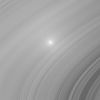
The Rings-PIA08248.jpgOpposition "Surge" on the B-Ring89 visiteBoth images ("A" and "B" Ring) were taken in visible light with the Cassini spacecraft wide-angle camera on July 23, 2006 at a distance of approxi. 262.000 Km (about 163.000 miles) from Saturn.
Image scale in the radial, or outward from Saturn, direction is roughly 13 Km (such as about 8 miles) per pixel.
|
|

The Rings-PIA08255.jpg"Penumbral fade" on Saturn's Rings74 visiteCaption NASA:"As the particles comprising Saturn's A-Ring slip into the Planet's shadow, they find themselves briefly in the penumbra of Saturn's shadow. In this very narrow region along the edge of the shadow, part (but not all) of the Sun is still visible around the side of the Planet, creating only a partial shadow there and making the shadow edge look fuzzy.
The image was taken in visible light with the Cassini spacecraft narrow-angle camera on July 26, 2006 at a distance of approx. 1,5 MKM (such as about 900.000 miles) from Saturn. Image scale is roughly 9 Km (about 5 miles) per pixel".
|
|

The Rings-PIA08257.jpgThe Music of Pan...The Waves in the Rings...75 visiteCaption NASA:"The Encke Gap displays gentle waves in its inner and outer edges that are caused by gravitational tugs from the small moon Pan. These scalloped edges were captured in a dramatic image taken by Cassini during its insertion into Saturn orbit in 2004.
The Encke Gap is a 325-Km (about 200-mile) wide division in Saturn's outer A-Ring.
Pan (26 Km, or approx. 16 miles across) orbits squarely in the center of this gap.
The original image was stretched in the horizontal direction by a factor of four to exaggerate the amplitude of the waves, then reduced to half size and cropped to focus on the gap.
The image was taken in visible light with the Cassini spacecraft narrow-angle camera on July 23, 2006 at a distance of approx. 290.000 Km(such as about 180.000 miles) from Saturn.
Scale in the original image was roughly 1 Km (about 0,6 mile) per pixel".
|
|

The Rings-PIA08259.jpgGravitational Disturbances72 visiteCaption NASA originale:"The clumpy disturbed appearance of the brilliant F-Ring constantly changes. The irregular structure of the Ring is due, in large part, to the gravitational perturbations on the ring material by one of Saturn's moons, Prometheus (about 102 Km, or 63 miles across).
Interior to the F-Ring, the A-Ring bears a striking resemblance to a classic grooved, vinyl record. Visible here are the Keeler Gap (about 42 Km, or 26 miles wide) and the Encke Gap (about 325 Km, or 200 miles wide).
The image was taken using a spectral filter sensitive to wavelengths of infrared light centered at 862 nnmts. The view was acquired with the Cassini spacecraft narrow-angle camera on July 26, 2006 at a distance of approx. 1,5 MKM (about 900.000 miles) from Saturn and at a Sun-Saturn-spacecraft, or phase, angle of 141°. Image scale is roughly 8 Km (such as about 5 miles) per pixel".
|
|

The Rings-PIA08275.jpgThe Rings63 visiteCaption NASA originale:"This wide and sweeping view of the sunlit Rings of Saturn takes in the impressive variety in their structure -- from the clumpy and perennially intriguing F-Ring to the many waves, ringlets and gaps in the A and B Rings and the Cassini Division in between.
The image was taken in visible light with the Cassini spacecraft wide-angle camera on Sept. 9, 2006 at a distance of approx. 640.000 Km (about 397.000 miles) from Saturn. The view was acquired from about 10° below the Ring-Plane. Image scale on the sky at the distance of Saturn is approx. 35 Km (about 22 miles) per pixel".
|
|

The Rings-PIA08277.jpgThe "Encke Gap" in detail66 visiteCaption NASA:"Although the embedded moon Pan is nowhere to be seen, there is a bright clump-like feature visible here, within the Encke Division.
Also discernable are periodic brightness variations along the outer (right side) gap edge. (...)
The view looks toward the sunlit side of the rings from about 17° below the Ring-Plane.
The image was taken in visible light with the Cassini spacecraft narrow-angle camera on Sept. 9, 2006 at a distance of approx. 421.000 Km (about 261.000 miles) from Saturn. Image scale on the sky at the distance of Saturn is roughly 2 Km (1,4 miles) per pixel".
|
|

The Rings-PIA08283.jpgNot the Sun, but Aldebaran!68 visiteCaption NASA:"The Cassini spacecraft took a series of images on Sept. 9, 2006 as it watched the bright red giant star Aldebaran slip behind Saturn's Rings.
This type of observation is known as a stellar occultation and uses a star whose brightness is well known. As Cassini watches the rings pass in front of the star, the star's light fluctuates, providing information about the concentrations of ring particles within the various radial features in the Rings.
This view shows the Encke Gap (325 Km, or approx. 200 miles wide) and the faint ringlets which share the gap with the embedded moon Pan. The view looks toward the sunlit side of the Rings from about 19° below the Ring-Plane.
Bright Aldebaran is overexposed, creating thin vertical lines on its image.
The image was taken in visible light with the Cassini spacecraft narrow-angle camera on Sept. 9, 2006 at a distance of approx. 359,000 Km (about 233.000 miles) from Saturn. Image scale on the sky at the distance of Saturn is 2 Km per pixel".
Nota: la NASA - finalmente - ci fornisce un'informazione contestuale utile e ci permette di correggere un nostro errore interpretativo (del quale ci scusiamo con Voi). Non è dunque il Sole, l'astro che viene occultato dagli Anelli di Saturno, bensì la super-gigante Rossa "Aldebaran". Ottimo: non finiamo mai di stupirci per quello che Cassini riesce a mostrarci!
|
|

The Rings-PIA08285.jpgNot the Sun, but Aldebaran!66 visitenessun commento
|
|

The Rings-PIA08287.jpgNot the Sun, but Aldebaran!64 visiteCaption NASA originale:"Cassini took a series of images on Sept. 9, 2006 as it watched the bright red giant star Aldebaran slip behind Saturn's Rings.
This type of observation is known as a "stellar occultation" and uses a star whose brightness is well known. As Cassini watches the rings pass in front, the star's light fluctuates, providing information about the concentrations of ring particles within the various radial features in the Rings.
Here, Cassini watches the star through the part of the Rings masked by Saturn's shadow. The view looks toward the sunlit side of the Rings from about 20° below the Ring-Plane. Bright Aldebaran is over exposed, creating thin vertical lines ("effetto goccia") on its image.
The image was taken in visible light with the Cassini spacecraft narrow-angle camera on Sept. 9, 2006 at a distance of approx. 351.000 Km (such as about 218.000 miles) from Saturn. Image scale on the sky at the distance of Saturn is 2 Km (a little more than 1 mile) per pixel".
|
|

The Rings-PIA08288.jpgSpokes!63 visiteA group of bright spokes tightly cluster together in Saturn's B ring. The spokes seen here generally all exhibit the same degree of shearing, or tilting, but some deviations are apparent. In this image, the direction to Saturn is downward; orbital motion is to the left.
Ring scientists are eager for data to help them understand and eventually explain how these mysterious ring features are created. To that end, Cassini has been directed to acquire movie sequences, like the one this image is part of, that watch for these elusive radial structures.
This observation focused on the morning side of the rings, the side where the rings are rotating out from Saturn's shadow. Spokes appear most frequently at this location.
Also barely visible in this image are broader, much fainter but still bright radial regions that extend over larger radial distances than the spokes in the upper left. Where these fainter features cross ringlets in the lower part of the image, slight variations in brightness are apparent. These are probably due to tiny particles, possibly part of a former spoke, that haven't yet settled down onto the ring plane.
Although their formation is still a subject of inquiry, scientists are confident that the microscopic spoke particles are slightly electrically charged and therefore are influenced by Saturn's magnetic field.
The brightness of the spokes, when combined with viewing geometry information and estimates of their particle sizes can help researchers determine the amount of material in the spokes--a crucial quantity to constrain theories of spoke formation.
The image was taken in visible light with the Cassini spacecraft narrow-angle camera on Sept. 28, 2006, at a distance of approximately 1.3 million kilometers (800,000 miles) from Saturn and at a Sun-Saturn-spacecraft, or phase, angle of 147 degrees. Scale in the original image was about 32 kilometers (20 miles) per pixel. The view has been magnified by a factor of two.
|
|

The Rings-PIA08290.jpgThe F-Ring (detail mgnf)71 visiteCaption NASA:"For some time, scientists have suspected the presence of tiny moonlets that orbit Saturn in association with the clumpy and braided-looking Ring. As the small satellites move close to the F-Ring core they leave a gravitational signature. In some cases they can draw out material in the form of a "streamer" - a miniature version of the interaction Cassini has witnessed between Prometheus and the F-Ring material. The dynamics of this interaction are the same, but the scale is different.
Scientists speculate that there could be several small moons with a variety of sizes involved in the creation of structures like the one seen here.
The image was taken in visible light with the Cassini spacecraft narrow-angle camera on Sept. 25, 2006 at a distance of approx. 255.000 Km (about 159.000 miles) from Saturn and at phase angle of 29°. Scale in the original image was 1 Km (about 3.873 feet) per pixel. The image has been magnified by a factor of two and contrast enhanced".
|
|

The Rings-PIA08295.jpgWhat's inside the Rings?63 visiteThe 2 prominent dark gaps in Saturn's A-Ring contain small embedded moons and a host of other intriguing features. Here, 3 unique ringlets are visible in the Encke Gap (about 325 Km wide). The innermost ringlet (topmost here) is faint but continuous. The center ringlet brightens substantially toward upper left and displays a few slight kinks. This ringlet is coincident with the orbit of Pan (about 26 Km across). The outermost ringlet is discontinuous, with two bright regions visible.
The narrower Keeler Gap (about 42 Km wide) hosts the moon Daphnis (7 Km across - not visible in this image), which raises waves in the Gap edges as it orbits Saturn. At lower left, faint ringlets flanking the bright F-Ring core are visible. These features were found by the Cassini spacecraft to be arranged into a spiral arm structure that winds around the Planet like a spring. The spiral may be caused by tiny moonlets or clumps of material that have smashed through the F-Ring core and liberated material.
This view looks toward the unlit side of the rings from about 23 degrees above the ringplane.
The image was taken in visible red light with the Cassini spacecraft narrow-angle camera on Sept. 11, 2006 at a distance of approximately 1.1 million kilometers (700,000 miles) from Saturn and at a Sun-Saturn-spacecraft, or phase, angle of 151 degrees. Image scale is about 6 kilometers (4 miles) per pixel.
|
|
| 2243 immagini su 187 pagina(e) |
 |
|
|
|
|
173 | |
|
|
|
|








