Saturn: the "Ringed Beauty" and His Moons
|
|
|

The Rings-PIA07610.jpgClose look at the "B-Ring"63 visiteOriginal caption:"This detailed view of Saturn's mid-B ring shows intriguing structure, the cause of which has yet to be explained by ring scientists. The image shows a radial location located between approx. 107.200 to 115.700 Km (about 66.600 to 71.900 miles) from Saturn.
The image was taken with the Cassini spacecraft narrow-angle camera on Sept. 3, 2005, at a distance of approx. 1,1 MKM (roughly 700.000 miles) from Saturn using a filter sensitive to wavelengths of infrared light centered at 752 nnmts. The image scale is 6 Km (about 4 miles) per pixel".
|
|

The Rings-PIA07611.jpgDeep inside the "C-Ring"96 visiteOriginal caption:"This close-up view shows an inner region of Saturn's C-Ring. It covers a radial location on the rings located approx. 78.000 to 80.500 Km (about 48.500 to 50.000 miles) from the center of the Planet. Saturn itself has a radius of 60.330 Km (that is about 34.490 miles).
A bright feature, informally referred to as a "plateau", arcs across the image center. The plateau is not high in terms of elevation, but rather in terms of particle density (seen here as brightness). The density is fairly uniform within the bright band, and some five times higher than in the surrounding ring structure. Although the many plateaus in Saturn's Rings appear unchanged over 25 years of observations, scientists do not know what determines their locations or maintains their sharp boundaries.
The image was taken in visible light with the Cassini spacecraft narrow-angle camera on Sept. 5, 2005, at a distance of approx. 418.000 Km(such as about 260.000 miles) from Saturn. The image scale is 2 Km per pixel".
|
|
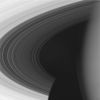
The Rings-PIA07613.jpgThe C-Ring64 visiteOriginal caption:"The Cassini spacecraft looks close at Saturn to frame a view encompassing the entire C-Ring. In the dark region closer to the planet lies the much dimmer D-Ring. The bright B-Ring wraps around the left side of the scene, while Saturn's shadow darkens the Rings at bottom. For reference, Saturn’s Ring sequence from its surface outwards is "D", "C", "B", "A", "F", "G" then "E".
The image was taken in visible light with the Cassini spacecraft wide-angle camera on Sept. 4, 2005, at a distance of approx. 627.000 Km (390.000 miles) from Saturn. The image scale is 34 Km (about 21 miles) per pixel".
|
|

The Rings-PIA07616.jpgThe "Cassini" Division (close-up)85 visiteOriginal caption:"The outer reaches of Saturn's Cassini Division merges with the inner A-Ring (at the right) in a Region that is rich in structure.
The smooth Region leading up to the A-Ring grows brighter from the left to the right (known as a "ramp" to Ring).
This Region contains a faint "double-wave" structure that is a density feature caused by the influence of the co-orbital moons Janus and Epimetheus. Scientists are interested in observing the evolution of this density wave as the moons swap places in their orbits every few years, presumably resulting in a change in the perturbations that cause this feature.
This image was taken in visible light with the Cassini narrow-angle camera on Sept. 5, 2005, at a distance of approx. 441.000 Km (about 274.000 miles) from Saturn. The image scale is 2 Km (a little more than 1 mile) per pixel".
|
|

The Rings-PIA07631.jpgThe sweet colors of the Rings (approx. true colors)63 visiteOrigThe dark Cassini Division, within Saturn's Rings, contains a great deal of structure, as seen in this color image. The sharp inner boundary of the division (left of center) is the outer edge of the massive B-Ring and is maintained by the gravitational influence of the moon Mimas.
Spectroscopic observations by Cassini indicate that the Cassini Division, similar to the C-Ring, contains more contaminated ice than do the B and A-Rings on either side.
This view is centered on a region approx. 118.500 Km (about 73.600 mi) from Saturn's center. (Saturn is about 120.500 Km wide - roughly 74.900 mi - at the equator.) From left to right, the image spans approx. 11.000 Km (about 6.800 mi) across the Ring-Plane. Images taken using red, green and blue spectral filters were combined to create this view, which approximates what the human eye might see. The image was taken with the Cassini spacecraft narrow-angle camera on May 18, 2005, at a distance of approx. 1,6 MKM (about 1 MMs) from Saturn. Res. is 9 Km per px.
|
|
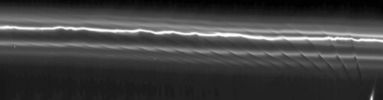
The Rings-PIA07750.jpgSurfing the waves of the F-Ring (from 1,1 MKM)63 visiteOriginal caption:"This mosaic of 15 Cassini images of Saturn's F-Ring shows how the moon Prometheus creates a gore in the Ring once every 14 h and 42', as it approaches and recedes from the F-Ring on its eccentric orbit. The individual images have been processed to make the Ring appear as if it has been straightened, making it easier to see the Ring's structure. The mosaic shows a Region 147.000 Km (about 91.000 miles) along the Ring (horizontal direction in the image); this represents about 60° of Longitude around the Ring. The Region seen here is about 1500 Km (900 miles) across (vertical direction). The first and last images in the mosaic were taken approximately 2,5 hours apart.
Each dark channel, or "gore," is clearly visible across more than 1,000 kilometers (600 miles) of the ring and is due to the gravitational effect of Prometheus (102 kilometers, or 63 miles across), even though the moon does not enter the F ring. The channels have different tilts because the ring particles closer to Prometheus (overexposed, stretched, and just visible at the bottom right of the image) move slower with respect to the moon than those farther away. This causes the channels to shear with time, their slopes becoming greater, and gives the overall visual impression of drapes of ring material. The channels at the right are the youngest and have near-vertical slopes, while those at the left are the oldest and have near-horizontal slopes. This phenomenon has not previously been detected in any other planetary ring system, but computer simulations of the system prove that the disturbance is caused by a simple gravitational interaction. The eccentric orbit of Prometheus is gradually moving so that the moon will eventually come even closer in its closest approach to the eccentric F ring. Scientists calculate that its perturbations of the F ring will reach a maximum in December 2009".
|
|

The Rings-PIA08036~0.jpgThe Rings, 26 Taurus and reddish Hydrogen64 visiteThis image is a false-color ultraviolet view of Saturn's B-Ring (center) and A-Ring (right), separated by a large gap known as the Cassini Division.
It shows a bright horizontal streak, created by a series of time lapse images involving a star named 26 Taurus.
The image was made over a 9-hour period as the star drifted behind the Rings. The opacity of the outer A-Ring is most pronounced on its inner edge, indicating more ring debris is present there. The Encke Gap, much smaller than the Cassini Division, is visible near the outer edge of the A-Ring. The B-Ring is significantly more opaque than the A-Ring, indicating a greater density of ring material when imaged from above.
The sky behind the Rings glows red in the ultraviolet wavelengths from the hydrogen gas that fills the Solar System.
The images were processed from data taken by the ultraviolet imaging spectrograph aboard the Cassini spacecraft in May 2005.
|
|

The Rings-PIA08129.jpgThe "sharp" G-Ring78 visiteThis contrast-enhanced view of Saturn's faint G-Ring shows its extremely sharp inner edge and more diffuse outer boundary. Using its large high-gain antenna as a shield, the Cassini spacecraft flew through the Region interior to the G-Ring during insertion into Saturn orbit. The spacecraft was struck many times by the fine icy particles that populate the Region between the F and G Rings.
The image was taken in visible light with the Cassini spacecraft narrow-angle camera on Jan. 19, 2006, at a distance of approx. 1,2 MKM (such as about 700.000 miles) from Saturn. The image scale is about 7 Km (approx. 4 miles) per pixel.
|
|

The Rings-PIA08163-1.jpgThe "E-Ring" of Saturn: the "Enceladus Ring" (1)83 visiteThis excellent view of the faint E-Ring - a ring feature now known to be created by Enceladus - also shows two of Saturn's small moons that orbit within the Ring, among a field of stars in the background.
The E-Ring extends from three to eight Saturn radii - about 180.000 Km(such as about 118.000 miles) to 482.000 Km (about 300.000 miles). Its full extent is not visible in this view.
Calypso (22 Km, or about 14 miles across) and Helene (32 Km, or about 20 miles across) orbit within the E-Ring's expanse. Helene skirts the outer parts of the E-Ring, but here it is projected in front of a region deeper within the Ring.
Calypso and Helene are trojan satellites, or moons that orbit 60° in front or behind a larger moon. Calypso is a Tethys trojan and Helene is a trojan of Dione. An interesting feature of note in this image is the double-banded appearance of the E-Ring, which is created because the Ring is somewhat fainter in the Ring-Plane than it is 500-1000 Km (about 300-600 miles) above and below it.
|
|

The Rings-PIA08163-2.jpgThe "E-Ring" of Saturn: the "Enceladus Ring" (2)74 visiteThis appearance implies that the particles in this part of the Ring have nonzero inclinations (a similar affect is seen in Jupiter's Gossamer Ring). An object with a nonzero inclination does not orbit exactly at Saturn¿s Ring-Plane: its orbit takes it above and below it. Scientists are not entirely sure why the particles should have such inclinations, but they are fairly certain that the reason involves Enceladus. One possible explanation is that all the E-Ring particles come from the plume of icy material that is shooting due South out of the moon's Pole.
This means all of the particles are created with a certain velocity out of the Ring-Plane, and then they orbit above and below that plane.
Another possible explanation is that Enceladus produces particles with a range of speeds, but the moon gravitationally scatters any particles that lie very close to the Ring-Plane, giving them nonzero inclinations. Stray light within the camera system is responsible for the broad, faint "Y" shape across the image.
The image was taken in visible light with the Cassini spacecraft wide-angle camera on March 15, 2006, at a distance of approximately 2.4 million kilometers (1.5 million miles) from Saturn. The image scale on the sky at the distance of Saturn is 142 kilometers (88 miles) per pixel.
|
|

The Rings-PIA08243.jpgThe Huygens "Gap"62 visiteCaption NASA:"The sharp outer boundary of Saturn's B-Ring, which is the bright ring region seen to the right in this image, is maintained by a strong resonance with the moon Mimas. For every two orbits made by particles at this distance from Saturn, Mimas makes one orbit.
The moon's repeated gravitational tugs force ring particles away from this region.
The dark region is called the "Huygens Gap" and it includes the bright, eccentric Huygens Ringlet, also visible here near center".
|
|
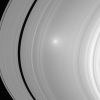
The Rings-PIA08247.jpgOpposition "Surge" on the A-Ring62 visiteThe Opposition Effect exists because of two contributing factors: one is due to the fact that the shadows of Ring particles directly opposite the Sun from Cassini - the Region of Opposition - fall completely behind the particles as seen from the spacecraft. These shadows are thus not visible to the spacecraft: all ring particle surfaces visible to the spacecraft in this image are in Sunlight and therefore bright. Much farther away from the Region of Opposition, the Ring particle shadows become more visible and the scene becomes less bright. The brightness falls off in a circular fashion around the Opposition Point. The main factor to the Opposition Surge in this image is an optical phenomenon called "coherent backscatter": here, the electromagnetic signal from the rays of scattered Sunlight making its way back to the spacecraft is enhanced near the Region of Opposition because, instead of canceling, the electric and magnetic fields comprising the scattered radiation fluctuate in unison.
|
|
| 2243 immagini su 187 pagina(e) |
 |
|
|
|
|
172 | |
|
|
|
|








