Saturn: the "Ringed Beauty" and His Moons
|
|
|
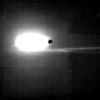
The Rings-N00042087.jpgThe "G-Ring" and a "Dark Object" in the light...71 visiteOriginal caption:"N00042087.jpg was taken on October 24, 2005 and received on Earth October 25, 2005. The camera was pointing toward SATURN-G-RING at approximately 2.120.861 kilometers away and the image was taken using the IR2 and CL2 filters. This image has not been validated or calibrated".
Una simile immagine - un probabile photo-artifact, ma non si può esserne sicuri al 100% - l'avevamo già incontrata quando, diversi mesi fa, la Sonda Cassini si era avvicinata a Giapeto ed aveva effettuato due scatti che produssero un risultato visivo molto simile a questo. E Voi cosa dite? Stiamo guardando una Nave Spaziale Aliena che si "nasconde" nei raggi e nella luce di un Sole lontano - ma comunque brillante - oppure è solo un artefatto fotografico (una "distorsione" da sovraesposizione)?
|
|
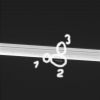
The Rings-N00051339.jpgHiding in the Rings?62 visitePortate l'immagine sino al full-size e poi verificate anche Voi:
Cerchiatura Bianca n. 1: si tratta di un clump, di un difetto dell'immagine (photoartifact) o di una shepherd moon non ancora catalogata?
Cerchiatura Bianca n. 2: evidentemente si tratta di una luna "mossa", ma quale luna di Saturno si esprime fotograficamente lasciando due strisce, per giunta disallineate?
Cerchiatura Bianca n. 3: secondo noi un'altra luna (o comunque un corpo celeste di qualche tipo) si intuisce appena, quasi del tutto eclissato dagli Anelli.
|
|
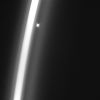
The Rings-N00065684.jpgShining through the Rings... (1)62 visiteUn Sole - il nostro Sole - splende nello Spazio di Saturno e, fra pochi istanti, si immergerà negli Anelli.
Due sugestive immagini CASSINI che riprendono un Sole piccolo e lontano, ma comunque luminoso...
|
|
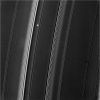
The Rings-N00065689.jpgShining through the Rings... (2)73 visitenessun commento
|
|
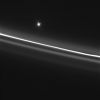
The Rings-N00066646.jpgThe Sun through the Rings (1)73 visitenessun commento
|
|
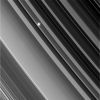
The Rings-N00066660.jpgThe Sun through the Rings (2)76 visitenessun commento
|
|
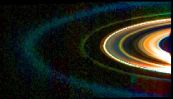
The Rings-PIA01940.jpgInfrared Rings69 visiteThis mosaic of Saturn's rings was acquired by Cassini's VIMS (Visual and Infrared Mapping Spectrometer) on Sept. 15, 2006, while the spacecraft was in the shadow of the Planet looking back towards the Rings from a distance of about 2,16 MKM (approx. 1,34 MMs).
Data at wavelengths of 1,0, 1,75 and 3,6 microns were combined in the blue, green and red channels to make the pseudo-color image shown here. The brightest feature in the mosaic is the F-Ring, located at the outer edge of the main Rings. The F-Ring is overexposed and appears white in this image. Of the main A, B and C Rings; the C-Ring is the most prominent and reddish in color, becoming saturated close to the Sun. The more opaque A and B Rings are muddy in color and very dark in this geometry.
By contrast, the normally faint D-Ring, located just interior to the C-Ring, is quite bright and blue, indicating the presence of very small ring particles. Similarly, a narrow, green ringlet in the Cassini Division, as well as the greenish G-Ring and blue E-Ring - located at increasing distances outside the F-Ring - are predominantly composed of small particles.
The faint reddish band immediately outside the F-Ring is likely to be an artifact caused by the extremely bright F-Ring.
|
|

The Rings-PIA06175_modest.jpgThe Rings (full view) in natural colors64 visiteCaption NASA originale:"Saturn's most prominent feature, its dazzling Ring System, takes center stage in this stunning natural color mosaic which reveals the color and diversity present in this wonder of the Solar System. Gaps, gravitational resonances and wave patterns are all present and the delicate color variations across the System are clearly visible.
This mosaic of 6 images covers a distance of approximately 62.000 Km along the ring plane, from a radius of 74.565 Km to 136.780 Km from the Planet's center.
This view is from Cassini's vantage point beneath the ring plane. The rings are tilted away from Cassini at an angle of about 4°.
Images taken using red, green and blue spectral filters were used to create this natural color mosaic. The images were acquired using the Cassini spacecraft narrow angle camera on Dec. 12, 2004, at a distance of approximately 1,8 MKM (1,1 MMs).
The image scale is 10,5 Km per pixel".
|
|

The Rings-PIA06195.jpgGravitational Anomalies and Interferences in the Rings74 visiteCaption NASA originale:"Image A displays an unusual mottled-looking narrow region, with a radial width varying with longitude from 5 to 10 Km, seen for the first time about 60 Km inside the outer edge of Saturn's A-Ring.
Image B is a close-up of this region, mapped into a longitude-radius system and contrast enhanced, that is characterized by blotchy light and dark areas about 30/40 Km in longitudinal extent.
The mottled regions also are probably caused by particle clumping brought about by gravitational disturbances. The outer A-Ring edge is sculpted into a 7-lobed pattern called a Lindblad resonance (a type of dynamical resonance that occurs in rings systems) with the co-orbital satellites Janus and Epimetheus. The resonant perturbations in this region are complicated by the presence of these 2 moons whose orbits are within 50 Km of each other.
Image C is a dark-side image of the outer edge of the Encke gap, with a resolution of about 270 meters per pixel".
|
|
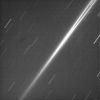
The Rings-PIA06627.jpgThe G-Ring and "Star-Trails"70 visiteCaption NASA originale:"Cassini's ability to remain sharply pointed at its targets allowed this image of Saturn's faint, dusty G-Ring to be made. The thin streaks visible here are "Star-Trails", which are created during long exposures, when the spacecraft remains locked onto a single target. The camera shutter was open for 3 and 1/2 minutes during this particular exposure. A long exposure was required to see details of this quite tenuous Ring.
The feature inside the G-Ring, at upper right, is also a star trail.
The image was taken in polarized visible light with the Cassini spacecraft narrow-angle camera on March 7, 2005, at a distance of approx. 1,2 MKM (such as approx. 750.000 miles) from Saturn. The image scale is approx. 10 Km per pixel".
|
|

The Rings-PIA07512.jpgClose-up on the Rings!64 visiteCaption NASA originale:"This amazing close-up of Saturn's Rings reveals their incredible variety. In some regions there are wavelike structures, while in other places the Rings' structure appears to be more chaotic.
This image shows (from top to bottom) the A-Ring with the Encke gap, the Cassini Division, the B-Ring and the C-Ring.
The image was taken in visible light with the Cassini spacecraft narrow-angle camera on April 26, 2005, at a distance of approx. 2,3 MKM (such as 1,5 MMs) from Saturn. The image scale is 14 Km (approx. 8 miles) per pixel".
|
|

The Rings-PIA07513.jpgWatching "through" the Rings...77 visiteGli Anelli di Saturno, come questo frame dimostra ampiamente, non sono affatto spessi, anzi...
Dietro il sottilissimo strato di detriti, ghiaccio e polveri, infatti, il profilo del Gigante Gassoso occhieggia in maniera netta e definita mentre la Sonda Cassini 'scivola' al di sotto del piano degli Anelli e scatta questa superba istantanea che, a nostro parere, rappresenta una delle più belle mai ottenute nella Storia dell'Esplorazione delle Regioni più esterne del Sistema Solare.
Caption NASA originale:"In this fabulous close-up, Cassini peers directly through regions of the A, B and C-Rings (from top to bottom) to glimpse shadows of the very same Rings cast upon the Planet's atmosphere. Near the top, shadows cast by ringlets in the Cassini division (center) look almost like a photo negative. This type of image helps scientists probe the Rings' structure in detail and provides information about the density of their constituent particles. The image was taken from a distance of 2,3 MKM from Saturn".
|
|
| 2243 immagini su 187 pagina(e) |
 |
|
|
|
|
171 | |
|
|
|
|








