Saturn: the "Ringed Beauty" and His Moons
|
|
|

The Rings from approx. 6.390.000 Km.jpgThe Rings from app.x 6.390.000 Km76 visitenessun commento
|
|

The Rings from approx. 6.500.000 Km.jpgThe Rings from app.x 6.500.000 Km66 visitenessun commento
|
|

The Rings from approx. 6.700.000 Km.jpgThe Rings from app.x 6.700.000 Km69 visitenessun commento
|
|
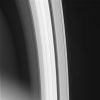
The Rings from approx. 7.553.000 Km.jpgThe Rings from app.x 7.553.000 Km66 visitenessun commento
|
|
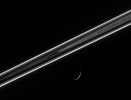
The Rings&Dione-PIA08201.jpgLike Neon-Lights...63 visiteCaption originale:"The dark side of the Ring-Plane glows with scattered light, including the luminous F-Ring, which shines like a rope of brilliant neon.
Below, Dione (1.126 Km, or 700 miles across) presents an exquisitely thin crescent.
The image was taken using a spectral filter sensitive to wavelengths of infrared light centered at 930 nanometers and it was acquired with the Cassini spacecraft narrow-angle camera on May 3, 2006 at a distance of approx. 1,8 MKM (about 1,1 MMs) from Dione and at a phase angle of 160°. Image scale is roughly 11 Km (about 7 miles) per pixel".
|
|

The Rings-2-PIA07872.jpgThe "Rings": the most spectacular view ever seen!66 visiteSpecially designed Cassini orbits place Earth and Cassini on opposite sides of Saturn's rings, a geometry known as "occultation". Cassini conducted the 1st radio occultation observation of Saturn's Rings on May 3, 2005.
Three simultaneous radio signals of 0,94; 3,6, and 13 cm wavelengths (Ka-, X-, and S-bands) were sent from Cassini through the rings to Earth. The observed change of each signal as Cassini moved behind the Rings provided a profile of the distribution of ring material as a function of distance from Saturn, or an optical depth profile.
This simulated image was constructed from the measured optical depth profiles. It depicts the observed ring structure at about 10 Km in resolution. Color is used to represent information about ring particle sizes in different regions based on the measured effects of the 3 radio signals. Shades of purple, primarily over most of the inner ring (ring B) and the inner portion of the next ring (ring A), indicate regions where there is a lack of particles less than 5 centimeters (about 2 inches) in diameter. Green and blue shades indicate regions where there are particles of sizes smaller than 5 centimeters (2 inches) and 1 centimeter (less than one third of an inch), respectively, primarily in outer ring A and within most of ring C. From other evidence in the radio observations, all ring regions appear to be populated by a broad range of particle size distribution that extends to boulder sizes (several to many meters or yards across).
|
|

The Rings-Bulge-PIA07651.jpgA "bulge" in the F-Ring?!?62 visiteViewing Saturn's Rings very close to edge-on produces some puzzling effects, as these 2 images of the F-Ring demonstrate: the upper image was acquired from less than 1/10th of 1° beneath the RingPlane and shows a mysterious bulge. Such a feature has not been seen previously by the Cassini spacecraft from this angle. It is possible that, because of the very shallow viewing angle, the Cassini spacecraft's view takes a long path through the Ring, making very faint material visible. It also may be that an embedded object of about 1 Km stirs up the neighboring ring particles to create a bulge. Alternatively, an impact into an embedded moonlet that was covered with debris could produce a cloud like this. Images taken by the Voyager spacecrafts showed clumps that might have been produced in these ways. Cassini's investigations will help to determine the vertical extent of such clumps and understand their origins.
The lower image was obtained from less than a hundredth of a degree beneath the ringplane. Across the center of the rings is a dark lane, giving them an appearance not unlike that of a spiral galaxy, seen edge-on.
|
|
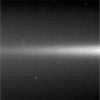
The Rings-GRing-N00055772.jpgN00055772: the motion of Cassini65 visiteData:"N00055772.jpg was taken on March 21, 2006 and received on Earth March 22, 2006. The camera was pointing toward Saturn's G-Ring that, at the time, was approximately 749.522 Km away.
The image was taken using the CL1 and CL2 filters. This image has not been validated or calibrated".
|
|

The Rings-N00021001.jpgThe "Rings"88 visiteAltissima definizione per questa spettacolare veduta degli Anelli di Saturno: un'immagine - almeno apparentemente - perfetta.
E meno male che, secondo alcuni (le solite "Cassandre"...), la Sonda Cassini-Huygens, su Saturno (oppure in orbita attorno a Saturno) non ci sarebbe mai arrivata...
|
|

The Rings-N00032099.jpgThe "clumpy" F-Ring and two Shepherd Moons78 visiteUna spettacolare inquadratura dell'Anello F di Saturno il quale, come sapete si caratterizza (anche) a causa delle sue numerose irregolarità ed increspature (che alla NASA chiamano clumps---->grumi/agglomerati) che dovrebbero essere dovute all'azione mareale di Lune-Pastore come Pandora ed Atlas, per esempio.
|
|

The Rings-N00034622.jpgSunshine and stars, through the F-Ring!64 visiteUn'immagine davvero molto bella e suggestiva; inutili altri commenti.
|
|

The Rings-N00034670.jpgThe 'clumpy' F-Ring68 visiteUn frame HD che ci mostra, con ampio dettaglio, le 'imperfezioni' (cioè i 'clumps'------> addensamenti, nodi, blocchi et sim.) che caratterizzano questo sottile, ma sempre affascinante, Anello "F".
|
|
| 2243 immagini su 187 pagina(e) |
 |
|
|
|
|
170 | |
|
|
|
|








