Saturn: the "Ringed Beauty" and His Moons
|
|
|

Tethys.pngTethys and the Sun (possible Natural Colors; credits for the additional process. and color.: Marco Faccin and E. Bonora)119 visitenessun commentoMareKromium
|
|
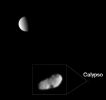
Tethys_and_Calypso-PIA09735.jpgTethys and Calypso64 visiteCaption NASA:"Two companion moons share the sky before the Cassini Spacecraft. Tethys is seen here with one of its two Trojan moons. Calypso, which trails the larger moon in its orbit by 60°, is a couple of pixels across near lower right. Telesto (not pictured) is the other Tethys co-orbital moon, leading Tethys by 60°.
The image was taken in visible light with the Cassini spacecraft narrow-angle camera on Aug. 25, 2007. The view was obtained at a distance of approx. 2,2 MKM (about 1,4 MMs) from Tethys.
Image scale is roughly 13 Km (about 8 miles) per pixel on Tethys".MareKromium
|
|
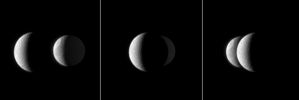
Tethys_and_Dione-PIA12534.jpgMutual Event in the Space of Saturn: Tethys and Dione66 visiteCaption NASA:"From the Cassini Spacecraft's perspective, Saturn's moon Dione passes in front of the moon Tethys in this "Mutual Event".
These 3 images were each taken about one minute apart. These images are part of a Mutual Event Sequence in which one moon passes close to or in front of another. Such observations help scientists refine their understanding of the orbits of Saturn's moons.
Brightly lit Terrain seen here is on the anti-Saturn side of Dione and between the Leading Hemisphere and anti-Saturn side of Tethys. The large Odysseus Crater is visible on Tethys. Tethys is approx.2,6 MKM (about 1,6 MMs) from Cassini. Dione is spprox. 2,2 MKM (such as about 1,4 MMs) away.
Sunlight reflected by Saturn, which is out of the frame to the right, is lighting up the side of Tethys that is away from the Sun, but due to the Spacecraft's viewing angle and the relative positions of each body, this is not true for Dione.
The images were taken in Visible Light with the Cassini pacecraft narrow-angle camera on Nov. 28, 2009. Scale in the original images was roughly 13 Km (a little more than 8 miles) per pixel on Dione and about 16 Km (approx. 10 miles) per pixel on Tethys.
The images were contrast enhanced and magnified by a factor of 1.5 to enhance the visibility of Surface Features on both moons".MareKromium
|
|
Tethys_and_Enceladus-N00144766-N00144785.gifOrbit after Orbit... (GIF-Movie; credits: Dr G. Barca)74 visitenessun commentoMareKromium
|
|
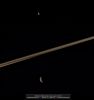
Tethys_and_Mimas-EB-LXTT.jpgSo close, and yet so Far: Tethys and Mimas (Natural Colors; credits: Elisabetta Bonora - Lunexit Team)74 visitenessun commentoMareKromium
|
|

Tethys_and_Rhea-N00147318-N00147337.gifSilent Running: Tethys and Rhea (GIF-Movie; credits: Elisabetta Bonora)64 visitenessun commentoMareKromium
|
|

Tethys_and_Saturn-PIA18318-PCF-LXTT-IPF.jpgFather and Daughter... (Absolute Natural Colors; credits for the additional process. and color.: Dr Paolo C. Fienga - Lunexit Team)82 visiteThe two large Impact Craters on Tethys, near the line where the day fades into the night (the so-called "Terminator Line"), almost resemble two giant eyes observing Saturn. The location of these aforementioned Impact Craters on Tethys' Terminator throws their topography into sharp relief. Both are large Impact Craters, but the larger and Southernmost of the two, shows a more complex structure.
The angle of the lighting highlights a Central Peak in this Crater. In fact, Central Peaks are the final and well visible result of the Surface (of the impacted Celestial Body) reacting to the violent Post-Impact Excavation of the Crater itself. On the other hand, the Northern Crater does not show a similar Surface Feature. Why? No one knows for sure but, possibly, the impact was too small (better yet: to small AND slow) to form a Central Peak or, maybe, the composition of the Materials located in the immediate vicinities of the Impact Area couldn't support the formation of a Central Peak. In this image, Tethys is significantly closer to the NASA - Cassini Spacecraft's Wide-Angle Camera, while the Ringed Gas-Giant Planet (---> Saturn) is in the background. And yet, the moon is still utterly dwarfed by Saturn.
This view looks toward the Anti-Saturn Side of Tethys; North is up and rotated 42° to the right (Dx). The image was taken in Visible Light with the NASA - Cassini Spacecraft's Wide-Angle Camera on April 11, 2015. The view was obtained at a distance of approximately 75.000 miles (such as about 120.700,5 Km) from Tethys and the Image Scale on Tethys is roughly 4 miles (such as about 6,437 Km) per pixel.
This frame (which is an Original NASA - CASSINI Spacecraft's b/w and NON Map-Projected image published on the NASA - Planetary Photojournal with the ID n. PIA 18318) has been additionally processed, contrast enhanced, magnified, in order to allow the vision of the slightest details of the Surface, Gamma corrected and then colorized - according to an educated guess (or, if you wish, an informed speculation) carried out by Dr Paolo C. Fienga - in Absolute Natural Colors (such as the colors that a human eye would actually perceive if someone were onboard the NASA - Cassini Spacecraft and then looked outside, toward Saturn and the Saturnian moon "Tethys"), by using an original technique created - and, in time, dramatically improved - by the Lunar Explorer Italia Team. Different colors, as well as different shades of the same color, mean, among other things, the existence of different Elements (Gases and Minerals, respectively) present in the Atmosphere of Saturn, and on the Surface of Tethys, each having a different Albedo (---> Reflectivity) and Chemical Composition.
Note: it is possible (but we, as IPF, have no way to be one-hundred-percent sure of such a circumstance), that the actual luminosity of Saturn and Tethys - as it is in this frame - would appear, to an average human eye, a little bit lower than it has been shown (or, better yet: interpreted) here.MareKromium
|
|

The C-Ring-PIA06537_modest.jpgThe C-Ring in full detail67 visiteCaption NASA originale: "Saturn's inner C-Ring spreads across the field of view, showing the characteristic plateau and wave-like structure for which it is famed.
The center of this image shows an area approximately 75.000 Km from Saturn. The dark gap through the middle of the frame is the Colombo gap which houses the bright, narrow, eccentric Colombo ringlet, in resonance with the moon Titan.
The image was taken with the Cassini spacecraft narrow angle camera on Oct. 29, 2004, at a distance of about 842.000 Km from Saturn. The image scale is 4.7 Km per pixel".
|
|
The E-Ring - W00002645.jpgThe "E-Ring" from approx. 415.000 Km75 visitenessun commento
|
|
The E-Ring - W00002666.jpgThe "E-Ring" from approx. 411.000 Km63 visiteUn'immagine spettacolare ma assolutamente enigmatica: dalla distanza da cui è stata effettuata questa ripresa, infatti, la reale tessitura dell'Anello "E" non è ancora risolvibile. Certo, si vedono già molte cose ("clumps" e "punti luminosi" abbastanza ben definiti) ma, secondo noi, interpretarle in questo momento ed usando solo i pochi dati a nostra disposizione, equivarrebbe - in fondo - a "tirare ad indovinare". Per cui aspettiamo ancora un pò...
|
|
The E-Ring - W00002680.jpgThe "E-Ring" from approx. 412.000 Km62 visiteUn'immagine davvero ravvicinata (sempre in termini spaziali, come ovvio...) dell'Anello "E" di Saturno, inquadrato da una distanza inferiore al mezzo milione di Km.
Una visione decisamente spettacolare ed enigmatica, davvero.
|
|

The F-Ring - N00023767.jpgThe "F-Ring" of Saturn from approx. 544.000 Km62 visiteUna spettacolare ripresa (una delle tantissime, a dire il vero) del misterioso "F-Ring" di Saturno da una distanza - relativamente - breve: poco più di mezzo milione di Km. Svariati dettagli di questo enigmatico anello sono chiaramente visibili e, in particolare, potete vedere i cosiddetti "clumps", ossìa una specie di "grumi" di roccia e detriti che rendono irregolari alcune sezioni dell'anello (in particolare ce ne sono 4 assai ben visibili in basso ed alla Vostra Dx).
Sul margine superiore interno dell'Anello, alla Dx dell'Osservatore, si vede un puntino bianco che potrebbe essere (ma di questo non ne siamo certi) un altro "Ring Master" oppure, se preferite, una "Shepherd Moon". Due modi e due nomi diversi per indicare una piccolissima Luna di Saturno che, con la sua sola presenza, contribuisce a mantenere in equilibrio il sistema degli anelli - da un lato - e, talvolta, ad "incresparlo" - dall'altro.
|
|
| 2243 immagini su 187 pagina(e) |
 |
|
|
|
|
167 | |
|
|
|
|








