Saturn: the "Ringed Beauty" and His Moons
|
|
|

Tethys-PIA08401.jpgThe Edge of Tethys63 visiteThe cold, cratered landscape of Saturn's moon Tethys shines in stark relief in this crescent view. Aside from its obvious aesthetic beauty, this particular Cassini mosaic was obtained mainly to understand important details about how the surface of Tethys reflects light at high phase angles (the Sun-Tethys-Spacecraft viewing angle). The beautiful interplay of light with surface topographic features is an important factor in this regard. The surface is heavily cratered, and at this oblique angle the craters give the surface a highly scalloped appearance.
Unlike some HR crescent views of Saturn's moons, this image truly gives Tethys the appearance of being composed of ice and frost. There appear to be numerous sun glints sparkling across the surface. Some of these might be specular (or mirror-like) reflections off of exposed walls of solid ice inside craters, or they might be uniformly large, frosty or icy-particle covered facets of topography that are so oriented as to give exceptionally bright but diffuse reflections.
The shadows cast by most craters in the scene are not dark, but rather, they are illuminated by light bouncing off of their sunlit walls and those of other craters. This light, which has been scattered multiple times, makes visible some details along the shadowed walls and floors of craters that would not otherwise be visible in this viewing geometry.
This mosaic was assembled from four clear filter, narrow-angle camera images, with low resolution, wide-angle camera data filling a small gap in coverage. The view is an orthographic projection and has a resolution of 211 meters (692 feet) per pixel. An orthographic view is most like the view seen by a distant observer looking through a telescope. North is up.
The view was obtained by the Cassini spacecraft on June 29, 2007, from a distance of approximately 38.000 Km (about 24.000 miles) and at a Sun-Tethys-Spacecraft, or phase, angle of 152°.
MareKromium
|
|
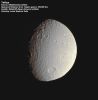
Tethys-PIA08967.jpgTethys (natural colors - elab. Lunexit)76 visiteCaption NASA:"The Cassini spacecraft surveys the battered surface of icy Tethys. The great impact basin straddling the Terminator is itself overprinted by many smaller impact sites.
The view in this image is toward the Southern Hemisphere on the moon's Saturn-facing side. North on Tethys is up and rotated 7° to the right.
The image was taken in visible light with the Cassini spacecraft narrow-angle camera on May 11, 2007. The view was obtained at a distance of approx. 559.000 Km (such as about 347.000 miles) from Tethys and at a phase angle of 60°.
Image scale is roughly 3 Km (about 2 miles) per pixel".MareKromium
|
|

Tethys-PIA08974-1.jpgTethys (natural colors - elab. Lunexit)64 visiteCaption NASA:"Ithaca Chasma rips across Tethys from North to South near the center of this view. The moon's western limb is flattened, indicating the rim of the giant impact basin Odysseus.
The dark, East-West trending band often observed in this region (see PIA07571) is just visible here, but its contrast is reversed at these short, ultraviolet wavelengths -- it is bright against the already bright terrain.
North on Tethys (1071 Km, or about 665 miles across) is up and rotated 24° to the left. This view looks toward the moon's Saturn-Facing Hemisphere.
The image was taken with the Cassini spacecraft narrow-angle camera on May 27, 2007 using a combination of spectral filters sensitive to wavelengths of light centered at 298 and 338 nanometers. The view was obtained at a distance of approx. 267.000 Km (about 166.000 miles) from Tethys and at a Sun-Tethys-spacecraft, or phase, angle of 13°.
Image scale is roughly 2 Km (5.236 feet) per pixel".MareKromium
|
|

Tethys-PIA09017.jpgOdysseus74 visiteCaption NASA:"The Cassini spacecraft provides a stunning view of the Odysseus impact basin on Tethys. The enormous basin is about 450 Km (approx. 280 miles) wide.
The medium-sized crater Melanthius is seen along the Terminator at lower left.
This view looks toward the Leading Hemisphere of Tethys. North is up.
The image was taken in visible light with the Cassini spacecraft narrow-angle camera on July 21, 2007. The view was obtained at a distance of approx. 211.000 Km (such as about 131000 miles) from Tethys and at a Sun-Tethys-spacecraft, or phase, angle of 46°.
Image scale is 1 kilometer (0.6 mile) per pixel".MareKromium
|
|
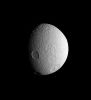
Tethys-PIA09723.jpgThe "Scars" of Tethys...74 visiteCaption NASA:"The Cassini spacecraft spies four large impact basins on the Southern Hemisphere of icy Tethys.
Tethys (approx. 1071 Km, or 665 miles across), like the other airless worlds of the Solar System, wears the record of countless impacts experienced over the eons.
Lit terrain seen here is on the leading hemisphere of Tethys. North is up and rotated 15° to the left.
The image was taken in visible light with the Cassini spacecraft narrow-angle camera on July 21, 2007. The view was obtained at a distance of approx. 452.000 Km (such as about 281.000 miles) from Tethys and at a Sun-Tethys-spacecraft, or phase, angle of 54°.
Image scale is roughly 3 Km (about 2 miles) per pixel".MareKromium
|
|

Tethys-PIA09737.jpgCrescent Tethys72 visiteCaption NASA:"The pockmarked crescent of Tethys displays slightly darker terrain in a band at its Equator. The rim of the great crater Odysseus lurks on the Terminator.
Lit terrain seen here is on the Leading Hemisphere of Tethys. North is up.
The image was taken in visible light with the Cassini spacecraft wide-angle camera on Aug. 29, 2007. The view was obtained at a distance of approx. 56.000 Km (such as about 35.000 miles) from Tethys and at a Sun-Tethys-spacecraft, or phase, angle of 105°.
Image scale is roughly 3 Km (about 2 miles) per pixel".MareKromium
|
|

Tethys-PIA09766.jpgThe "Dark Belt" of Tethys137 visiteCaption NASA:"Around the Equator on its Leading Side, Tethys wears a band of slightly darker surface material. Cassini Imaging Scientists suspect that the darkened region may represent an area of less contaminated ice with differently sized grains than the material at higher latitudes on either side of the band.
Lit terrain seen here is on the Saturn-facing side of Tethys. North is up. Part of the great canyon system Ithaca Chasma can be seen near the eastern limb in this frame-filling view.
The image was taken with the Cassini spacecraft narrow-angle camera on Sept. 30, 2007 using a spectral filter sensitive to wavelengths of infrared light centered at 930 nanometers. The view was acquired at a distance of approx. 186.000 Km (such as about 116.000 miles) from Tethys and at a Sun-Tethys-spacecraft, or phase, angle of 62°.
Image scale is roughly 1 Km (about 0,6 mile) per pixel".MareKromium
|
|

Tethys-PIA09788.jpgTrue Colors?74 visiteCaption NASA:"As seen from the side not illuminated by the Sun, Saturn's thinner Rings are highlighted in shades of brown and gold, contrasting with the more neutral appearance of the icy moon Tethys. The A-Ring and Cassini Division are separated by the optically thick B-Ring, which does not permit sunlight to penetrate and appears as the broad, dark lane between them in this view.
This view looks toward the anti-Saturn side of Tethys.
North is up and rotated 35° to the right.
The view looks toward the unilluminated side of the rings from about 2° above the Ring-Plane.
Images taken using red, green and blue spectral filters were combined to create this natural color view. The view was acquired with the Cassini spacecraft narrow-angle camera on Oct. 29, 2007, at a distance of approx. 2,1 MKM (about 1,3 MMs) from Tethys and at a Sun-Tethys-spacecraft, or phase, angle of 21°.
Image scale is roughly 12 kilometers (8 miles) per pixel".MareKromium
|
|
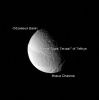
Tethys-PIA09835.jpgThe Main Surface Features of Tethys63 visiteCaption NASA:"This view of Tethys displays 3 of the moon's most notable surface features. At upper left is the giant Odysseus impact basin. At lower right is the great scar of Ithaca Chasma. Extending from east to west across the moon is the great swath of terrain that appears slightly darker than the rest of the moon's surface.
This view looks toward the Saturn-facing side of Tethys (1071 Km, or approx. 665 miles across) from 33° above the Equator. North is up.
The image was taken in visible light with the Cassini spacecraft narrow-angle camera on Jan. 14, 2008. The view was obtained at a distance of approx. 1,2 MKM (such as about 715.000 miles) from Tethys and at a Sun-Tethys-Spacecraft, or phase, angle of 70°.
Image scale is roughly 7 Km (about 4 miles) per pixel".MareKromium
|
|
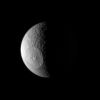
Tethys-PIA09878.jpgOdysseus in the Light69 visiteCaption NASA:"The Cassini spacecraft looks down onto high Northern Latitudes on Tethys, spying the enormous impact basin Odysseus.
Lit terrain seen here is on the anti-Saturn side of Tethys. North is towards the top of the image.
The image was taken in visible light with the Cassini spacecraft narrow-angle camera on March 11, 2008. The view was acquired at a distance of approx. 765.000 Km (such as about 475.000 miles) from Tethys and at a Sun-Tethys-Spacecraft angle of 97°.
Image scale is roughly 5 Km (about 3 miles) per pixel".MareKromium
|
|

Tethys-PIA09903.jpgIcy Impact: the Odysseus Basin on Tethys68 visiteCaption NASA:"The enormous Impact Basin Odysseus sits on the Eastern Limb of icy Tethys.
This view looks toward the Anti-Saturn side of Tethys and North is toward the top of the picture.
The image was taken with the Cassini Spacecraft narrow-angle camera on April 14, 2008 using a spectral filter sensitive to wavelengths of ultraviolet light centered at 338 nanometers. The view was obtained at a distance of approx. 1,1 MKM (such as about 714.000 miles) from Tethys and at a Phase Angle of 26°.
Image scale is roughly 7 Km (about 4 miles) per pixel".MareKromium
|
|

Tethys-PIA09915-0.jpgTethys (MULTISPECTRUM-2; credits: Lunexit)75 visiteCaption NASA:"From a highly inclined orbit, the Cassini Spacecraft looks toward far Northern Latitudes on Tethys.
Here, the spacecraft was above a position about 45° North of the moon's Equator.
This vantage point afforded a view of the moon's three most recognizable features: the Ithaca Chasma Canyon System (at lower right), Odysseus Crater (at upper left) and the Equatorial Band of Darker Terrain (at lower left).
Lit terrain seen here is on the Leading Hemisphere of Tethys (1062 Km, or approx. 660 miles across). North is up.
The image was taken in visible light with the Cassini spacecraft narrow-angle camera on April 29, 2008. The view was obtained at a distance of approx. 991.000 Km (such as about 616.000 miles) from Tethys and at Phase Angle of 73°.
Image scale is roughly 6 Km (about 4 miles) per pixel".MareKromium
|
|
| 2243 immagini su 187 pagina(e) |
 |
|
|
|
|
164 | |
|
|
|
|








