Saturn: the "Ringed Beauty" and His Moons
|
|
|

Tethys-PIA07693.jpgOdysseus (elab. Lunexit)65 visitenessun commentoMareKromium
|
|

Tethys-PIA07698.jpgSmiling Tethys...63 visiteCaption originale: "The profile of Ithaca Chasma forms a great scar in the icy crescent of Tethys. The chasm stretches more than a 1.000 Km (about 620 miles) over Tethys' surface, from North to South.
The image was taken in visible light with the Cassini spacecraft narrow-angle camera on Dec. 25, 2005 at a distance of approximately 313.000 Km (about 195.000 miles) from Tethys and at a Sun-Tethys-spacecraft, or phase, angle of 151°. Image scale is about 2 Km (approx. 1 mile) per pixel".
|
|

Tethys-PIA07734.jpgIthaca Chasma and the "steep scarps" of Tethys66 visiteOriginal caption: "This view of the surface of Saturn's moon Tethys, taken during Cassini's close approach to the moon on Sept. 24, 2005, reveals an icy land of steep cliffs. The view is of the southernmost extent of Ithaca Chasma, in a Region not seen by NASA's Voyager spacecraft.
The ridges around Ithaca Chasma have been thoroughly hammered by impacts.
This appearance suggests that Ithaca Chasma as a whole is very old. There is brighter material in the floors of many craters on Tethys.
That's the opposite situation from Saturn's oddly tumbling moon Hyperion, where dark material is concentrated in the bottoms of many craters.
This view is centered on terrain at approximately 2,5° South Latitude and 352° West Longitude on Tethys. North on Tethys is toward the right in this view.
This clear filter view was obtained using the Cassini spacecraft narrow-angle camera at a distance of approximately 32.300 Km (roughly 20.000 miles) from Tethys and at a phase angle of 20°. The image scale is 190 mt per pixel".
|
|
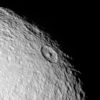
Tethys-PIA07735.jpgTelemachus and Teiresias75 visiteOriginal caption: "The Northern Polar Region of Saturn's moon Tethys seen in this Cassini flyby image is a ponderously ancient surface.
Above the prominent peaked crater Telemachus are the remnants of a very old crater (at the 10 o'clock position relative to Telemachus) named Teiresias.
The ancient impact site is so badly overprinted and eroded by impact weathering and degradation that all that remains is a circular pattern of hummocks that mark where the old crater rim existed.
This view is centered on terrain at approximately 1,2° South Latitude and 342° West Longitude on Tethys. The view is rotated so that North is about 40° to the right.
This clear filter view was taken during Cassini's close approach to Tethys on Sept. 24, 2005. The image was acquired using the Cassini spacecraft narrow-angle camera at a distance of approximately 69,200 kilometers (43,000 miles) from Tethys and at a Sun-Tethys-spacecraft, or phase, angle of 21°. Image scale is 410 mt per pixel".
|
|

Tethys-PIA07736.jpgLandslides on Tethys (HR)65 visiteOriginal caption: "This view is among the closest Cassini images of Tethys' icy surface taken during the Sept. 24, 2005 flyby. This image is a clear-filter view and is the highest resolution image acquired by Cassini during the encounter.
The two large craters at the right show evidence that landslides have modified their outlines and covered their floors with large quantities of debris. Linear depressions cutting across the terrain probably mark the surface expressions of faults or fractures.
This view is centered on terrain at approx. 4,2° South Latitude and 357° West Longitude on Tethys. The image has been rotated so that North on Tethys is up.
The view was obtained using the Cassini spacecraft narrow-angle camera at a distance of approx. 19.000 Km (about 11.800 miles) from Tethys and at a Sun-Tethys-spacecraft, or phase, angle of 17°.
Image scale is 110 mt (360 feet) per pixel".
|
|

Tethys-PIA07737.jpgLandslides on Tethys (HR & false colors)64 visiteOriginal caption: "This false-color image, created with infrared, green and ultraviolet frames, reveals a wide variety of surface colors across this terrain.
The presence of this variety at such small scales may indicate a mixture of different surface materials. Tethys was previously known to have color differences on its surface, especially on its trailing side, but this kind of color diversity is new to imaging scientists.
This view is centered on terrain at approx. 4,2° South Latitude and 357° West Longitude on Tethys. The view has been rotated so that North on Tethys is up.
The images for this view were obtained using the Cassini spacecraft narrow-angle camera at distances ranging from approx. 18.400 to 19.000 Km (about 11.400 to 11.800 miles) from Tethys and at a Sun-Tethys-spacecraft, or phase, angle of 17°. Image scale is 213 mt (700 feet) per pixel".
|
|

Tethys-PIA08149.jpgPenelope is always waiting...77 visiteCaption NASA originale:"This dramatic close-up of Tethys shows the large crater Penelope lying near center, overprinted by many smaller, younger impact sites. Three smaller impact features of roughly similar size make a line left of Penelope that runs North-South: (from bottom) Ajax, Polyphemus and Phemius.
Features on Tethys are named for characters and places from "The Iliad" and "The Odyssey". The largest impact structure on Tethys is named Odysseus.
This view is toward the Saturn-facing Hemisphere on Tethys and North is up.
This image was taken in polarized ultraviolet light with the Cassini spacecraft narrow-angle camera on Feb. 25, 2006 at a distance of approximately 165.000 Km (about 103.000 miles) from Tethys and at a Sun-Tethys-spacecraft, or phase, angle of 23°.
Image scale is about 984 meters (approx. 3.227 feet) per pixel".
|
|

Tethys-PIA08254-0.jpgMelanthius Crater (context image)67 visitenessun commento
|
|

Tethys-PIA08254-1.jpgMelanthius Crater (detail mgnf)62 visiteCaption NASA:"Cassini looks into the 245-Km (150-mile) wide crater Melanthius in this view of the Southern Terrain on Tethys. The crater possesses a prominent cluster of peaks in its center which are relics of its formation.
Notable here is a distinct boundary in crater abundance -- the cratering density is much higher in the farthest Western Terrain (left side of the image) than elsewhere.
North on Tethys is up and rotated 45° to the left.
The image was taken in visible light with the Cassini spacecraft narrow-angle camera on July 23, 2006 at a distance of approx. 120.000 Km (such as about 75.000 miles) from Tethys and at a Sun-Tethys-spacecraft, or phase, angle of 29°.
Image scale is roughly 715 mt (such as about 2,345 feet) per pixel".
|
|

Tethys-PIA08284-1.jpgTethys' transition (false colors)72 visiteCaption NASA originale:"An extreme false-color view of Tethys reveals a surface detail not visible in a monochrome view taken at the same time. The false-color view shows a color transition from the moon's Saturn-facing side (left) to a region its trailing side (bottom).
Near the top of the images, the central-peaked crater Telemachus lies in the deeply grooved terrain that marks the northern reaches of Ithaca Chasma.
To create the false-color view, ultraviolet, green and infrared images were combined into a single picture that isolates and maps regional color differences. This "color map" was then superposed over a clear-filter image that preserves the relative brightness across the body.
The combination of color map and brightness image shows how colors vary across Tethys' surface. The origin of the color differences is not yet understood, but may be caused by subtle differences in the surface composition or the sizes of grains making up the icy surface material".
|
|

Tethys-PIA08291.jpgTethys64 visiteCaption NASA:"Tethys has a crater-saturated surface, where older, larger basins have been completely overprinted by newer, smaller impacts. This state is what scientists expect to see on a very old surface, where small impactors have struck more frequently than larger ones over several billion years. Larger impacts were more common events in the early history of the Solar System.
This view looks toward the Leading Hemisphere of Tethys (1.071 Km, or about 665 miles across). North is up. The great scar of Ithaca Chasma is seen at right.
The view was captured in visible light with the Cassini spacecraft narrow-angle camera on Sept. 25, 2006 at a distance of approx. 449.000 Km (such as about 279.000 miles) from Tethys and at a phase angle of 49°. Image scale is roughly 3 Km (about 2 miles) per pixel".
|
|

Tethys-PIA08400.jpgOdysseus is looking up!63 visiteThe vast expanse of the crater Odysseus spreads out below Cassini in this mosaic view of Saturn's moon Tethys.
The crater (about 450 Km or approx. 280 miles across) is a remarkably well-preserved example of an ancient multi-ringed impact basin: the outer ring is defined by steep, cliff-like walls that descend to generally broad internal terraces. The inner ring is formed by a prominent, crown-shaped, 140-Km (88-mile) diameter circular band of icy mountains. Multi-ring basins are seen on rocky bodies as well as icy ones.
The complex internal structure and multi-ringed nature of these very large basins are believed to arise from the rebound of intense shock waves that penetrated the body at the time of impact.
This mosaic was assembled from four clear filter, narrow-angle camera images. The view is an orthographic projection centered on 3° South Latitude, 119° West Longitude and has a resolution of 572 meters (0,35 mile) per pixel. An orthographic view is most like the view seen by a distant observer looking through a telescope. North is up.
The view was obtained by the Cassini spacecraft on Aug. 30, 2007, from a distance of approximately 97.000 Km (about 60.000 miles) and at a Sun-Tethys-Spacecraft, or phase, angle of 51°.MareKromium
|
|
| 2243 immagini su 187 pagina(e) |
 |
|
|
|
|
163 | |
|
|
|
|








