Saturn: the "Ringed Beauty" and His Moons
|
|
|

Tethys-PIA06590.jpgTethys from approx. 1,9 MKM63 visiteCaption NASA originale:"This Cassini view of Saturn's moon Tethys shows several large craters near the moon's eastern limb. These craters have fanciful names such as Phemius, Polyphemus and Ajax. The moon's massive rift-like canyon system, Ithaca Chasma, is in the darkness to the west. The image has been rotated so that north on Tethys is up and this view shows mainly the moon's trailing hemisphere. The image was taken in visible blue light with the Cassini spacecraft narrow angle camera on Jan. 19, 2005, at a distance of approximately 1,9 MKM (approx. 1,2 MMs) from Tethys and at a phase angle of 111°. Resolution in the original image was 11 Km (approx. 7 miles) per pixel. The image has been contrast-enhanced and magnified by a factor of two to aid visibility".
|
|
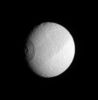
Tethys-PIA06625.jpgOdysseus: the "eye" of Tethys68 visiteCaption NASA originale:"Saturn's moon Tethys turns like a great eye as the enormous crater Odysseus (450 Km across) rotates into Cassini's view. The image was taken in visible light with the Cassini spacecraft narrow-angle camera on March 6, 2005, at a distance of approximately 1,7 MKM (approx. 1,1 MMs) from Tethys and from a Sun-Tethys-spacecraft, or phase, angle of 35°. The image scale is 10 Km (approx. 6 miles) per pixel. The image has been magnified by a factor of two and contrast- enhanced to aid visibility".
|
|

Tethys-PIA06632.jpgTethys (infrared vision) from approx. 1,4 MKM64 visiteCaption NASA originale:"In this infrared view, Saturn's cratered moon Tethys shows a faint, dark band across its equatorial region. North is up in this view.
The image was taken with the Cassini spacecraft narrow-angle camera on March 11, 2005, through a filter sensitive to wavelengths of infrared light centered at 930 nnmts. The view was acquired at a distance of approximately 1,4 MKM from Tethys and at a phase angle of 80°. Resolution in the original image was 8 Km per pixel.
The image has been contrast-enhanced and magnified by a factor of two to aid visibility".
|
|
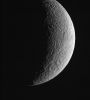
Tethys-PIA06633.jpgTethys (ultraviolet vision) from 200.000 Km64 visiteCaption NASA originale:" This view of Saturn's moon Tethys shows the contrast between the more heavily cratered region near the top and the more lightly cratered (and presumably younger) plains toward the bottom part of the image and near the limb. Some of the larger craters in the latter region appear to be somewhat subdued or filled in.
This view shows principally the anti-Saturn hemisphere on Tethys; North is up and tilted 20° to the left.
The image was taken with the Cassini spacecraft narrow-angle camera on March 9, 2005, through a filter sensitive to wavelengths of ultraviolet light centered at 338 nnmts. The view was obtained at a distance of approximately 200.000 Km from Tethys and at a phase angle of 120°. Resolution in the image is 1 Km (approx. 0,6 mile) per pixel".
|
|

Tethys-PIA07557_modest.jpgOdysseus: the Eye of Tethys62 visiteCaption NASA originale: "This richly textured look at Saturn's moon Tethys shows the huge crater Odysseus and its central mountain in relief, as well as many smaller impact sites. Vertical relief on solid Solar System bodies is often most easily visible near the terminator (the line between day and night).
North on Tethys is up in this view. The lit portion of Tethys seen here is on the moon's leading hemisphere as it orbits Saturn.
The image was taken in visible light with the Cassini spacecraft narrow-angle camera on June 27, 2005, at a distance of approximately 490.000 Km (approx 304.000 miles) from Tethys and at a Sun-Tethys-spacecraft, or phase, angle of 117°. The image scale is 3 Km (about 2 miles) per pixel".
|
|

Tethys-PIA07571.jpgTethys and...Odysseus74 visiteCaption NASA originale: "Saturn's moon Tethys displays its distinctive dark equatorial band here, along with two sizeable impact craters in the West. The larger crater to the North is Odysseus, which has a diameter (450 Km across) that is a substantial fraction of the Moon's width - remember that Tethys is 1.071 Km (about 665 miles) across.
Several moons in the Outer Solar System have large impact features like Odysseus and scientists are interested in learning how such powerful impacts have altered the moons' surfaces.
The image was taken in visible light with the Cassini spacecraft narrow-angle camera on July 10, 2005, at a distance of approx. 1,8 MKM (such as 1,1 MMs) from Tethys. The image scale is 11 Km (about 7 miles) per pixel. The image has been magnified by a factor of two to aid visibility".
|
|

Tethys-PIA07589.jpgOdysseus is "slicing" Tethis...62 visiteOriginal caption: "The profile of the 450-Km-wide (about 280 miles) Crater Odysseus makes this image look as if someone sliced off a chunk of Tethys. According to measurements made in Voyager images, the Crater rim rises to about 5 Km (approx. 3 miles) above the surrounding terrain.
This view shows territory eastward of a previously released Cassini view that looked more directly into the giant impact basin. Tethys' equatorial dark band can be seen here as well.
This view shows principally the Southern leading Hemisphere of Tethys. North is up and rotated 10° to the left.
The image was taken in visible light with the Cassini spacecraft narrow-angle camera on July 31, 2005, at a distance of approximately 1,3 MKM (approx. 800.000 miles) from Tethys and at a Sun-Tethys-spacecraft, or phase, angle of 18°. The image scale is 8 Km (about 5 miles) per pixel".
|
|

Tethys-PIA07607.jpgTethys and the Rings62 visiteOriginal caption: "The dramatic Ithaca Chasma carves an enormous gash for more than 1000 Km (about 620 miles) across Saturn's moon Tethys. Stretching across the top of this view are the B and A-Rings, separated by the Cassini Division. Ithaca Chasma is on the moon's Saturn-facing Hemisphere.
North on Tethys is up and rotated 15° to the left in this view.
This image was taken in visible light with the Cassini spacecraft narrow-angle camera on Aug. 24, 2005, at a distance of approx. 2,2 MKM (such as about 1,3 MMs) from Tethys and at a Sun-Tethys-spacecraft angle of 87°. The image scale is 13 Km (about 8 miles) per pixel".
|
|
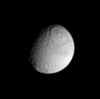
Tethys-PIA07622.jpgOdysseus and Melanthius64 visiteOriginal caption: "Cassini offers up this nice view of the craters Odysseus (at the top) and Melanthius (at the bottom) on Saturn's moon Tethys. Melanthius appears to have an elongated mountain range, rather than a single central peak, at its center.
This is the trailing hemisphere of Tethys, being centered on terrain at roughly 270° Longitude. North on Tethys is up.
This image was taken with the Cassini spacecraft narrow-angle camera on Sept. 20, 2005, through a filter sensitive to wavelengths of ultraviolet light centered at 338 nanometers.
This view was obtained at a distance of approx. 1,4 MKM (about 900.000 miles) from Tethys and at a phase angle of 50°. Resolution in the original image was 8 Km (about 5 miles) per pixel. The image has been magnified by a factor of 2 to aid visibility".
|
|
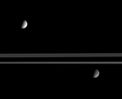
Tethys-PIA07623.jpgTethys and Dione64 visiteOriginal caption: "Saturn's expansive Rings separate the moon's Tethys (at the top) from Dione (at the bottom). Even in this distant view, it is easy to see that the moons' surfaces, and likely their evolutionary paths, are very different.
Both moons are on the far side of the Rings in this scene, which shows their Saturn-facing Hemispheres (terrain centered on 0° Long.). The dark shadow across the rings is cast by Saturn's Southern Hemisphere.
Note that the diameter of Tethys is about 1.071 Km while the diameter of Dione is approx. 1.126 Km.
This image was taken in visible light with the Cassini spacecraft narrow-angle camera on Sept. 12, 2005, at a distance of approx. 2,4 MKM (such as about 1,5 MMs) from Saturn. The image scale is about 17 Km (about 11 miles) per pixel on the two moons".
|
|

Tethys-PIA07662.jpgGrand Canyon on Tethys74 visiteA crescent Tethys shows off its Grand Canyon, Ithaca Chasma, for which the moon is renowned. The chasm is about 100 Km (app.x 60 miles) across on average, and its up to 4 Km (about 2 miles) deep in places.
Ithaca Chasma is the most prominent sign of ancient geologic activity on Tethys, whose surface is characterized principally by heavy cratering.
The lit surface visible here is on the moon's Saturn-facing Hemisphere. North on Tethys is straight up.
The image was taken with the Cassini spacecraft narrow-angle camera on Nov. 28, 2005 using a filter sensitive to wavelengths of infrared light centered at 930 nnmts. The view was acquired from a distance of app.x 1,1 MKM (equivalent to about 700.000 miles) from Tethys and at a phase angle of 123°.
Resolution in the original image was 6 Km (about 4 miles) per pixel. The image has been magnified by a factor of two and contrast-enhanced to aid visibility.
|
|

Tethys-PIA07667.jpgTethys and Saturn, in "natural colors"64 visiteOriginal caption:"Tethys floats before the massive, golden-hued globe of Saturn in this natural color view. The thin, dark line of the Rings curves around the horizon at top.
Visible on Tethys are the huge craters Odysseus (top) and Melanthius (bottom). The view looks toward the anti-Saturn side of Tethys.
Images taken using red, green and blue spectral filters were combined to create this color view. Tethys is apparently darker than Saturn at these wavelengths. The edge of the Planet appears fuzzy, which may indicate that we are seeing haze layers that are separated from the main cloud deck.
The images were acquired by the Cassini spacecraft narrow-angle camera on Dec. 3, 2005, at a distance of approx. 2,5 MKM (about 1,6 MMs) from Saturn. The image scale is about 15 Km (app.x 9 miles) per pixel on Saturn and about 13 Km (app.x 8 miles) per pixel on Tethys".
|
|
| 2243 immagini su 187 pagina(e) |
 |
|
|
|
|
162 | |
|
|
|
|








