Saturn: the "Ringed Beauty" and His Moons
|
|
|

Tethys from Voyager2.jpgTethys, from Voyager 282 visiteCaption NASA originale:"Voyager 2 obtained this view of Saturn's moon Tethys on Aug.25 from a distance of 540.000 Km. It shows the numerous impact craters and fault valleys of a very ancient surface. Tethys itself is 1.090 km. (approx. 675 mi) in diameter and the great chasm seen at the top of this image extends about 1.700 Km (approx. 1.050 mi) halfway across the satellite. The largest impact crater visible here is 90 Km (approx. 55 mi) in diameter".
|
|

Tethys in natural colors-V2.jpgTethys in natural colors67 visiteCaption NASA originale:"Voyager 2 obtained this image of Tethys on Aug. 25, when the spacecraft was 594.000 Km from this moon of Saturn. This photograph was compiled from images taken through the violet, clear and green filters of Voyager's narrow-angle camera. Tethys shows two distinct types of terrain - bright, densely cratered regions and relatively dark, lightly cratered planes that extend in a broad belt across the satellite. The densely cratered terrain is believed to be part of the ancient crust of the satellite; the lightly cratered planes are thought to have been formed later by internal processes. Also clearly seen is a trough that runs parallel to the terminator (the day-night boundary, seen at right). This trough is an extension of the huge canyon system that also Voyager 1 saw and photographed . This system extends nearly 2/3rds the distance around Tethys".
|
|

Tethys&Co-PIA08165.jpgWonderful Trio, in Saturn's Space64 visiteCaption originale:"The three very different moons seen here provide targets of great interest for planetary scientists studying the Saturn System. Captured here by Cassini, along with the Rings, are Tethys at upper right, Enceladus below center and Janus at lower left.
Researchers study the orbital dance of Janus (181 Km, or about 113 miles across) with Epimetheus, tectonics and cratering on Tethys (1.071 Km, or approx. 665 miles across) and geyser activity on Enceladus (505 Km, or about 314 miles across). And these are only a few of the wonders that await exploration in the realm of the Ringed Planet.
The image was taken in visible light with the Cassini spacecraft narrow-angle camera on March 16, 2006, at a distance of approx. 2,4 MKM (such as about 1,5 MMs) from Tethys; 1,9 MKM (about 1,2 MMs) from Enceladus and 2,2 MKM (roughly 1,4 MMs) from Janus. The image scale is about 14 Km (appx. 9 miles) per pixel on Tethys, 11 Km (about 7 miles) p. px. on Enceladus and 13 Km (about 8 miles) p. px on Janus".
|
|
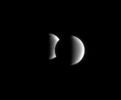
Tethys&Dione-PIA08134.jpgCrossing Spheres69 visiteCaption originale:"Dione steps in front of Tethys for a few minutes in an occultation - or "mutual event". These events occur frequently for the Cassini spacecraft when it is orbiting close to the Ring-Plane.
The image was taken in visible red light with the Cassini spacecraft narrow-angle camera on Feb. 10, 2006, at a distance of approx. 3,7 MKM(such as about 2,3 MMs) from Dione and approx. 4 MKM (about 2,5 MMs) from Tethys. Resolution in the original image was about 22 Km (approx. 14 miles) per pixel on Dione and about 24 Km (approx. 15 miles) per pixel on Tethys.
The image has been magnified by a factor of two.
|
|
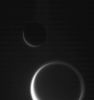
Tethys&Titan-PIA08124.jpgDancing in the dark76 visiteGhostly details make this dark scene more than just a beautiful grouping of two Saturn moons: Tethys and Titan.
In Titan's thick and inflated atmosphere, the detached high haze layer can be seen, as well as the complex Northern Polar "hood". Images like this one can help scientists make definitive estimates of the altitudes to which the high haze extends.
The faint vertical banded pattern is a type of noise that usually is removed during image processing.
Since this image was processed to enhance the visibility of details in Titan's atmosphere as well as in the faint G-Ring, the vertical noise was also enhanced.
This view was obtained in visible light with the Cassini spacecraft narrow-angle camera on Jan. 19, 2006, at a distance of approx. 2,4 MKM (such as about 1,5 MMs) from Titan and 1 MKM (about 600.000 miles) from Tethys. The image scale is 14 Km (about 9 miles) per pixel on Titan and 6 Km (about 4 miles) per pixel on Tethys.
|
|
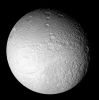
Tethys-CASSINI.jpgTethys66 visiteWhat processes formed the unusual Surface of Saturn's moon Tethys? To help find out, NASA sent the robotic Cassini Spacecraft right past the enigmatic ice moon in 2005. Pictured above is one of the HR images of an entire face of Tethys yet created. The pervasive white color of Tethys is thought to be created by fresh ice particles continually falling onto the moon from Saturn's diffuse E-Ring - particles expelled by Saturn's moon Enceladus. Some of the unusual cratering patterns on Tethys remain less well understood, however. Close inspection of the above image of Tethys' South Pole will reveal a great rift running diagonally down from the middle: Ithaca Chasma. A leading theory for the creation of this great canyon is anchored in the tremendous moon-wide surface cracking that likely occurred when Tethys' internal oceans froze.
If so, Tethys may once have harbored internal oceans, possibly similar to the underground oceans some hypothesize to exist under the surface of Enceladus today. Might ancient life be frozen down there?MareKromium
|
|

Tethys-HD3D-MF-LXTT.jpgCrescent Tethys (Hi-Def-3D; credits for the additional process.: Dr Marco Faccin - Lunexit Team)67 visitenessun commentoMareKromium
|
|

Tethys-IMG001589-br500.jpgItaca Chasma on Tethys64 visiteCaption NASA originale:"Saturn's icy moon Tethys displays a very old impact basin here, just South-East of its giant canyon system, Ithaca Chasma. The large crater has been degraded, or softened, by time and a more recent impact has formed a smaller crater near its southern edge. This large basin was first seen in images from the NASA Voyager mission. A sharper, presumably younger crater called Penelope lies near the eastern limb, at the 3 o'clock position. This view shows principally the trailing hemisphere on Tethys and North is directly up.
The image was taken in visible light with the Cassini spacecraft narrow-angle camera on May 20, 2005, at a distance of approx. 1 MKM (approx. 600.000 miles) from Tethys and at a Sun-Tethys-spacecraft, or phase, angle of 31°. Resolution in the original image was 6 Km (about 4 miles) per pixel. The image has been contrast-enhanced and magnified by a factor of two to aid visibility".
|
|
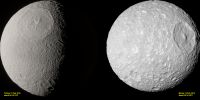
Tethys-Mimas-EB.jpgSaturnian Twins: Tethys and Mimas (Natural Colors - Image-Mosaic; credits: Elisabetta Bonora - Lunexit Team)79 visitenessun commentoMareKromium
|
|
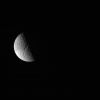
Tethys-N00025970.jpgTethys from approx. 564.000 Km63 visiteUn'ottima immagine di Tethys la quale, nonostante la grande distanza che ancora separa la Sonda Cassini/Huygens da questa luna, è già capace di rivelarci alcune delle tante caratteristiche superficiali di questa luna. Notiamo, in particolare, all'altezza dell'equatore di Tethys, a ridosso del terminatore (e con riflessi su una larga parte della sua superficie illuminata), la presenza di una profondissima cicatrice la quale, probabilmente, è la prova di un catastrofico impatto - occorso qualche milione di anni orsono - fra questa luna ed uno o più corpi vaganti di notevoli dimensioni. Le note oggettive della cicatrice più grande suggeriscono un angolo di impatto piuttosto basso. Non è neppure da escludersi la possibilità che Tethys sia stata colpita nella medesima area da (almeno) tre corpi celesti ed in epoche diverse e lontane fra loro (osservate infatti i 2 solchi quasi paralleli fra loro - ad ore 8 di Tethys - che intersecano, sovrapponendosi, il solco più grande che giunge sino al terminatore).
|
|

Tethys-N00028723.jpgTethys, Epimetheus and the Rings from approx. 1.226.000 Km90 visitenessun commento
|
|

Tethys-N00030191.jpgTethys from approx. 197.000 Km65 visiteDa una luna all'altra, viaggiando sulle "autostrade" che vengono disegnate dalle orbite della Sonda Cassini intorno a Saturno, così come si passa da una città all'altra, sulle autostrade del nostro Pianeta. Dopo Encelado, avvicinata, sfiorata e superata, adesso è la volta di Teti, le cui caratteristiche superficiali - come già potete vedere molto bene in questo frame - sono decisamente diverse: non vediamo canyons, gole e canali, infatti, ma solo un terreno butterato da migliaia e migliaia di crateri da impatto. Un mondo lontano ma, in fondo, piuttosto simile alla nostra Luna e, da questo punto di vista, forse, un mondo molto più familiare...
|
|
| 2243 immagini su 187 pagina(e) |
 |
|
|
|
|
156 | |
|
|
|
|








