Saturn: the "Ringed Beauty" and His Moons
|
|
|

Saturn-W00065995-98-MF-LXTT.jpgHigh-Latitude Superstorm-Cell on Saturn (Superdefinition and Natural Colors; credits for the additional process. and color.: Dr Marco Faccin - Lunexit Team)177 visitenessun commentoMareKromium
|
|

Saturn-dragonstorm_cassini_full.jpgSaturn "dragon-storm" (false colors/near infrared)87 visiteDa "NASA - Picture of the Day" del 25 Febbraio 2005:"Dubbed the "Dragon Storm", convoluted, swirling cloud features are tinted orange in this false-color, near-infrared image of Saturn's Southern Hemisphere. In one of a series of discoveries announced by Cassini researchers, the Dragon Storm was found to be responsible for mysterious bursts of radio static monitored by Cassini instruments during the last year as the spacecraft orbited the ringed planet. The storm is now thought to be a giant Saturnian thunderstorm, like storms on Earth, with radio noise produced in high-voltage lightning discharges. The Cassini observations are also consistent with the Dragon Storm being a long-lived storm, deep within the gas giant's atmosphere, that periodically flares-up to produce large, visible storm regions".
|
|

Saturn-the Encke Gap-PIA06534_modest.jpgThe "Encke Gap" of Saturn's Rings76 visiteCaption NASA originale:"An intriguing knotted ringlet within the Encke Gap is the main attraction in this Cassini image. The Encke Gap is a small division near the outer edge of Saturn's rings that is about 300 Km wide. The tiny moon Pan (20 Km across) orbits within the gap and maintains it.
Many waves produced by orbiting moons are also visible.
The image was taken in visible light with the Cassini spacecraft narrow angle camera on Oct. 29, 2004, at a distance of about 807,000 Km from Saturn. The image scale is 4,5 Km per pixel".
|
|

Saturn-tilted.jpgTilted Saturn67 visiteCaption NASA originale:"Saturn's whirling vortices and feathery cloud bands are the signs of a restless world. Cassini captured this arresting view of the giant planet scored by bold shadows cast by the rings. The rings are seen edge-on in this dramatic, artfully tilted scene.
The image was taken with the Cassini spacecraft wide-angle camera on March 6, 2005, at a distance of approx. 1,7 MKM (1 MMs) from Saturn through a filter sensitive to wavelengths of infrared light centered at 750 nnmts. The image scale is 10 Km per pixel".
|
|

Saturn.jpgSaturn in real colors76 visitenessun commento
|
|
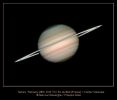
Saturn.jpgThe Lord of the Rings115 visiteCaption NASA, da "NASA - Picture of the Day" del giorno 4 Marzo 2009:"Very good telescopic views of Saturn can be expected in the coming days as the Ringed Planet nears "Opposition" on March 8th, its closest approach to Earth in 2009.
Of course, "Opposition" means opposite the Sun in planet Earth's sky - an arrangement that occurs almost yearly for Saturn. But while Saturn itself grows larger in telescopic images, Saturn's Rings seem to be vanishing as their tilt to our line-of-sight decreases.
In fact, the rings will be nearly invisible, edge-on from our perspective, by September 4, 2009.
Recorded on February 28, this sharp image was made with the 1 meter telescope at Pic Du Midi, a mountain top observatory in the French Pyrenees. The Rings are seen to be tilted nearly edge-on, but remarkable details are visible in the gas giant's cloud bands. The icy moon Tethys appears just beyond the Rings at the lower left".MareKromium
|
|

SaturnDustRing-SST.jpgDust-Ring around Saturn79 visiteWhat has created a large Dust-Ring around Saturn?
At over 200 times the radius of Saturn and over 50 times the radius of Saturn's expansive "E"-Ring, the newly discovered Dust-Ring is the largest planetary ring yet imaged. The Ring was found in IR Light by the Earth-orbiting Spitzer Space Telescope.
A leading hypothesis for its origin is impact material ejected from Saturn's moon Phoebe, which orbits right through the Dust-Ring's middle.
An additional possibility is that the Dust-Ring supplies the mysterious material that coats part of Saturn's moon Japetus, which orbits near the Dust-Ring's Inner Edge. Pictured above in the inset, part of the Dust-Ring appears as false-color orange in front of numerous background stars.MareKromium
|
|

SaturnRingsMoons_Cassini_960_annotated.jpgThe ringed Beauty and two "Close Friends"... (Credits: NASA, JPL-Caltech, Space Science Institute)140 visiteWhile cruising around Saturn, be on the lookout for picturesque arrangements of moons, rings, and shadows.
One such striking sight occurred in 2005 and was captured by the then Saturn-orbiting Cassini spacecraft. In the featured image, moons Mimas (left) and Tethys (right) are visible on either side of Saturn's thin rings, which are seen nearly edge-on.
Across the top of Saturn are dark shadows of the wide rings, exhibiting their impressive complexity. The violet-light image brings up the texture of the backdrop: Saturn's clouds.
Cassini orbited Saturn from 2004 until mid-2017, when the robotic spacecraft was directed to dive into Saturn to keep it from contaminating any moons.MareKromium
|
|

SaturnSpace-N00115343-N00115349.gifThrough the "Eyes" of Cassini... (GIF-Movie; credits: Dr G. Barca)68 visiteSuggestivo, affascinante e, alla fine - semplicemente -, bello!MareKromium
|
|

SaturnSpaceN00115280-N00115290.gifThrough the "Eyes" of Cassini... (GIF-Movie; credits: Dr G. Barca)68 visiteSuggestivo, affascinante e, alla fine - semplicemente -, bello! (repetita iuvant)MareKromium
|
|

SaturnStorm-PIA07788.jpgTurbulence... (1)77 visiteThis image shows a rare and powerful storm on the Night-Side of Saturn.
Light from Saturn's Rings (called "Ringshine") provided the illumination, allowing the storm and other cloud features to be seen.
The storm is a possible source of radio emissions believed to come from electrical discharges (lightning) deep in Saturn's atmosphere. Cassini began detecting the radio emissions, which are like those from lightning, on January 23, 2006. At about the same time, amateur astronomers reported that a storm had appeared in Saturn's Southern Hemisphere at Lat. - 35°. Cassini was in the wrong place to take good images of the storm on the day side, since the Planet showed only a thin crescent to the spacecraft, but night side imaging was possible using light from the Rings.
The image shows the storm as it appeared to the Cassini imaging system on January 27, 2006, and the storm's North-South dimension is about 3.500 Km (approx. 2.175 miles).
|
|

SaturnStorm-PIA07789.jpgTurbulence... - detail mgnf (2)75 visiteNo lightning flashes are visible in the image (they would look like medium-sized bright spots, since the light would spread out before it reaches the cloud tops), but non-detection does not mean that lightnings are absent, however. Lightning might be too faint to stand out above background or too deep to be seen through the thick clouds. Bad luck is another possibility: the camera might have missed the strong flashes during the 10' that the shutter was open. A narrow-cloud band crosses the storm from left to right. It is illuminated by the Rings from the North and is brighter on that side. Cassini scientists are looking forward to an extensive Night Side image set, designed to look for lightning. That set will be collected during the first half of 2006.
The view was obtained in visible light with the Cassini spacecraft narrow-angle camera at a distance of approx. 3,5 MKM (about 2,2 MMs) from Saturn. The image scale is approx. 20 Km (about 12 miles) per pixel.
|
|
| 2243 immagini su 187 pagina(e) |
 |
|
|
|
|
147 | |
|
|
|
|








