Saturn: the "Ringed Beauty" and His Moons
|
|
|

Saturn-RingPlane_cassini_big.jpgAlong the Ring-Plane of Saturn (natural colors; credits: NASA)66 visiteCaption NASA originale:"When Saturn's appendages disappeared in 1612, Galileo did not understand why. Later that century, it became understood that Saturn's unusual protrusions were Rings and that when the Earth crosses the Ring-Plane, the edge-on rings will appear to disappear.
This is because Saturn's Rings are confined to a plane many times thinner, in proportion, than a razor blade. In modern times, the Cassini Spacecraft orbiting Saturn now also crosses Saturn's Ring-Plane. A series of plane crossing images from late February (2006) was dug out of the vast online Cassini raw image archive by interested Spanish amateur Fernando Garcia Navarro.
Pictured above, digitally cropped and set in representative colors, is the striking result. Saturn's thin Ring-Plane appears in blue, bands and clouds in Saturn's Upper Atmosphere appear in gold and dark shadows of the Rings curve across the top of the Gas Giant Planet. Moons appear as bumps in the Rings". MareKromium
|
|
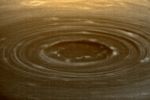
Saturn-SP-PIA11103.jpgSouthern Turbulence (natural colors; credits: Lunexit)66 visiteCaption NASA:"Shadows reveal the topography of Saturn's South Polar Vortex. At high resolution, a new, inner ring of isolated, bright clouds is seen. These clouds are localized regions of convective upwelling, an important clue to understanding how heat energy is transported in Saturn's Atmosphere.
See PIA11104 for a high-resolution Cassini view that looks more directly down onto the vortex, compared to this oblique perspective. Sunlight illuminates the scene from upper right, and the higher altitude rings of clouds surrounding the pole cast shadows toward lower left. North on Saturn is up.
The image was taken with the Cassini Spacecraft narrow-angle camera on July 15, 2008, with a combination of spectral filters sensitive to wavelengths of polarized infrared light centered at 746 and 938 nanometers. The grainy quality of the image is due primarily to the low signal-to-noise ratio of images taken with the 938 nanometer spectral filter, which is near the upper limit of the wavelength range the camera can see. "Signal-to-noise" is a term scientists use to refer to the amount of meaningful or useful information (signal) in their data versus the amount of background noise. A higher signal-to-noise ratio yields sharper, clearer views of features in the atmosphere.
The view was acquired from 24° below the Ring-Plane, at a distance of approx. 778.000 Km (about 483.000 miles) from Saturn.
The Sun-Saturn-Spacecraft, or Phase, Angle is about 30°.
Image scale is 4 Km (about 3 miles) per pixel".MareKromium
|
|
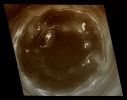
Saturn-SP-PIA11104.jpgSouthern Turbulence (False Colors; credits: Lunexit)64 visiteCaption NASA:"This detailed Cassini view of the monstrous vortex at Saturn's South Pole provides valuable insight about the mechanisms that power the Planet's Atmosphere.
This view is 10 times more detailed than any previous image of the Polar Vortex. See PIA11103 for a more oblique, wide-angle view that provides context for this close-up.
Previous images revealed an outer ring of high clouds surrounding a Region previously thought to be mostly clear air interspersed with a few puffy clouds that circulate around the center. This new image shows that what looked like puffy clouds at lower resolution are actually vigorous convective storms that form yet another distinct, inner ring. In other words, they are deep convective structures seen through the atmospheric haze. One of the deeper structures (at the 10 o'clock position) has punched through to a higher altitude and created its own little vortex. The ring is similar to the eyewall of a terrestrial hurricane, but much larger. The clear air there is warm, like the eye of a terrestrial hurricane, but on Saturn it is locked to the pole, whereas a terrestrial hurricane drifts around.
Convective structures are small regions of intense upwelling air, but the clear air of the vortex eye indicates that this is generally an area of downwelling. Convection is an important part of the planet's energy budget because the warm upwelling air carries heat from the interior. In a terrestrial hurricane, the convection occurs in the eyewall. Here it seems to occur in the eye as well. The camera filter used for this image captures light at wavelengths where atmospheric gases like Methane are fairly transparent, allowing for detailed views of deep cloud features. Other filters (see PIA09859) use light that is strongly absorbed by Methane gas; the light bounces off the high clouds, making them visible, but gets absorbed before it reaches the low clouds. Such "Methane-Band" images of the South Polar Vortex reveal that the convective clouds do not reach up to the base of the stratosphere, as convective clouds on Earth do. This view was acquired from 56° below the Ring-Plane. The image has been digitally reprojected to show the scene as it would appear to an observer positioned directly above the Pole.
The image was taken with the Cassini Spacecraft narrow-angle camera on July 14, 2008, using a combination of two spectral filters sensitive to wavelengths of polarized visible light centered at 617 and infrared light centered at 750 nanometers. The view was obtained at a distance of approx. 392.000 Km (243.000 miles) from Saturn and at a Sun-Saturn-Spacecraft, or Phase, Angle of 60°.
Image scale is roughly 2 Km (a little more than 1 mile) per pixel".MareKromium
|
|

Saturn-South Pole from 6.700.000 Km-PIA06462_modest.jpgThe South Pole of Saturn from 6.700.000 Km77 visitenessun commento
|
|
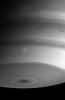
Saturn-South Pole~0.jpgThe South Pole of Saturn62 visiteQuesta immagine, pubblicata sul Sito "NASA Picture of the Day" del 18.10.2004 ci sembra interessante perchè presenta - a nostro parere - una Anomalia. Innanzitutto eccoVi la caption originale:"...Visible in the above image of Saturn are bright bands, dark belts and a dark spot right over the South Pole. The above image in infrared light spans over 30.000 Km and was taken early last month (Sept.) by the Cassini spacecraft. Saturn's atmosphere is about 75% H, 25% He and small amounts of heavier compounds including water vapor, methane, and ammonia. The relatively low gravity at Saturn's cloud tops result in a thicker haze layer, which in turn makes atmospheric features blurrier than Jupiter". I dati sull'atmosfera di Saturno sono interessanti e le indicazioni relative ad alcune surface features corrette. Ma che cosa possiamo dire di quell'area circolare, luminescente, biancastra, ben visibile, perpendicolare al Polo Sud, a circa centro immagine?!? E' un difetto di processo? Un artifact? Una nuvola sferica?
|
|

Saturn-SouthPole-PIA06657.jpgThe South-Pole of Saturn65 visiteCaption NASA originale:"Cassini peeks at Saturn's relatively dark South Pole, providing an up-close look at the haze-free upper atmosphere there. The banded structure around the pole seems to be superimposed on the characteristic high-latitude, mottled, turbulent structure (the white puffs of cloud near the Pole), suggesting that the banding is a shallow, not deep, feature.
The image was taken in visible light with the Cassini spacecraft narrow-angle camera on April 23, 2005, through a filter sensitive to wavelengths of polarized infrared light at a distance of approx. 2,4 MKM (about 1,5 MMs) from Saturn. The image scale is 14 Km (approx. 9 miles) per pixel".
|
|
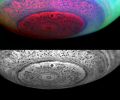
Saturn-SouthPole_cassini_big.jpgBeneath the South Pole of Saturn81 visiteCaption NASA:"What clouds lurk beneath Saturn's unusual South Pole?
To help find out, the robotic Cassini Spacecraft currently orbiting Saturn imaged the nether region of the gigantic ringed orb in infrared light.
There thick clouds appear dark as they mask much of the Infrared Light emitted from warmer regions below, while relatively thin clouds appear much lighter. Bands of clouds circle Saturn at several latitudes, while dark ovals indicate many dark swirling storm systems. Surprisingly, a haze of upper level clouds visible towards Saturn's Equator disappears near the Pole, including over Saturn's strange Polar Vortex.
Cassini entered orbit around Saturn in 2004, and recorded the above image last year (2007)". MareKromium
|
|

Saturn-Storm.jpgSaturnian Storm113 visiteCaption NASA:"Late last year, a new, remarkably bright storm erupted in Saturn's Northern Hemisphere. Amateur astronomers first spotted it in early December, with the Ringed Gas Giant rising in Planet Earth's predawn Sky.
Orbiting Saturn, the Cassini Spacecraft was able to record this close-up of the complex disturbance from a distance of about 1,8 MKM on December 24th, 2010.
Over time, the storm has evolved, spreading substantially in longitude, and now stretches far around the Planet. Saturn's thin Rings are also seen slicing across this space-based view, casting broad shadows on the Planet's Southern Hemisphere".MareKromium
|
|

Saturn-The Atlas Ring-PIA06113_modest.jpgThe "F-Ring" (or "Atlas Ring") of Saturn68 visiteRiteniamo la dichiarazione che riportiamo qui di seguito di GRANDE INTERESSE, specie per coloro che sappiano dei cosiddetti "Ring-Masters", ossìa i ("Mitologici") Creatori degli Anelli di Saturno: "...Scientists examining Saturn's contorted F-Ring - which has baffled them since its discovery - have found 1 or 2 small bodies orbiting in the F-ring region, and a ring of material associated with Saturn's moon Atlas...".
Cosa sono questi 1 o 2 "small bodies"? Perchè non si parla di nuovi mini-satelliti?
|
|

Saturn-The Atlas Ring-The New Object-PIA06115.jpgThe "New Object" found in Saturn's "F-Ring" (1)76 visiteEcco il nuovo enigma che ci viene proposto da Saturno e che, come già si era detto, potrà affascinare coloro che conoscono la storia (o la "leggenda", se preferite) dei "Ringmasters of Saturn". Questa, in originale, la nota di commento al fenomeno rilasciata dalla NASA: "A small new found object, temporarily designated S/2004 S 3, has been seen orbiting Saturn's outer F ring. Its nature, moon or clump, is not presently known".
Una dichiarazione che ci lascia davvero pensare...
|
|

Saturn-The Atlas Ring-The New Object-PIA06116.jpgThe "New Object" found in Saturn's "F-Ring" (2)80 visiteMa c'è di più: ingrandite le 2 immagini che Vi abbiamo proposto e poi osservate attentamente in alto alla Vostra Dx. Vedrete una piccola, ma ben definita, linea luminosa. Andate quindi sul Sito NASA "Planetary Photojournal - Images of Saturn": c'è una bellissima animazione ottenuta montando in sequenza 18 frames, oltre ai 2 qui pubblicati (ripresi con frequenza di 1 ogni 8 minuti su un arco di 135 minuti). Noterete che la "striscia" di luce di cui Vi stiamo parlando appare solo in 6.
Strano, vero?!?
|
|
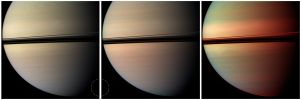
Saturn-Triplet-EB-LXTT.jpgSaturnian Views: RGB, IR and Methane (an Image-Mosaic by Elisabetta Bonora - Lunexit Team)65 visitenessun commentoMareKromium
|
|
| 2243 immagini su 187 pagina(e) |
 |
|
|
|
|
141 | |
|
|
|
|








