| |

Saturn: the "Ringed Beauty" and His Moons
|
|
|
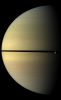
Saturn-PIA12513.jpgCrescent Saturn (Natural Colors; credits: NASA/JPL/Space Science Institute)74 visiteCaption NASA:"Saturn, stately and resplendent in this Natural Color view, dwarfs the icy moon Rhea.
Rhea orbits beyond the Rings on the right of the image. The moon Tethys is not shown here, but its shadow is visible on the Planet on the left of the image. This view looks toward the Northern, sunlit side of the Rings from just above the Ring-Plane.
Images taken using red, green and blue spectral filters were combined to create this Natural Color view. The images were obtained with the Cassini Spacecraft wide-angle camera on Nov. 4, 2009 at a distance of approx. 1,3 MKM (about 808.000 miles) from Saturn.
Image scale is roughly 72 Km (about 45 miles) per pixel".MareKromium
|
|

Saturn-PIA12533.jpgEternal Vision (Natural Colors; credits: NASA/JPL/Space Science Institute)78 visiteCaption NASA:"A pastel crescent of Saturn is interrupted by the moon Mimas and the Rings in this color image.
Mimas (approx. 396 Km - or about 246 miles across) appears as a dark speck just above the Rings.
This view looks toward the Northern, sunlit side of the Rings, from just above the Ring-Plane.
Images taken using red, green and blue spectral filters were combined to create this Natural Color view. The images were obtained with the Cassini Spacecraft wide-angle camera on Oct. 27, 2009 at a distance of approx. 2,2 MKM (such as about 1,4 MMs) from Saturn.
Image scale is roughly 129 Km (approx. 80 miles) per pixel".MareKromium
|
|

Saturn-PIA12721-PCF-LXTT.jpgThe "Oily Clouds" of Saturn (Natural Colors; credits for the additional process. and color.: Dr Paolo C. Fienga - Lunexit Team)113 visiteCaption NASA:"Clouds in Saturn's Upper Atmosphere create an intricate pattern reminiscent of whipped cream swirling in coffee. The view is centered on a region located about 15° South of the Planet's Equator. The image was taken with the Cassini Spacecraft narrow-angle camera on July 18, 2010 using a spectral filter sensitive to wavelengths of Near-InfraRed light centered at 727 nanometers.
The view was obtained at a distance of approx. 2,4 MKM (abput 1,5 MMs) from Saturn and at a Sun-Saturn-Spacecraft angle of 107°.
Image scale is roughly 14 Km (a little less than 9 miles) per pixel".MareKromium
|
|

Saturn-PIA12824.jpgSaturnian Storm (Natural Colors; credits: NASA/JPL-Caltech/Space Science Institute)76 visiteCaption NASA:"The huge storm churning through the Atmosphere in Saturn's Northern Hemisphere overtakes itself as it encircles the Planet in this Natural Colors view from NASA's Cassini Spacecraft.
This picture, captured on Feb. 25, 2011, was taken about 12 weeks after the storm began, and the clouds by this time had formed a tail that wrapped around the Planet. Some of the clouds moved south and got caught up in a current that flows to the East (to the right) relative to the storm head. This tail, which appears as slightly blue clouds South and West (left) of the storm head, can be seen encountering the storm head in this view.
This storm is the largest, most intense storm observed on Saturn by NASA's Voyager or Cassini Spacecraft. It is still active today. As scientists have tracked this storm over several months, they have found it covers 500 times the area of the largest of the Southern Hemisphere storms observed earlier in the Cassini Mission (see PIA06197).
The shadow cast by Saturn's Rings has a strong seasonal effect, and it is possible that the switch to powerful storms now being located in the Northern Hemisphere is related to the change of seasons after the Planet's August 2009 Equinox.
Huge storms called Great White Spots have been observed in previous Saturnian years (each of which is about 30 Earth years), usually appearing in late Northern Summer. Saturn is now experiencing early Northern Spring, so this storm, if it is a Great White Spot, is happening earlier than usual. This storm is about as large as the largest of the Great White Spots, which also encircled the planet but had latitudinal sizes ranging up to approx. 20.000 Km (roughly 12.000 miles). The Voyager and Cassini Spacecrafts were not at Saturn for previous Great White Spot appearances.
The storm is a prodigious source of radio noise, which comes from lightning deep in the Planet's Atmosphere. The lightning is produced in the water clouds, where falling rain and hail generate electricity. The mystery is why Saturn stores energy for decades and releases it all at once. This behavior is unlike that at Jupiter and Earth, which have numerous storms going on at all times.
This view looks toward the sunlit side of the Rings from just above the Ring-Plane. Images taken using red, green and blue spectral filters were combined to create this Natural Color view. The images were acquired with the Cassini Spacecraft wide-angle camera at a distance of approx. 1,4 MMs (such as about 2,2 MKM) from Saturn. Image scale is roughly 80 miles (128,7472 Km) per pixel".MareKromium
|
|

Saturn-PIA12825.jpgSaturnian Storm (False Colors; credits: NASA/JPL-Caltech/Space Science Institute)86 visiteCaption NASA:"These false-color images from NASA's Cassini Spacecraft chronicle a day in the life of a huge storm that developed from a small spot that appeared 12 weeks earlier in Saturn's Northern Mid-Latitudes.
This storm is the largest and most intense observed on Saturn by NASA's Voyager or Cassini Spacecraft. The storm is still active. As seen in these and other Cassini images, the storm encircles the Planet - whose circumference at these latitudes is approx. 186.000 miles (about 300.000 Km).
From North to South, it covers a distance of about 9000 miles (approx. 15.000 Km), which is one-third of the way around the Earth. It encompasses an area of about 1,5 BSMs (Billion Square Miles - such as approx. 4 BSKM), or eight times the surface area of Earth. This storm is about 500 times the area of the biggest of the Southern Hemisphere storms observed by Cassini.
The highest clouds in the image are probably around 100 millibars pressure, or 60 miles (approx. 100 Km) above the regular undisturbed clouds. These false colors show clouds at different altitudes. Clouds that appear blue here are the highest and are semitransparent, or optically thin. Those that are yellow and white are optically thick clouds at high altitudes. Those shown green are intermediate clouds. Red and brown colors are clouds at low altitude unobscured by high clouds, and the deep blue color is a thin haze with no clouds below. The base of the clouds, where lightning is generated, is probably in the water cloud layer of Saturn's Atmosphere. The storm clouds are likely made out of Water Ice covered by crystallized Ammonia.
Taken about 11 hours -- or one Saturn day -- apart, the two mosaics in the lower half of this image product consist of 84 images each. The mosaic in the middle was taken earlier than the mosaic at the bottom. Both mosaics were captured on Feb. 26, 2011, and each of the two batches of images was taken over about 4,5 hours.
Two enlargements from the earlier, middle mosaic are shown at the top of this product. The white lines below the middle mosaic identify those parts of the mosaic that were enlarged for these close-up views. The enlargement on the top left shows the head of the storm, and that on the top right shows the turbulent middle of the storm. Cassini observations have shown the head of the storm drifting West at a rate of about 2,8° of Longitude each Earth day (28 meters per second, or 63 miles per hour). The central latitude of the storm is the site of a Westward jet, which means that the clouds to the North and South are drifting Westward more slowly or even drifting eastward. In contrast, clouds at Saturn's Equator drift Eastward at speeds up to 450 meters per second (about 1000 miles per hour).
Both of the long mosaics cover an area ranging from about 30° to 51° North Latitude. The views stretch from about 138° (on the left) to 347° West Longitude (on the right), passing through 360/0° West Longitude near the far right of the mosaics.
The images were taken with the Cassini Spacecraft narrow-angle camera using a combination of spectral filters sensitive to wavelengths of Near-InfraRed light. The images filtered at 889 nanometers are projected as blue. The images filtered at 727 nanometers are projected as green, and images filtered at 750 nanometers are projected as red.
The views were acquired at a distance of approx. 1,5 MMs (such as about 2,4 MKM) from Saturn and at a Sun-Saturn-Spacecraft Angle (i.e.: Phase Angle) of 62°. Both the top and bottom images are simple cylindrical map projections, defined such that a square pixel subtends equal intervals of Latitude and Longitude. At higher Latitudes, the pixel size in the North-South direction remains the same, but the pixel size in the East-West direction becomes smaller. The pixel size is set at the Equator, where the distances along the sides are equal. The images of the long mosaics have a pixel size of 33 miles (53,108 Km) at the Equator, and the two close-up views have a pixel size of 6 miles (9,656 Km) per pixel at the equator".MareKromium
|
|

Saturn-PIA12826.jpgSaturnian Storm (Natural Colors; credits: NASA/JPL-Caltech/Space Science Institute)79 visitenessun commentoMareKromium
|
|

Saturn-PIA14119.jpgLarge Ammonia Crystals in Saturn Storm (False Colors; credits: NASA/JPL-University of Arizona)86 visiteCaption NASA:"This false-color InfraRed image, obtained by NASA's Cassini Spacecraft, shows clouds of large Ammonia ice particles dredged up by a powerful storm in Saturn's Northern Hemisphere. Large updrafts dragged Ammonia gas upward more than 30 miles (approx. 50 Km) from below. The Ammonia then condensed into large crystals in the frigid Upper Atmosphere. This storm is the most violent ever observed at Saturn by an orbiting Spacecraft.
Cassini's Visual and InfraRed Mapping Spectrometer obtained these images on Feb. 24, 2011. Scientists colorized the image by assigning red to brightness detected from the 4.08-micron wavelength, green to brightness from the 0.90-micron wavelength, and blue to brightness from the 2.73-micron wavelength. Large particles (red) reflect Sunlight well at 4.08 microns. Particles at high altitude (green) reflect Sunlight well at 0.9 microns. Particles comprised of Ammonia -- especially large ones -- do not reflect 2.73-micron sunlight well, but instead absorb light at this wavelength.
The storm here shows up as yellow, demonstrating that it has a large signal in both red and green colors. This indicates the cloud has large particles and extends upward to relatively high altitude. In addition, the lack of blue in the feature indicates that the storm cloud has a substantial component of Ammonia Crystals. The head of the storm is particularly rich in such particles, as created by powerful updrafts of Ammonia gas from depth in the throes of Saturn's thunderstorm".MareKromium
|
|

Saturn-PIA14656-PCF-LXTT-IPF.jpgThe restless Saturnian Atmosphere (Absolute Natural Colors; credits for the additional process. and color.: Dr Paolo C. Fienga/Lunar Explorer Italia/Italian Planetary Foundation)123 visiteThe always richly dynamic Atmosphere of Saturn rewards - once again - its observers by showing unique and fascinating (even though just temporary) Cloud Structures and Formations. Here, the NASA - Cassini Spacecraft used the Near-InfraRed filters on its Wide-Angle Camera to get a better look at some of Saturn's Cloud Patterns, which are continuously shaped (and re-shaped, restlessly) by the powerful Winds and Storms that keep blowing and forming, respectively, in the Upper Atmosphere of the ringed Gas-Giant Planet.
The view is centered at 30° North Latitude and 42° West Longitude; North is up and rotated 44° to the right. The image was taken with the NASA - Cassini Spacecraft Wide-Angle Camera on December 24, 2012, using a spectral filter sensitive to wavelengths of Near-InfraRed Light centered at 752 nanometers. The image was acquired at a distance of approximately 440.000 miles (such as about 708.000 Km) from the top of Saturn's Clouds and at a Sun-Saturn-CASSINI Spacecraft, or Phase, Angle of 14°. Image scale is roughly 26 miles (such as 41,84 Km) per pixel.
This picture (which is an Original NASA - Cassini Spacecraft b/w frame published on the NASA - Planetary Photojournal and identified by the n. PIA 14656) has been additionally processed and then colorized, according to an educated guess carried out by Dr Paolo C. Fienga (LXTT-IPF), in Absolute Natural Colors (such as the colors that a human eye would actually perceive if someone were onboard the NASA - Cassini Spacecraft and then looked outside, towards the Gas-Giant Planet Saturn), by using an original technique created - and, in time, dramatically improved - by the Lunar Explorer Italia Team. Different colors, as well as different shades of the same color, mean, among others, the existence of different Elements present in the Upper Atmosphere of Saturn, each having a different Albedo (---> Reflectivity) and Chemical Composition.
Note: it is possible (but we, as IPF, have no way to be one-hundred-percent sure of such a circumstance), that the actual luminosity of the Clouds and Hazes (as well as the luminosity of Saturn itself) seen in this frame would appear, to an average human eye, way lower than it has been shown (or, better yet: interpreted) here.MareKromium
|
|

Saturn-PIA21895.jpgFarewell Cassini...170 visiteCaption NASA:"This Natural Color view view is the last image taken by the imaging cameras on NASA's Cassini Spacecraft. It looks toward the planet's night side, lit by reflected light from the Rings, and shows the location at which the Spacecraft would enter the Planet's Atmosphere a few hours later.
ThE view was created by using images taken with red, green and blue spectral filters. The imaging cameras obtained the view at approximately the same time that Cassini's Vsual and InfraRed Mapping Spectrometer made its own observations of the impact area in the thermal infrared.
This location - the site of Cassini's atmospheric entry - was at this time on the night side of the Planet, but would rotate into daylight by the time Cassini made its final dive into Saturn's Upper Atmosphere, ending its remarkable 13-year exploration of Saturn.
The view was acquired on Sept. 14, 2017 at 19:59 UTC (spacecraft event time). The view was taken in Visible Light using the Cassini Spacecraft Wide-Angle Camera at a distance of about 394.000 miles (such as roughly 634.081 Km) from Saturn. Image scale is about 11 miles (about 17,7 Km). The original image has a size of 512 x 512 pixels".MareKromium
|
|

Saturn-PIA21899.gifPolar Lights (Auroral Emissions from the North Pole of Saturn)127 visiteCaption NASA Originale:"On Sept. 14, 2017, one day before making its final plunge into Saturn's Atmosphere, NASA's Cassini Spacecraft used its Ultraviolet Imaging Spectrograph, or UVIS, instrument to capture this final view of Ultraviolet Auroral Emissions over the Planet's North Polar Regions.
The view is centered on the North Pole of Saturn, with lines of Latitude visible for 80, 70 and 60°. Lines of Longitude are spaced 40° apart. The Planet's Day-Side is at the bottom of the picture, while the Night-Side is at the top. A sequence of images from this observation has also been assembled into a movie sequence. The last image in the movie was taken about an hour before the still image, which was the actual final UVIS auroral image.
Auroral Emissions are generated by charged particles traveling along the invisible lines of Saturn's Magnetic Field. These particles (then) precipitate into the Atmosphere, releasing light when they strike (the) Gas Molecules (that are present) there.
Several individual auroral structures are visible here, despite that this UVIS view was acquired at a fairly large distance from the Planet (such as about 424.000 miles or approx. 682.361,856 Km). Each of these features is connected to a particular phenomenon (occurring) in the Saturnian Magnetosphere. For instance, it is possible to identify Auroral "signatures" here that are related to the injection of "Hot Plasma" from the Day-Side Magnetosphere, as well as Auroral Features associated with a change in the Magnetic Field's shape (existing) on the Magnetosphere's Night-Side.
Several possible scenarios have been postulated over the years to explain Saturn's changing Auroral Emissions, but researchers are still far from a complete understanding of this complicated puzzle. Researchers will continue to analyze the hundreds of image sequences UVIS obtained of Saturn's auroras during Cassini's 13-year mission, with many new discoveries likely to be made.
This image and movie sequence were produced by the Laboratory for Planetary and Atmospheric Physics (LPAP) of the STAR Institute of the University of Liege in Belgium, in collaboration with the UVIS Team".MareKromium
|
|

Saturn-PIA21903-00.jpgThe End....114 visiteCaption NASA originale:"This view of Saturn looks toward thePplanet's Night Side, only lit by Sunlight reflected from the Rings.
A mosaic of some of the very last images captured by Cassini's cameras, shows the location where the Spacecraft would have entered the Planet's Atmosphere a few hours later. An annotated view (see the next frame) marks the entry site with an oval. While this area was on the Night Side of the Planet at the time, it would rotate into daylight by the time Cassini made its final dive into Saturn's Upper Atmosphere, ending its remarkable 13-year exploration of Saturn.
Images taken using red, green and blue spectral filters were combined to show the scene in Near Natural Colors. The images were taken with Cassini's wide-angle camera on Sept. 14, 2017, at a distance of approx. 394.000 miles (such as a little more than 634.000 Km) from Saturn.
The Cassini spacecraft ended its mission on Sept. 15, 2017".MareKromium
|
|

Saturn-PIA21903-01.jpgThe End....125 visitenessun commentoMareKromium
|
|
| 2243 immagini su 187 pagina(e) |
|
|
|
|
|
140 | |
|
|
|
|
|
|








