| |

Saturn: the "Ringed Beauty" and His Moons
|
|
|

Saturn-PIA11473.jpgThe Northern Region of Saturn (Natural Colors; credits: NASA/JPL/Space Science Institute)74 visiteCaption NASA:"Saturn's Northern Hemisphere is seen here against its nested Rings.
This view from the Cassini Spacecraft looks toward the unilluminated side of the Rings from about 30° above the Ring-Plane. The rings have been brightened relative to the Planet to enhance visibility.
Images taken using red, green and blue spectral filters were combined to create this Natural Color view.
The images were acquired with the Cassini Spacecraft wide-angle camera on Feb. 24, 2009 at a distance of approx. 866.000 Km (about 538.000 miles) from Saturn.
Image scale is roughly 38 Km (about 24 miles) per pixel".MareKromium
|
|

Saturn-PIA11478.jpgTransparencies (Natural Colors; credits: NASA/JPL/Space Science Institute)78 visiteCaption NASA:"This Natural Color view from the Cassini Spacecraft highlights the myriad gradations in the transparency of Saturn's inner Rings.
The dark shadows of the Rings separate Saturn's Southern Hemisphere in the bottom of the image from the North. The innermost D-Ring is invisible, laid over the Planet's Northern Hemisphere. The translucent C-Ring runs through the middle of the image. The denser B-Ring stretches across the top of the image.
This view looks toward the sunlit side of the Rings from about 48° below the Ring-Plane. Images taken using red, green and blue spectral filters were combined to create this Natural Color view. The images were acquired with the Cassini Spacecraft wide-angle camera on Feb. 28, 2009 at a distance of approx. 1 MKM (about 620.000 miles) from Saturn.
Image scale is roughly 59 Km (approx. 37 miles) per pixel".MareKromium
|
|

Saturn-PIA11493.jpgBetween Day and Night... (Natural Colors; credits: NASA/JPL/Space Science Institute)82 visiteCaption NASA:"Rays of light from the Sun have taken many different paths to compose this glorious image of Saturn and its Rings.
This view looks toward the unilluminated (North) side of the Rings and, at the top of the image, the night side of Saturn. Sunlight has been reflected off the illuminated side of the Rings to light the Planet's Southern Hemisphere, seen here as a bright band of yellow-orange.
The Northern Hemisphere, in the top left corner of the image, is dimly lit by light diffusely scattered through the rings. The Planet's shadow cuts across the Rings, but light reflected off the Southern Hemisphere backlights parts of the C-Ring, making them visible in silhouette. Bright points of light in the image are stars occulted by the Rings.
This view looks toward the unilluminated side of the Rings from about 41° above the Ring-Plane. Images taken using red, green and blue spectral filters were combined to create this Natural Color view. The images were acquired with the Cassini Spacecraft wide-angle camera on March 20, 2009 at a distance of approx. 892.000 Km (such as about 554.000 miles) from Saturn.
Image scale is roughly 50 Km (about 31 miles) per pixel".MareKromium
|
|

Saturn-PIA11513.jpgSouthern Colors (Natural Colors; credits: NASA/JPL/Space Science Institute)78 visiteCaption NASA:"The Cassini Spacecraft samples a bit of Saturn's Southern Hemisphere along with a spread of the Planet's main Rings.
Working outward from the Planet, the C, B, and A-Rings are visible in this Natural Color image. The Rings have been brightened relative to the Planet to enhance their visibility.
This view looks toward the sunlit side of the Rings from about 59° below the Ring-Plane. Images taken using red, green and blue spectral filters were combined to create this Natural Color view.
The images were acquired with the Cassini Spacecraft wide-angle camera on April 23, 2009 at a distance of approx. 1 MKM (about 621.000 miles) from Saturn.
Image scale is roughly 58 Km (approx. 36 miles) per pixel".MareKromium
|
|

Saturn-PIA11518.jpgApproaching the Equinox94 visiteCaption NASA:"The shadow of the moon Mimas has just slipped off Saturn's Rings and onto the Planet in this Cassini Spacecraft image. The shadow is visible as a short dash below the Rings' shadows on the Planet. At this exposure setting, the Rings are too dim to be seen easily. As Saturn approaches its August 2009 equinox, the Planet's moons cast shadows onto the Rings.
This view looks toward the unilluminated side of the Rings from about 61° above the Ring-Plane. Images taken using red, green and blue spectral filters were combined to create this Natural Color view. The images were obtained with the Cassini Spacecraft wide-angle camera on April 30, 2009 at a distance of approx. 1,4 MKM (about 870.000 miles) from Saturn.
Image scale is roughly 80 Km (about 50 miles) per pixel".MareKromium
|
|
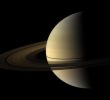
Saturn-PIA11613.jpgPost-Equinox Colors (Natural Colors; credits: NASA/JPL/Space Science Institute)86 visiteCaption NASA:"The Cassini Spacecraft captured this Natural Color View of Saturn almost a month after the Planet's August 2009 Equinox. The shadow cast on the Planet by the Rings remains narrow.
Spokes are visible on the B-Ring. To learn more about these ghostly radial structures, see PIA11144.
Mimas (approx. 396 Km, or about 246 miles across) can be seen in the lower left. Mimas and the Rings have been brightened relative to the Planet to increase visibility.
The novel illumination geometry that accompanies Equinox lowers the Sun's angle to the Ring-Plane, significantly darkens the Rings, and causes out-of-plane structures to look anomalously bright and cast shadows across the Rings. These scenes are possible only during the few months before and after Saturn's Equinox, which occurs only once in about 15 Earth years.
Before and after Equinox, Cassini's cameras have spotted not only the predictable shadows of some of Saturn's moons (see PIA11657), but also the shadows of newly revealed vertical structures in the Rings themselves (see PIA11665).
This view looks toward the Northern, sunlit side of the Rings from about 10° above the Ring-Plane.
The red, green and blue images that were mosaicked together to create this view were obtained with the Cassini Spacecraft wide-angle camera on Sept. 4, 2009. The view was obtained at a distance of approx. 2,7 MKM (such as about 1,7 MMs) from Saturn and at a Sun-Saturn-Spacecraft, or Phase, Angle of 92°.
Image scale is roughly 156 Km (about 97 miles) per pixel".MareKromium
|
|
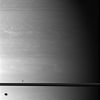
Saturn-PIA11633.jpgShadows...69 visiteCaption NASA:"The shadows of two moons appear on Saturn, above and below the plane of the Planet's Rings.
North on Saturn is up in this image, and the shadow of Dione can be seen south of the Planet's Equator. The smaller shadow of Mimas is north of the Equator.
Dione and Mimas both have orbits that are slightly inclined in relation to the Planet's Equatorial Plane, so, depending upon the orientation of their orbits, their shadows may appear North or South of Saturn's Equator. The moons themselves do not appear in this image.
This view looks toward the Northern, sunlit side of the Rings from about 1° above the Ring-Plane. Scale in the original image was about 100 Km (approx. 62 miles) per pixel. The image has been magnified by a factor of 1.5 and contrast-enhanced to aid visibility.
The image was taken with the Cassini Spacecraft wide-angle camera on Oct. 15, 2009 using a spectral filter sensitive to wavelengths of Near-InfraRed Light centered at 752 nanometers. The view was acquired at a distance of approx. 899.000 Km (about 558.000 miles) from Saturn and at a Sun-Saturn-Spacecraft, or Phase, angle of 65°".MareKromium
|
|
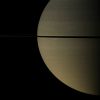
Saturn-PIA11640.jpgNarrow Shadow77 visiteCaption NASA:"From just above the Plane of Saturn's Rings, the Cassini Spacecraft snapped this shot of Saturn two months after Saturn's August 2009 Equinox, showing the shadow of its Rings as a narrow band on the Planet.
Cassini is looking toward the sunlit side of the rings from about 1° above the Ring-Plane.
The novel illumination geometry that accompanies Equinox lowers the Sun's angle to the Ring-Plane, significantly darkens the Rings, and causes out-of-plane structures to look anomalously bright and cast shadows across the Rings. These scenes are possible only during the few months before and after Saturn's Equinox, which occurs only once in about 15 Earth years.
Before and after Equinox, Cassini's cameras have spotted not only the predictable shadows of some of Saturn's moons (see, for instance, PIA11657), but also the shadows of newly revealed Vertical Structures in the Rings themselves (see PIA11665).
The image was taken with the Cassini Spacecraft wide-angle camera on Oct. 16, 2009 using a spectral filter sensitive to wavelengths of Near-InfraRed Light centered at 752 nanometers. The view was obtained at a distance of approx. 1,5 MKM (such as about 932.000 miles) from Saturn and at a Sun-Saturn-Spacecraft, or Phase, Angle of 83°.
Image scale is roughly 86 Km (approx. 53 miles) per pixel".MareKromium
|
|
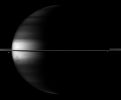
Saturn-PIA11649.jpgOut of the Darkness...66 visiteCaption NASA:"Dramatic differences between dark and light embellish this Cassini Spacecraft image of Saturn, its rings and its moons Dione and Enceladus.
Saturn's Northern and Southern Latitudes appear dark in this image because of the camera filter used. This view uses a spectral filter sensitive to absorption of certain wavelengths of light by Methane in Saturn's Atmosphere. The cloud tops in the Northern and Southern Latitudes are at a slightly greater depth than in the Equatorial Region, and are underneath a layer of Methane. This means that light travels along a longer path compared to the Equatorial Region as it enters the Atmosphere, reflects off the cloud tops, and returns through the Upper Atmosphere to enter the camera.
The light at Near-InfraRed wavelengths thus passes through more light-absorbing Methane at the Northern and Southern Latitudes than at the Equator, and so these Latitudes appear darker.
Dione (approx 1123 Km, or about 698 miles across) can be seen on the left of the image. Enceladus (approx. 504 Km, or about 313 miles across) is visible on the right.
This view looks toward the Northern, sunlit side of the Rings from just above the Ring-Plane.
The image was taken with the Cassini Spacecraft wide-angle camera on Oct. 21, 2009 using a spectral filter sensitive to wavelengths of Near-InfraRed Light centered at 890 nanometers. The view was obtained at a distance of approx. 2,5 MKM (such as about 1,6 MMs) from Saturn and at a Sun-Saturn-Spacecraft, or Phase, Angle of 104°.
Image scale is roughly 143 KM (such as about 89 miles) per pixel".MareKromium
|
|
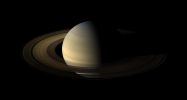
Saturn-PIA11667.jpgThe Lord of the Rings (Natural Colors; credits: NASA/JPL/Space Science Institute)78 visiteCaption NASA:"Of the countless Equinoxes Saturn has seen since the birth of the Solar System, this one, captured here in a mosaic of light and dark, is the first witnessed up close by an emissary from Earth … none other than our faithful robotic explorer, Cassini.
Seen from our planet, the view of Saturn’s Rings during Equinox is extremely foreshortened and limited. But in orbit around Saturn, Cassini had no such problems. From 20° above the Ring-Plane, Cassini’s wide angle camera shot 75 exposures in succession for this mosaic showing Saturn, its Rings, and a few of its moons a day and a half after exact Saturn Equinox, when the Sun’s disk was exactly overhead at the Planet’s Equator.
The novel illumination geometry that accompanies equinox lowers the Sun’s angle to the Ring-Plane, significantly darkens the Rings and causes out-of-plane structures to look anomalously bright and to cast shadows across the Rings themselves.
These scenes are possible only during the few months before and after Saturn’s Equinox which occurs only once in about 15 Earth years.
Before and after Equinox, Cassini’s cameras have spotted not only the predictable shadows of some of Saturn’s moons (see also PIA11657), but also the shadows of newly revealed vertical structures in the Rings (see, for example, PIA11665).
Also at Equinox, the shadows of the Planet’s expansive Rings are compressed into a single, narrow band cast onto the Planet as seen in this mosaic. (For an earlier view of the Rings’ wide shadows draped high on the Northern Hemisphere, see PIA09793)
The images comprising the mosaic, taken over about eight hours, were extensively processed before being joined together. First, each was re-projected into the same viewing geometry and then digitally processed to make the image “joints” seamless and to remove lens flares, radially extended bright artifacts resulting from light being scattered within the camera optics.
At this time so close to Equinox, illumination of the Rings by sunlight reflected off the planet vastly dominates any meager sunlight falling on the Rings. Hence, the half of the Rings on the left illuminated by planetshine is, before processing, much brighter than the half of the Rings on the right. On the right, it is only the vertically extended parts of the Rings that catch any substantial sunlight.
With no enhancement, the Rings would be essentially invisible in this mosaic. To improve their visibility, the dark (right) half of the Rings has been brightened relative to the brighter (left) half by a factor of three, and then the whole Ring System has been brightened by a factor of 20 relative to the Planet. So the dark half of the rings is 60 times brighter, and the bright half 20 times brighter, than they would have appeared if the entire System, Planet included, could have been captured in a single image.
The moon Janus (about 179 Km, or approx. 111 miles across) is on the lower left of this image. Epimetheus about (113 Km, or approx. 70 miles across) appears near the middle bottom. Pandora (about 81 Km, or approx. 50 miles across) orbits outside the Rings on the right of the image. The small moon Atlas (about 30 Km, or approx. 19 miles across) orbits inside the thin F-Ring on the right of the image.
The brightnesses of all the moons, relative to the Planet, have been enhanced between 30 and 60 times to make them more easily visible. Other bright specks are background stars. Spokes -- ghostly radial markings on the B ring -- are visible on the right of the image.
This view looks toward the northern side of the Rings from about 20° above the Ring-Plane.
The images were taken on Aug. 12, 2009, beginning about 1,25 days after exact equinox, using the red, green and blue spectral filters of the wide angle camera and were combined to create this Natural Colors view.
The images were obtained at a distance of approx. 847.000 Km (about 526.000 miles) from Saturn and at a Sun-Saturn-Spacecraft, or Phase, Angle of 74°.
Image scale is roughly 50 Km (about 31 miles) per pixel".
Nota Lunexit: una interpretazione in Colori Naturali davvero stupenda, per qualità, definizione e realismo. Una prova evidente che i lavori "brutti" (e cioè il 99% dei prodotti fotografici a colori riguardanti Marte) la NASA non li fa perchè "non è capace" (ovviamente), ma solo perchè "non vuole farli com sa fare".
Il motivo? Beh, certo non è "pigrizia" (anche se non si può mai dire)...MareKromium
|
|
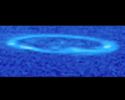
Saturn-PIA11832.jpgSaturnian Aurora67 visiteCaption NASA:"Glowing like a neon lasso, Saturn’s Aurora is seen spinning above Saturn’s North Pole over the course of most of a Saturn day in this image taken by the ultraviolet imaging spectrograph on NASA’s Cassini Spacecraft.
Saturn’s auroral lights are the result of a rain of electrically charged particles from the magnetic bubble, called the Magnetosphere, that surrounds the Planet.
When the particles strike gaseous Hydrogen in Saturn’s Atmosphere, the Hydrogen becomes excited and glows, creating Aurorae. Neon signs work in a similar way: electricity is used to excite a gas, usually Neon or Argon, in a tube.
Changes that occur in Saturn’s Magnetosphere can cause fluctuations in the Aurora. Undulations in the Aurora may be caused by waves moving along magnetic field lines.
A surge in auroral brightness is the result of a sudden injection of particles into the Magnetosphere. These charged particles come from a variety of sources, including the Sun, Saturn’s Rings, and the water ice plume of Saturn’s moon Enceladus.
This image was taken on May, 25th, 2007.
Saturn's Aurorae were discovered by NASA’s Pioneer 11 Spacecraft in 1979 and observed in the Saturn flybys by the NASA Voyager 1 and 2 Spacecrafts in the early '80s. NASA’s Hubble Space Telescope first obtained images of an Aurora in 1994. From Cassini’s always-changing orbit around Saturn, fresh observations in UltraViolet and InfraRed wavelengths are being combined with other data to help characterize similarities and differences among the Aurorae of Saturn, Jupiter and Earth". MareKromium
|
|
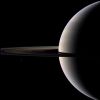
Saturn-PIA12318.jpgCosmic Vision (Natural Colors; credits: NASA/JPL/Space Science Institute)77 visiteCaption NASA:"Looking cool and serene, Saturn shares its soft glow with Cassini. This view of Saturn, its Rings and the moon Tethys represents "Target 1" in the fall 2009 edition of the Cassini Scientist for a Day contest.
(See http://saturn.jpl.nasa.gov/education/scientistforaday8thedition/.) The contest is designed to give students a taste of life as a scientist by challenging them to write an essay describing the value of one target choice among three for Cassini to image.
A bonus feature in the image is the presence of bright Spokes on and just above the ansa, or curved edge of the darkened Ring-Plane. The Spokes are made visible here by sunlight scattering through the dust-sized icy particles and toward Cassini's cameras.
Images taken using red, blue and green spectral filters were combined to create this color view.
The images were acquired with the Cassini wide-angle camera on Oct. 11, 2009 at a distance of approx. 1,7 MKM (a little more than 1 MMs) from Saturn".
Nota Lunexit: la dizione "Natural" l'abbiamo aggiunta noi, dato che la NASA - curiosamente - parla solo di "Color View" (insomma, adesso non fanno più nemmeno la fatica di dirci se si tratta di Natural, Approximate True, True e/o False Colors...bah!).MareKromium
|
|
| 2243 immagini su 187 pagina(e) |
|
|
|
|
|
139 | |
|
|
|
|
|
|








