Saturn: the "Ringed Beauty" and His Moons
|
|
|
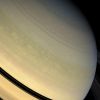
Saturn-PIA10578.jpgThe Northern Hemisphere of Saturn (Natural Colors; credits: NASA/JPL/Space Science Institute)65 visiteCaption NASA:"A chef's bounty of colors is represented in this full color view of Saturn's Northern Hemisphere.
Butternut, peach, and olive hues have replaced the azure blue of Winter. The blue of Saturn's Winter Hemisphere during the early Cassini Prime Mission still remains a puzzle. Over the course of time, the blue color has faded and has been replaced with bands of other hues (see also PIA11141).
This picture is a combination of images taken in red, green and blue light with the Cassini spacecraft wide-angle camera on Jan. 1, 2009. The view was obtained at a distance of approx. 1,1 MKM (such as about 680.000 miles) from Saturn and at a Sun-Saturn-Spacecraft, or Phase, Angle of 28°.
Image scale is roughly 65 Km (about 40 miles) per pixel".MareKromium
|
|
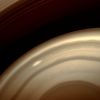
Saturn-PIA10580.jpgSouthern Atmosphere (Natural Colors; credits: Lunar Explorer Italia)65 visiteCaption NASA:"A Cassini Spacecraft image captures a bright, oblong storm swirling high through the Middle Latitudes of the Southern Hemisphere.
The image was taken through a spectral filter centered on wavelengths of light that are strongly absorbed by Methane gas. Hence, any light making it through this filter to the camera's detector has bounced off clouds that are high in the Atmosphere, making them visible, while light passing through the cloud-free surroundings gets absorbed by the Methane gas there before it reaches the lower clouds.
The image was taken with the Cassini Spacecraft wide-angle camera on Jan. 5, 2009 using a spectral filter sensitive to wavelengths of near-InfraRed Light centered at 890 nanometers. The view was acquired at a distance of approx. 711.000 Km (such as about 442.000 miles) from Saturn and at a Sun-Saturn-Spacecraft, or Phase, Angle of 106°.
Image scale is roughly 39 Km (about 24 miles) per pixel".MareKromium
|
|

Saturn-PIA10585.jpgSaturnian Terminator (Natural Colors; credits: Lunar Explorer Italia)76 visiteCaption NASA:"The Terminator nearly covers the South Pole of Saturn and its stormy vortex in darkness.
As the Southern Hemisphere moves toward Winter in the Planet's 29-year orbit, darkness eventually will consume the vortex. But this seasonal change also will bring the North Pole into the light.
This view looks toward the sunlit side of the Rings from about 69° below the Ring-Plane.
The image was taken with the Cassini Spacecraft wide-angle camera on Jan. 6, 2009 using a spectral filter sensitive to wavelengths of near-InfraRed Light centered at 752 nanometers. The view was acquired at a distance of approx. 761.000 Km (about 473.000 miles) from Saturn and at a Phase Angle of 96°.
Image scale is roughly 42 Km (approx. 26 miles) per pixel.MareKromium
|
|
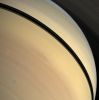
Saturn-PIA10588.jpgJust like an Iris... (Natural Colors; credits: NASA/JPL/Space Science Institute65 visiteCaption NASA:"Rendered in myriad hues, vivid details of Saturn's stormy Atmosphere play out below the shadow of the Rings. A well defined storm swirls through the atmosphere of the southern hemisphere in the lower left of the image, like the tight blue circle of an eye's iris.
This view looks toward the sunlit side of the Rings from about 36° below the Ring-Plane.
Images taken using red, green and blue spectral filters were combined to create this Natural Color view. The images were obtained with the Cassini Spacecraft wide-angle camera on Dec. 29, 2008 at a distance of approx. 1,1 MKM (such as about 680.000 miles) from Saturn and at a Sun-Saturn-Spacecraft, or Phase, Angle of 51°.
Image scale is roughly 60 Km (about 37 miles) per pixel".MareKromium
|
|
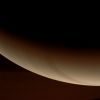
Saturn-PIA10591.jpgHigh Southern Latitudes (Natural Colors; credits: Lunar Explorer Italia)64 visiteCaption NASA:"Intricate curlicues and circular patterns of storms swirl through the High Latitudes near Saturn's South Pole in this image from the Cassini Spacecraft.
The view was obtained at a distance of approx. 588.000 Km (such as abpout 365.000 miles) from Saturn and at a Sun-Saturn-Spacecraft, or Phase, Angle of 140°. At this High Phase Angle, the Sun is illuminating the limb of the Planet from almost the opposite side of Saturn from the Spacecraft.The image was taken with the Cassini Spacecraft wide-angle camera on Jan. 5, 2009 using a spectral filter sensitive to wavelengths of near-InfraRed Light centered at 752 nanometers.
Image scale is roughly 32 Km (about 20 miles) per pixel".MareKromium
|
|

Saturn-PIA10596.jpgSouthern Turbulence (Natural Colors; credits: Lunar Explorer Italia)79 visiteCaption NASA:"Through the Atmosphere of the Southern Hemisphere of Saturn rolls a large storm, seen here as a tight dark circle in the lower left of this image. Horizontal strands of other atmospheric formations give the image the fibrous look of travertine stone.
Prometheus (about 86 Km, or 53 miles across) is a small dark dot in the top left part of the image.
The image was taken with the Cassini spacecraft wide-angle camera on Dec. 30, 2008 using a combination of polarized and spectral filters sensitive to wavelengths of near-InfraRed Light centered at 752 nanometers.
The view was acquired at a distance of approx. 1,2 MKM (about 750.000 miles) from Saturn and at a Sun-Saturn-Spacecraft, or Phase, Angle of 27°.
Image scale is roughly 68 Km (approx. 42 miles) per pixel".MareKromium
|
|
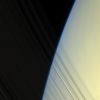
Saturn-PIA10598.jpgThe C-Ring (Natural Colors; credits: NASA/JPL/Space Science Institute)64 visiteCaption NASA:"The Cassini Spacecraft peers through Saturn's delicate, translucent inner C-Ring to see the diffuse blue limb of Saturn's Atmosphere.
This view looks toward the unilluminated side of the rings from about 20° above the Ring-Plane. Images taken using red, green and blue spectral filters were combined to create this Natural Color view. The images were obtained with the Cassini Spacecraft narrow-angle camera on April 25, 2008 at a distance of approx. 1,5 MKM (about 930.000 miles) from Saturn.
Image scale is roughly 8 Km (approx. 5 miles) per pixel".MareKromium
|
|

Saturn-PIA11141.jpgThe Lord of the Rings (natural colors; credits: NASA)67 visiteCaption NASA:"As Saturn advances in its orbit toward Equinox and the Sun gradually moves Northward on the Planet, the motion of Saturn's Ring shadows and the changing colors of its atmosphere continue to transform the face of Saturn as seen by Cassini.
This captivating natural color view was created from images collected shortly after Cassini began its extended Equinox Mission in July 2008. It can be contrasted with earlier images from the Spacecraft's four-year Prime Mission that show the shadow of Saturn's Rings first draped high over the Planet's Northern Hemisphere, then shifting Southward as Northern Summer changed to Spring.
During this time, the colors of the Northern Hemisphere have evolved from azure/blue to a multitude of muted-colored bands.
This mosaic combines 30 images — 10 each of red, green and blue light — taken over the course of approximately two hours as Cassini panned its wide-angle camera across the entire Planet and Ring System on July 23, 2008, from a southerly elevation of 6°.
Six moons complete this constructed panorama: Titan, Janus, Mimas, Pandora, Epimetheus and Enceladus.
NASA's Cassini Spacecraft captured these images at a distance of approx. 1,1 MKM (such as about 690.000 miles) from Saturn and at a Sun-Saturn-Spacecraft, or phase, angle of 20°. Image scale is roughly 70 Km (about 43,6 miles) per pixel".MareKromium
|
|
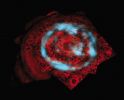
Saturn-PIA11396.jpgSouth Polar Aurora on Saturn64 visiteCaption NASA:"This image of the North Polar Regions of Saturn shows both the Aurora and underlying Atmosphere, seen at 2 different wavelengths of IR light as captured by NASA's Cassini spacecraft.
Energetic particles, crashing into the Upper Atmosphere cause the Aurora, shown in blue, to glow brightly at 4 microns (six times the wavelength visible to the human eye). The image shows both a bright ring, as seen from Earth, as well as an example of bright Auroral Emission within the Polar Cap that had been undetected until the advent of Cassini.
This Aurora, which defies past predictions of what was expected, has been observed to grow even brighter than is shown here. Silhouetted by the glow (cast here to the color red) of the hot interior of Saturn (clearly seen at a wavelength of 5 microns, or seven times the wavelength visible to the human eye) are the clouds and haze that underlie this Auroral Region. For a similar view of the Region beneath the Aurora see PIA09185.
This image is a composite captured with Cassini's Visual and Infrared Mapping Spectrometer. The aurora image was taken in the near-infrared on Nov. 10, 2006, from a distance of about 1 MKM (such as about 659.000 miles), with a phase angle of 157° and a sub-Spacecraft Planetocentric Latitude of 52° North.
The image of the clouds was obtained by Cassini on June 15, 2008, from a distance of approx. 602.000 Km (such as about 374.000 miles) and a sub-Spacecraft Planetocentric Latitude of 73° North".MareKromium
|
|
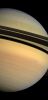
Saturn-PIA11453.jpgShadows (Natural Colors; credits: NASA/JPL/Space Science Institute)71 visiteCaption NASA:"Saturn's Rings cast a dramatic shadow separating the blues and greens of the Planet's Northern Hemisphere from the creamy pastels coloring the Southern Hemisphere.
This mosaic combines 6 images — 2 each of red, green and blue spectral filters — to create this Natural Color view. The images were obtained with the Cassini Spacecraft wide-angle camera on Dec. 30, 2008 at a distance of approx. 1,2 MKM (such as about 750.000 miles) from Saturn and at a Sun-Saturn-Spacecraft, or Phase, Angle of 30°.
Image scale is roughly 67 Km (about 42 miles) per pixel".MareKromium
|
|

Saturn-PIA11461.jpgBlack Shadow from the "White Moon" (Natural Colors; credits: Lunar Explorer Italia)78 visiteCaption NASA:"The shadow of Saturn's moon Enceladus cast onto the Planet's Atmosphere appears like a drop of black ink on a canvas of Saturnian storms.
The image was taken with the Cassini spacecraft narrow-angle camera on June 20, 2008 using a spectral filter sensitive to wavelengths of Near-InfraRed Light centered at 750 nanometers. The view was obtained at a distance of approx. 1,3 MKM (such as about 810.000 miles) from Saturn and at a Sun-Saturn-Spacecraft, or Phase, Angle of 24°.
Image scale is roughly 7 Km (about 4 miles) per pixel".MareKromium
|
|

Saturn-PIA11464.jpgDaybreak from above66 visiteCaption NASA:"Day breaks on the Northern Hemisphere of Saturn in this image from Cassini. The D-Ring is hidden below the horizon, but, working outward from the Planet, this image shows the C, B, A and F-Rings. The moon Prometheus is a faint speck inside the thin F-Ring in the upper left of the image.
This view looks toward the unilluminated side of the Rings from about 39° above the Ring-Plane. The image was taken with the Cassini Spacecraft wide-angle camera on March 20, 2009 using a spectral filter sensitive to wavelengths of Near-InfraRed Light centered at 853 nanometers.
The view was obtained at a distance of approx. 888.000 Km (such as about 552.000 miles) from Saturn and at a Sun-Saturn-Spacecraft, or Phase, Angle of 121°.
Image scale is roughly 50 Km (about 31 miles) per pixel".MareKromium
|
|
| 2243 immagini su 187 pagina(e) |
 |
|
|
|
|
138 | |
|
|
|
|








