Saturn: the "Ringed Beauty" and His Moons
|
|
|

Saturn-PIA10476.jpgSaturn in the Ringshine (natural colors; credits: NASA)77 visiteCaption NASA:"Large regions of Saturn's night side are illuminated by the Planet's gleaming Rings. Except for a sliver of the sunlit crescent at left, this view shows a part of the Planet lit almost entirely by "Ringshine".
The Southern Hemisphere, at bottom, receives its illumination from sunlight that strikes the Rings' southern face and is reflected onto the Planet. The Northern Hemisphere, at top, is lit by the feeble light that wends its way through countless ring particles to emerge on the Rings' north face. Despite the dim lighting on the northern part of the Planet, many cloud features can be seen there nevertheless.
This view was acquired from about 44° above the Ring-Plane. At bottom, the Planet's shadow stretches across the D and C-Rings.
Images taken using red, green and blue spectral filters were combined to create this natural color view. The images were obtained with the Cassini Spacecraft wide-angle camera on April 23, 2007 at a distance of approx. 901.000 Km (about 560.000 miles) from Saturn.
Image scale is roughly 50 Km (about 31 miles) per pixel".MareKromium
|
|

Saturn-PIA10478.jpgSaturn and Mimas (natural colors; credits: NASA/JPL/Space Science Institute )63 visiteCaption NASA:"The Cassini Spacecraft looks beyond Saturn's limb toward the icy face of Mimas, the innermost of the Planet's major moons.
This view looks toward the sunlit side of the rings from about 3° below the Ring-Plane. Mimas is about 396 Km (approx. 246 miles) across.
Images taken using red, green and blue spectral filters were combined to create this natural color view. The images were acquired with the Cassini Spacecraft narrow-angle camera on Sept. 4, 2007 at a distance of approx. 2,7 MKM (such as about 1,7 MMs) from Saturn and 2,8 MKM (such as about 1,8 MMs) from Mimas.
Image scale is roughly 16 Km (about 10 miles) per pixel on Saturn and approx. 17 Km (such as about 11 miles) per pixel on Mimas". MareKromium
|
|
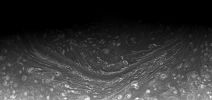
Saturn-PIA10486.jpgTwo sides of Saturn's "Hexagon"76 visiteCaption NASA:"Saturn's North Polar Hexagon appears to be a long-lived feature of the Atmosphere, having been spotted in images of Saturn in the early 1980s, again in the 1990s, and then by the Cassini Spacecraft in the past several years.
The persistent nature of the Hexagon in imaging observations implies that it is present throughout Saturn's 29-year seasonal cycle. Two sides of the Hexagon are seen here.
This view was obtained from about 67° above the Equator. The image was taken with the Cassini Spacecraft wide-angle camera on Aug. 25, 2008 using a spectral filter sensitive to wavelengths of infrared light centered at 752 nanometers. The view was acquired at a distance of approx. 566.000 Km (about 352.000 miles) from Saturn.
Image scale is roughly 31 Km (about 19 miles) per pixel".MareKromium
|
|

Saturn-PIA10487.jpgMany Colors for Many Moons... (natural colors; credits: NASA)63 visiteCaption NASA:"Four moons huddle near Saturn's multi-hued disk.
The coloration of the planet's northern hemisphere has changed noticeably since the Cassini Spacecraft's arrival in orbit in mid-2004. Imaging scientists are working to understand the causes of this change, which is suspected to be a seasonal effect.
Giant Titan (5150 Km, or approx. 3200 miles across), with its darker Winter Hemisphere, dominates the smaller moons in the scene. Beneath and left of Titan is Janus (181 Km, or about 113 miles across). Mimas (397 Km, or approx. 247 miles across) appears as a bright dot close to the Planet and beneath the Rings. Prometheus (102 Km, or about 63 miles across) is a faint speck hugging the Rings between the two small moons.
This view looks toward the unilluminated side of the Rings from less than 1° above the Ring-Plane.
Images taken using red, green and blue spectral filters were combined to create this natural color view. The view was acquired with the Cassini spacecraft wide-angle camera on Oct. 26, 2007, at a distance of approx. 1,5 MKM (such as about 920.000 miles) from Saturn and 2,7 MKM (about 1,7 MMs) from Titan.
Image scale is roughly 89 Km (approx. 55 miles) per pixel on Saturn and 164 Km (about 102 miles) per pixel on Titan".MareKromium
|
|

Saturn-PIA10493.jpgSaturn (natural colors; credits: NASA)93 visiteCaption NASA:"The Cassini Spacecraft looks toward the sunlit face of Saturn's Rings, whose shadows continue to slide southward on the Planet toward their temporary disappearance during equinox in August 2009.
This two-frame color mosaic was created from images taken as part of a photometry observation of the Rings. Photometry observations are useful for determining a host of ring particle properties.
This view looks toward the sunlit side of the Rings from about 3° below the Ring-Plane. Images taken using red, green and blue spectral filters were combined to create this natural color view. The images were acquired with the Cassini Spacecraft wide-angle camera on Aug. 22, 2008 at a distance of approx. 1,2 MKM (such as about 728.000 miles) from Saturn.
Image scale is roughly 66 Km (about 41 miles) per pixel".MareKromium
|
|
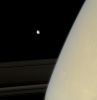
Saturn-PIA10510.jpgAtmosferic Distortion (natural colors; credits: NASA/JPL/Space Science Institute)75 visiteCaption NASA:"Mimas emerges from behind hazy Saturn. The Rings appear (slightly) distorted near the Planet as their image passes through the Upper Atmosphere.
The limb of Mimas (about 396 Km, or approx. 246 miles across) is slightly flattened on the left side by the rim of the large crater Herschel (see also PIA08278).
This view looks toward the unilluminated side of the Rings from about 9° above the Ring-Plane. Images taken using red, green and blue spectral filters were combined to create this natural color view. The images were acquired with the Cassini Spacecraft narrow-angle camera on Nov. 30, 2007 at a distance of approx. 1,7 MKM (such as about 1,1 MMs) from Mimas.
Image scale is roughly 10 Km (about 6 miles) per pixel on Mimas".MareKromium
|
|
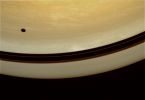
Saturn-PIA10512.jpgLonely Shadow... (possible True Colors; credits: Lunexit)71 visiteCaption NASA:"The shadow of Tethys drifts across the face of Saturn. Nearby, shadows of the Planet's Rings form a darkened band above the Equator. This view looks toward Saturn from a vantage point 63° North of the Equator.
The image was taken in visible green light with the Cassini Spacecraft wide-angle camera on Oct. 1, 2008. The view was acquired at a distance of approx 615.000 Km (about 382000 miles) from Saturn.
Image scale is roughly 37 Km (approx. 23 miles) per pixel".MareKromium
|
|
Saturn-PIA10513.jpgThe South Pole of Saturn (natural colors; credits: Lunexit)75 visiteCaption NASA:"Long streamers of cloud encircle the South Polar Region of Saturn. Farther poleward, or toward lower left, faint, deeper atmospheric structures lurk beneath the haze.
This image was acquired from a vantage point 74° South of the Planet's equator.
The view was taken with the Cassini spacecraft wide-angle camera on Oct. 2, 2008 using a spectral filter sensitive to wavelengths of IR light centered at 728 nanometers. The view was obtained at a distance of approx. 369.000 Km (such as about 229.000 miles) from Saturn.
Image scale is roughly 19 Km (about 12 miles) per pixel".MareKromium
|
|

Saturn-PIA10539-M.jpgSpokes (natural - but enhanced - colors; credits: Lunar Explorer Italia)81 visiteCaption NASA:"A large group of Spokes emerges from Saturn's shadow in this image taken of the morning side of the Rings. Such groupings may hold clues to the manner in which these features are formed.
The image was taken in visible light with the Cassini spacecraft wide-angle camera on Nov. 2, 2008 at a distance of approx. 869.000 Km (such as about 540.000 miles) from Saturn and at a Phase angle of 37°.
Image scale is approx. 48 Km (such about 30 miles) per pixel".MareKromium
|
|
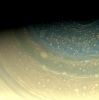
Saturn-PIA10553-1.jpgThe Blue Pole of Saturn (natural colors; credits: NASA/JPL/Space Science Institute and Lunar Explorer Italia)65 visiteCaption NASA:"Saturn's North Pole is littered with storms, as we see in this color view of it. A bit of the North Polar Hexagon is also visible at the upper-right. Cassini scientists are looking forward to sunrise on this Pole next year so that they can better study it in Visible Light.
Images taken using red, green and blue spectral filters were combined to create this full color view. The images were obtained with the Cassini Spacecraft wide-angle camera on Nov. 16, 2008 at a distance of approx. 673.000 Km (such as about 418.000 miles) from Saturn and at a Sun-Saturn-Spacecraft, or Phase, Angle of 71°.
Image scale is roughly 37 Km (about 23 miles) per pixel".MareKromium
|
|

Saturn-PIA10558.jpgPolar Blue (possible True Colors; credits: NASA/JPL/Space Science Institute)65 visiteCaption NASA:"Saturn's North Pole retains its bluish hue in this true color Cassini image, even as Northern Winter is coming to an end. The azure blue of Saturn's Winter Hemisphere during the early Cassini prime mission still remains a puzzle. Over the course of time, the blue color has faded and has been replaced with bands of other hues (see also PIA11141).
The North Pole is in shadow here, but a portion of its oscillating hexagonal pattern is visible. Storms create the look of a pockmarked surface.
Images taken using red, green and blue spectral filters were combined to create this Natural Color view. The images were acquired with the Cassini Spacecraft wide-angle camera on Nov. 29, 2008 at a distance of approx. 1,1 MKM (about 683.000 miles) from Saturn and at a Sun-Saturn-Spacecraft, or Phase, Angle of 38°.
Image scale is roughly 62 Km (about 39 miles) per pixel".MareKromium
|
|
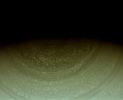
Saturn-PIA10568.jpgNorth Polar Hues (possible Natural Colors; credits: Lunar Explorer Italia)75 visiteCpation NASA:"Cassini imaging scientists have waited years for the Sun to reveal the Hexagonal Wave Pattern (a.k.a.: The Hexagon) in the clouds of Saturn's North Pole, part of which can be seen at the top of this image from the Cassini Spacecraft. This mosaic combines four separate near-InfraRed images to show one full side of the Hexagon and two partial sides cut off by shadow.
When the Spacecraft arrived in 2004, Winter darkened the North Pole. As the Planet continues its 29-year orbit, the Sun sheds more light on northern features and uncovers more of this strange, long-lived formation first observed in Voyager images of the illuminated Northern Pole from the early 1980's.
False color images made from data collected by Cassini's Visual and InfraRed Mapping Spectrometer (VIMS) have previously captured the full six-sided pattern in the IR Light. (See PIA09188)
South of the Hexagon at least five large storm systems can be seen spinning in a sea of smaller storms.
The image was taken with the Cassini Spacecraft wide-angle camera on Dec. 1, 2008 using a spectral filter sensitive to wavelengths of near-iIR Light centered at 752 nanometers. The view was obtained at a distance of approx. 712.000 kilometers (442,000 miles) from Saturn and at a Sun-Saturn-spacecraft, or phase, angle of 69 degrees. Image scale is 39 Km (such as about 24 miles) per pixel".MareKromium
|
|
| 2243 immagini su 187 pagina(e) |
 |
|
|
|
|
137 | |
|
|
|
|








