Saturn: the "Ringed Beauty" and His Moons
|
|
|
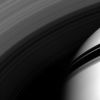
Saturn-PIA09908.jpgThrough the Rings...75 visiteCaption NASA:"The Cassini spacecraft peers through the Gossamer Strands of Saturn's innermost rings, whose own shadows adorn the Planet beyond.
This view looks toward the sunlit side of the rings from about 35° below the Ring-Plane. The image was taken in visible light with the Cassini Spacecraft wide-angle camera on April 21, 2008. The view was obtained at a distance of approximately 620.000 Km (approx. 385.000 miles) from Saturn.
Image scale is roughly 67 Km (approx. 42 miles) per pixel".MareKromium
|
|

Saturn-PIA09908~0.jpgThrough the Rings... (MULTISPECTRUM; credits: Lunexit)64 visitenessun commentoMareKromium
|
|
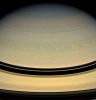
Saturn-PIA09910.jpgThe "Head" of Saturn (Natural Colors; credits: NASA/Space Science Institute)63 visiteCaption NASA:"Bright puffs and ribbons of cloud drift lazily through Saturn's murky skies. In contrast to the bold red, orange and white clouds of Jupiter, Saturn's clouds are overlain by a thick layer of haze. The visible cloud tops on Saturn are deeper in its atmosphere due to the Planet's cooler temperatures.
This view looks toward the unilluminated side of the Rings from about 18° above the Ring-Plane. Images taken using red, green and blue spectral filters were combined to create this natural color view. The images were acquired with the Cassini spacecraft wide-angle camera on April 15, 2008 at a distance of approx. 1,5 MKM (such as about 906,000 miles) from Saturn.
Image scale is roughly 84 Km (about 52 miles) per pixel".MareKromium
|
|
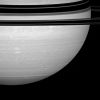
Saturn-PIA09913.jpgJust a Matter of "Proportions"...63 visiteCaption NASA:"A great, eye-like vortex stares out of Saturn's roiling atmosphere. The storm is wide enough to span the distance from Washington, DC to London. Bright Enceladus drifts past in the foreground.
This view looks toward the unilluminated side of the Rings from about 3° above the Ring-Plane.
The image was taken with the Cassini Spacecraft wide-angle camera on April 23, 2008 using a combination of spectral filters sensitive to wavelengths of polarized infrared light centered at 752 nanometers. The view was acquired at a distance of approx. 1,3 MKM (such as about 783.000 miles) from Saturn.
Image scale is roughly 72 Km (about 45 miles) per pixel".MareKromium
|
|
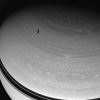
Saturn-PIA09917.jpgFrom farther North, than the North Pole...74 visiteCaption NASA:"Myriad vortices churn through Saturn's high Northern Latitudes while Dione's shadow drifts across the gas giant's face.
This view looks toward the unilluminated side of the Rings from about 43° above the Ring-Plane.
The image was taken with the Cassini Spacecraft wide-angle camera on May 7, 2008 using a spectral filter sensitive to wavelengths of infrared light centered at 752 nanometers.
The view was obtained at a distance of approx. 1,2 MKM (about 760.000 miles) from Saturn. Image scale is roughly 69 Km (about 43 miles) per pixel".MareKromium
|
|

Saturn-PIA10358.jpgSaturn's Infrared Temperature Snapshot (Labeled)78 visiteCaption NASA:"Scientists have discovered a wave pattern, or oscillation, in Saturn's atmosphere only visible from Earth every 15 years. The pattern ripples back and forth like a wave within Saturn's upper atmosphere. In this region, temperatures switch from one altitude to the next in a candy cane-like, striped, hot-cold pattern.
The temperature "snapshot" shown in these two images captures two different phases of this wave oscillation: the temperature at Saturn's Equator switches from hot to cold, and temperatures on either side of the Equator switch from cold to hot every Saturn half-year.
The image on the left was taken in 1997 and shows the temperature at the equator is colder than the temperature at 13° South Latitude. Conversely, the image on the right taken in 2006 shows the temperature at the Equator is warmer.
These images were taken with NASA's Infrared Telescope Facility in Mauna Kea, Hawaii".MareKromium
|
|
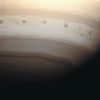
Saturn-PIA10411.jpgStorm Alley (MULTISPECTRUM-2; credits: Lunexit)63 visiteCaption NASA:"A line of dark vortices charge through Saturn's "Storm Alley" — such as a Region that has seen intensive storm activity since the Cassini Spacecraft began its observations of the Planet in early 2004.
The image was taken with the Cassini Spacecraft wide-angle camera on May 19, 2008 using a spectral filter sensitive to wavelengths of infrared light centered at 728 nanometers. The view was obtained at a distance of approx. 863.000 Km (about 536.000 miles) from Saturn.
Image scale is roughly 48 Km (about 30 miles) per pixel".MareKromium
|
|

Saturn-PIA10413-PCF-LXTT-IPF.jpgNorthern Swirls (Absolute Natural Colors; credits for the additional process. and color.: Dr Paolo C. Fienga/Lunar Explorer Italia/Italian Planetary Foundation)103 visiteSinuous and swirling Clouds (which appear to be extremely dense) and Hurricane-sized Vortices, mingle in Saturn's Northern Skies (in fact, this view looks toward a Region of Saturn that is located at about 70° North Latitude). Despite the level of detail that is visible here, the Region shown in today's APOD is wide enough to contain the planet Mars comfortably.
The image was taken with the NASA - Cassini Spacecraft's CB1 Spectral Filter, which is sensitive to Wavelengths of Visible Red Light centered at 619 nanometers. The view was acquired with the Spacecraft's Narrow-Angle Camera on May 23, 2008 at a distance of approximately 1,2 Million KiloMeters (such as about 745.200 miles) from Saturn. Image scale is roughly 7 Km (about 4,3 miles) per pixel.
This frame (which is a NASA - CASSINI Spacecraft Original b/w frame published on the NASA - Planetary Photojournal and identified by the serial n. PIA 10413) has been additionally processed and then colorized, according to an educated guess carried out by Dr Paolo C. Fienga (LXTT-IPF), in Absolute Natural Colors (such as the colors that a human eye would actually perceive if someone were onboard the NASA - Cassini Spacecraft and then looked outside, towards the Upper Atmosphere of Satun), by using an original technique created - and, in time, dramatically improved - by the Lunar Explorer Italia Team. Different colors, as well as different shades of the same color, mean, among others, the existence of different Elements in the Upper Atmosphere of Satun, each having a different Albedo (---> Reflectivity) and Chemical Composition.MareKromium
|
|

Saturn-PIA10413.jpgSwirling Clouds (MULTISPECTRUM; credits: Lunexit)63 visiteCaption NASA:"Sinuous clouds and hurricane-sized vortices mingle in Saturn's Northern Skies. This view looks toward a Region located at 70° North Latitude on Saturn.
Despite the level of detail visible here, the Region shown is wide enough to contain the planet Mars comfortably.
The image was taken with Cassini's CB1 spectral filter, which is sensitive to wavelengths of visible red light centered at 619 nanometers. The view was acquired with the spacecraft's narrow-angle camera on May 23, 2008 at a distance of approx. 1,2 MKM (about 775.000 miles) from Saturn.
Image scale is roughly 7 Km (about 4 miles) per pixel".MareKromium
|
|
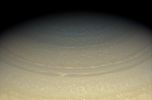
Saturn-PIA10414.jpgNorthern Blue (natural colors; credits: NASA/JPL/Space Science Institute)63 visiteCaption NASA:"Golden hues continue to creep Northward on Saturn, subduing the blues and grays the Cassini Spacecraft witnessed upon arrival in mid-2004. This view was acquired from about 27° above the Ring-Plane.
Images taken using red, green and blue spectral filters were combined to create this natural color view. The images were acquired with the Cassini Spacecraft wide-angle camera on May 23, 2008 at a distance of approx. 1,3 MKM (such as about 780.000 miles) from Saturn.
Image scale is roughly 71 Km (about 44 miles) per pixel".MareKromium
|
|

Saturn-PIA10416.jpgSaturnian "Twirling Vortices" and "Cirrus-like" Clouds Formation (MULTISPECTRUM-2; credits: Lunexit)64 visiteCaption NASA:"Twirling vortices swim through a vast ocean of Hydrogen and Helium in Saturn's far North. This view looks toward a region at 70° North Latitude.
The image was taken with the Cassini spacecraft narrow-angle camera on May 23, 2008 using a spectral filter sensitive to wavelengths of infrared light centered at 750 nanometers. The view was obtained at a distance of approx. 1,2 MKM (such as about 776.000 miles) from Saturn.
Image scale is roughly 7 Km (about 4 miles) per pixel".MareKromium
|
|
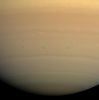
Saturn-PIA10457.jpgSouthern Turbulence (natural colors; credits: NASA)64 visiteCaption NASA:"A line of vortices rolls through the turbulent region on Saturn nicknamed "Storm Alley" by Cassini scientists. This latitude band, centered around 35° South, has displayed persistent, intensive storm activity since Cassini began its approach to Saturn in early 2004.
Images taken using red, green and blue spectral filters were combined to create this natural color view. The images were obtained with the Cassini Spacecraft wide-angle camera on July 23, 2008 at a distance of approximately 1 MKM (such as about 622.000 miles) from Saturn.
Image scale is roughly 56 Km (about 35 miles) per pixel".MareKromium
|
|
| 2243 immagini su 187 pagina(e) |
 |
|
|
|
|
136 | |
|
|
|
|








