Saturn: the "Ringed Beauty" and His Moons
|
|
|
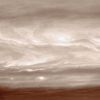
Saturn-PIA09722.jpgSub-Equatorial Saturnian Clouds (natural colors - elab. Lunexit)65 visiteCaption NASA:"A chevron-shaped pattern and bright vortices stand out in the turbulent Saturnian Atmosphere. Such features are hallmarks of the boundary between alternating East-West flowing cloud bands.
This view looks toward an area about 9° South of the Planet's Equator.
The image was taken with the Cassini spacecraft wide-angle camera on July 28, 2007 using a spectral filter sensitive to wavelengths of infrared light centered at 889 nanometers. The view was acquired at a distance of approx. 3,1 MKM (such as about 1,9 MMs) from Saturn.
Image scale is roughly 37 Km (approx. 23 miles) per pixel".MareKromium
|
|

Saturn-PIA09734.jpgTurbulences73 visiteCaption NASA:"The Cassini Spacecraft has a peek beneath the hazes in Saturn's Upper Atmosphere at the swirling vortices that lurk below.
Many vortices can be seen in this image, varying in size from small to large.
The largest one in this image exhibits a collar of bright clouds surrounding the central dark core.
The view is centered on a region about 46° South of the Planet's Equator.
The image was taken with the Cassini spacecraft narrow-angle camera on Aug. 12, 2007 using a spectral filter sensitive to wavelengths of infrared light centered at 750 nanometers. The view was acquired at a distance of approx. 4,1 MKM (such as about 2,5 MMs) from Saturn.
Image scale is roughly 24 Km (about 15 miles) per pixel".MareKromium
|
|

Saturn-PIA09776.jpgJust like the Solar System!73 visiteCaption NASA:"Saturn's icy satellites wheel about the colorful Giant Planet, while the Rings shine dimly in scattered sunlight. The Ringed Planet is, in many ways, a laboratory for investigating the history of our Solar System and how planets form around other stars. There are 4 moons visible in this view. Tethys (1071 Km, or 665 miles across), largest in the scene, is on the far side of the Ring-Plane. Mimas (397 Km, or 247 miles across), is the one on the near side of the Rings, below Tethys. Janus (181 Km, or 113 miles across), is left of the Rings' edge. Pandora (84 Km, or 52 miles across) is a speck below the Rings' edge, between Janus and Mimas. Mimas casts a shadow onto Saturn's bluish Northern Hemisphere.
This view looks toward the unilluminated side of the Rings from about 2° above the Ring-Plane. Images taken using red, green and blue spectral filters were combined to create this natural color view. The view was acquired with the Cassini spacecraft wide-angle camera on Oct. 30, 2007.
The view was taken at a distance of approx. 2,6 MKM (such as about 1,6 MMs) from Saturn.
Image scale is roughly 153 Km (about 95 miles) per pixel on the Planet".MareKromium
|
|
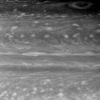
Saturn-PIA09778.jpgMonitoring the Maelstrom86 visiteCaption NASA:"Clouds and vortices churn in this beautiful, close-up view of Saturn. This image is part of a series of important Cassini observations designed to provide information about winds and convection on Saturn.
The view is centered on a Region 44° North of Saturn 's Equator.
The image was taken with the Cassini spacecraft narrow-angle camera on Nov. 7, 2007 using a spectral filter sensitive to wavelengths of infrared light centered at 750 nanometers. The view was acquired at a distance of approx. 2,9 MKM (such as about 1,8 MMs) from Saturn.
Image scale is roughly 17 Km (11 miles) per pixel".MareKromium
|
|

Saturn-PIA09793.jpgThe Northern Hemisphere of Saturn (natural colors; credits: NASA/Space Science Inst.)73 visiteCaption NASA: "Dark ring shadows adorn the Northern Hemisphere of Saturn.
The shadows have loosened their grip on the North compared to when Cassini arrived in 2004, and presently continue to slide farther South.
This view looks toward the unilluminated side of the rings from about 5° above the Ring-Plane. Images taken using red, green and blue spectral filters were combined to create this Natural Color View. The view was acquired with the Cassini spacecraft wide-angle camera on Oct. 22, 2007, at a distance of approx. 1,3 MKM (such as about 839.000 miles) from Saturn.
Image scale is roughly 77 Km (about 48 miles) per pixel".MareKromium
|
|
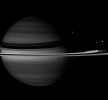
Saturn-PIA09795.jpgObscure Planet, Bright Moons... (IR)64 visiteCaption NASA: "Just before Rhea slipped behind Saturn, the Cassini Spacecraft captured the moon in its disappearing act.
Along with the partly obscured Rhea are Tethys, at right, and Enceladus, left of Tethys.
At the wavelength in which this image was taken, absorption of Sunlight by Methane gas in Saturn's Atmosphere is strong, causing the Planet to appear darker than at other wavelengths.
This view looks toward the unilluminated side of the Rings from about 4° above the Ring-Plane. The image was taken with the Cassini spacecraft wide-angle camera on Nov. 9, 2007 using a spectral filter sensitive to wavelengths of Infrared Light centered at 890 nanometers. The view was acquired at a distance of approx. 2,8 MKM (about 1,7 MMs) from Saturn and at a Sun-Saturn-spacecraft, or phase, angle of 44°.
Image scale is roughly162 Km (such as about 101 miles) per pixel".MareKromium
|
|
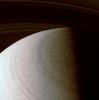
Saturn-PIA09828.jpgNorthern Latitudes (possible natural colors; credits: Lunexit)75 visiteCaption NASA:"As seasons change on Saturn, and sunlight creeps farther north, the region surrounding the North Pole is steadily coming to light. This scene reveals many features in Saturn's dynamic and beautiful Atmosphere, including a detail largely obscured from the imaging cameras until now: on the Terminator at center right is part of the Polar Hexagon, which was previously observed by Cassini's Visible and Infrared Mapping Spectrometer (VIMS) and Composite Infrared Spectrometer (CIRS).
These instruments used heat radiated from Saturn to observe the Polar Hexagon (rather than reflected sunlight, as is the case in this view). The Hexagon was first imaged by the Voyager spacecraft more than 25 years ago.
The view looks toward the unilluminated side of the Rings from about 38° above the Ring-Plane and is centered on a region 63° north of the Saturnian Equator.
The image has been brightened to show details at high Northern Latitudes, where solar illumination is presently weak.
The image was taken with the Cassini spacecraft wide-angle camera on Jan. 2, 2008 using a combination of spectral filters sensitive to wavelengths of polarized infrared light centered at 752 and 705 nanometers. The view was acquired at a distance of approx. 930.000 Km (about 578.000 miles) from Saturn.
Image scale is roughly 52 Km (approx. 32 miles) per pixel".MareKromium
|
|

Saturn-PIA09854.jpgThe Southern Hemisphere of Saturn (natural colors - credits: NASA/SSI)76 visiteCaption NASA: "Saturn's Southern Hemisphere is glimpsed through the Gossamer Veil of its Rings. Ring shadows adorn the low Northern Latitudes.
This view looks toward the unilluminated side of the Rings from about 22° above the Ring-Plane. Images taken using red, green and blue spectral filters were combined to create this natural color view.
The images were acquired with the Cassini spacecraft wide-angle camera on Dec. 16, 2007 at a distance of approx. 1,5 MKM (about 908.000 miles) from Saturn.
Image scale is roughly 84 Km (approx. 52 miles) per pixel".MareKromium
|
|

Saturn-PIA09864.jpgNever "Dark Nights"... (natural colors; credits: NASA)71 visiteCaption NASA:"Titan emerges from behind Saturn, while Tethys streaks into view, in this colorful scene. Saturn's shadow darkens the far arm of the Rings near the Planet's limb. Titan is about 5150 Km (approx. 3200 miles) wide; Tethys is 1071 Km (such as approx. 665 miles) wide.
This view looks toward the unilluminated side of the Rings from about 3° above the Ring-Plane. Images taken using red, green and blue spectral filters were combined to create this natural color view. The images were acquired with the Cassini spacecraft wide-angle camera on Jan. 30, 2008 at a distance of approx. 1,3 MKM (such as about 800.000 miles) from Saturn.
Image scale is roughly 77 Km (about 48 miles) per pixel on Saturn".MareKromium
|
|

Saturn-PIA09876~0.jpgNorthern Latitudes (Natural Colors; credits: NASA)64 visiteCaption NASA:"Saturn dominates this colorful view, taken from a vantage point high above the Rings. From here the Cassini Spacecraft can see the Rings' far side, where the dark shadow of Saturn abruptly terminates their visibility.
Mimas (about 397 Km, or approx. 247 miles across) casts its shadow onto the Planet's Northern Latitudes (just below center).
This view looks toward the unilluminated side of the Rings from about 27° above the Ring-Plane.
Images taken using red, green and blue spectral filters were combined to create this natural color view. The images were acquired with the Cassini spacecraft wide-angle camera on Feb. 26, 2008 at a distance of approx. 1,6 MKM (such as about 1 MMs) from Saturn.
Image scale is roughly 93 Km (about 58 miles) per pixel".MareKromium
|
|
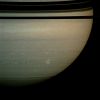
Saturn-PIA09900.jpgContinuing or Perpetual Storm? (MULTISPECTRUM; credits: Lunexit)74 visiteCaption NASA:"The longest-lived continuously monitored electrical storm ever observed on Saturn continues to churn through the tempest-tossed region nicknamed "Storm Alley" because of its preponderance of storm activity. This image of the storm was taken about 5 months after it was first detected by Cassini's Imaging Cameras and the Radio and Plasma Wave Science Experiment.
This view looks toward the unilluminated side of the Rings from about 1° above the Ring-Plane. The bands of the Ring shadows blanket the Planet at the top of the scene.
The image was taken with the Cassini spacecraft wide-angle camera on April 23, 2008 using a combination of spectral filters sensitive to wavelengths of polarized infrared light centered at 752 nanometers. The view was acquired at a distance of approx. 1,2 MKM (such as about 760.000 miles) from Saturn.
Image scale is roughly 70 Km (about 43 miles) per pixel".MareKromium
|
|
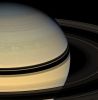
Saturn-PIA09906.jpgNorthern Latitudes (approx. true colors; credits: NASA)65 visiteCaption NASA:"Stately Saturn sits surrounded by its darkened disk of ice. An increasing range of hues has become visible in the Northern Hemisphere as Spring approaches and the Ring shadows slide southward.
This view looks toward the unilluminated side of the rings from about 17° above the Ring-Plane. Images taken using red, green and blue spectral filters were combined to create this natural color view. The images were acquired with the Cassini Spacecraft wide-angle camera on April 15, 2008 at a distance of approx. 1,5 MKM (such as about 906.000 miles) from Saturn.
Image scale is roughly 84 Km (about 52 miles) per pixel".MareKromium
|
|
| 2243 immagini su 187 pagina(e) |
 |
|
|
|
|
135 | |
|
|
|
|








