Saturn: the "Ringed Beauty" and His Moons
|
|
|

Saturn-PIA08944-01.jpgPrometheus Makes Contact (natural colors - elab. Lunexit)78 visitenessun commentoMareKromium
|
|

Saturn-PIA08952.jpgThe Southern Latitudes of Saturn64 visiteCaption NASA:"Stunning details in Saturn's clouds suggest movement within bands of atmosphere. This false color enhancement makes visible an exciting level of detail in the bright and dark bands that is more easily seen at Jupiter than at Saturn.
Saturn's Southern Hemisphere seems to fade into the blackness of space in this view.
The image was taken with the Cassini spacecraft wide-angle camera using a combination of spectral filters sensitive to wavelengths of infrared light centered at 752 (red channel), 890 (blue channel) and 728 (green channel) nanometers.
The view was acquired on Feb. 2, 2007 at a distance of approx. 1 MKM (such as about 600.000 miles) from Saturn.
Image scale is roughly 57 Km (about 36 miles) per pixel".MareKromium
|
|
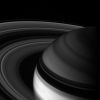
Saturn-PIA08973.jpgIR Saturn63 visiteCaption NASA:"Cassini looks toward Northern Latitudes on Saturn and out across the Ring-Plane.
This InfraRed (IR) view probes clouds beneath the hazes that obscure the Planet's depths in natural color views.
This image looks toward the unilluminated side of the Rings from about 24° above the Ring-Plane. The Rings' shadow drapes across the region North of the Planet's bright Equatorial Band.
The image was taken with the Cassini spacecraft wide-angle camera using a spectral filter sensitive to wavelengths of light centered at 890 nanometers. The view was acquired on May 24, 2007 at a distance of approx. 1,5 MKM (such as about 1 MMs) from Saturn.
Image scale is roughly 89 Km (55 miles) per pixel".MareKromium
|
|

Saturn-PIA08982.jpgIn the Night...74 visiteCaption NASA:"Graceful giant Saturn poses with a few of the small Worlds it holds close. From this viewpoint the Cassini Spacecraft can see across the entirety of the Planet's shadow on the Rings, to where the Ring-Plane emerges once again into Sunlight.
Tethys shines large and bright near the bottom of the scene. Pandora sits outside the F-Ring, below center. Epimetheus is a speck on the far side of the Ring-Plane, immediately to the right of Saturn's limb. Most of the other bright specks near the Rings are background stars.
This view looks toward the unilluminated side of the Rings from about 8° above the Ring-Plane. The image has been brightened to enhance the appearance of the small moons.
The image was taken with the Cassini spacecraft wide-angle camera on June 2, 2007 using a spectral filter sensitive to wavelengths of infrared light centered at 918 nanometers.
The view was obtained at a distance of approx. 2,2 MKM (such as about 1,4 MMs) from Saturn.
Image scale is roughly 131 Km (about miles) per pixel".MareKromium
|
|

Saturn-PIA08983.jpgSpokes!67 visiteCaption NASA:"The Cassini Spacecraft spies multiple spokes in Saturn's outer B-Ring. The precise origin and evolution of these transient features continue to provide Ring Scientists with intriguing puzzles to solve.
Most of these spokes are about 4000 Km long; the 2 near the bottom of the scene are about 1000 Km (about 600 miles) wide.
This view looks toward the unilluminated side of the Rings from about 8° above the Ring-Plane.
The image was taken in visible green light with the Cassini spacecraft narrow-angle camera on June 2, 2007. The view was acquired at a distance of approx. 2,2 MKM (such as about 1,4 MMs) from Saturn.
Image scale is roughly 13 Km (about 8 miles) per pixel".MareKromium
|
|
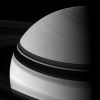
Saturn-PIA08987.jpgNorthern Latitudes64 visiteCaption NASA:"Incredible swirling details in Saturn's Northern Clouds can be seen in this dazzling view. Shadows cast by the Rings embrace the Northern Hemisphere.
The view looks toward the unilluminated side of the Rings from about 16° above the Ring-Plane.
The image was taken with the Cassini spacecraft wide-angle camera on June 10, 2007 using a spectral filter sensitive to wavelengths of infrared light centered at 939 nanometers. The view was acquired at a distance of approx. 1,3 MKM (such as about 800.000 miles) from Saturn. Image scale is roughly 72 Km (about 45 miles) per pixel".MareKromium
|
|
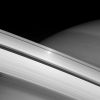
Saturn-PIA08992.jpgSurging Across the Rings75 visiteCaption NASA:"A surge in brightness appears on the Rings directly opposite the Sun from the Cassini Spacecraft. This "opposition surge" travels across the Rings as the Spacecraft watches. This view looks toward the sunlit side of the Rings from about 9° below the Ring-Plane.
The image was taken in visible light with the Cassini spacecraft wide-angle camera on June 12, 2007 using a spectral filter sensitive to wavelengths of infrared light centered at 853 nanometers.
The view was acquired at a distance of approx. 524.374 Km (such as about 325.830 miles) from Saturn.
Image scale is 31 Km (about 19 miles) per pixel".MareKromium
|
|

Saturn-PIA09009-PCF-LXTT-IPF.jpgSaturnian Cloud Bands (Absolute Natural Colors; credits for the additional process. and color.: Dr Paolo C. Fienga - Lunar Explorer Italia/Italian Planetary Foundation)137 visiteCaption NASA:"The Cassini Spacecraft spies smooth, sometimes wavy, contours in the banded East-West flowing clouds of Saturn. This view shows clouds in Saturn's Northern Mid-Latitudes.
The image was taken using a spectral filter sensitive to wavelengths of infrared light centered at 727 nanometers. The view was obtained with the Cassini spacecraft narrow-angle camera on July 8, 2007 at a distance of approx. 2,9 MKM (about 1,8 MMs) from Saturn.
Image scale is roughly 34 Km (about 21 miles) per pixel".
Un nuovo passo in avanti per la Colorizzazione Naturale Assoluta creata da Lunar Explorer Italia: ora, infatti, inizieremo la rivalutazione (in senso di analisi cromatica) dei frames CASSINI e, quindi, la ricolorizzazione di Saturno. Ecco il primo "nato" di questa nuova serie.MareKromium
|
|
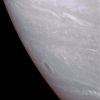
Saturn-PIA09012.jpgIncoming Storm64 visiteCaption NASA:"A great vortex, ringed by bright clouds, rolls through the Southern Skies of Saturn in this Cassini spacecraft view.
The image was taken using a spectral filter sensitive to wavelengths of infrared light centered at 750 nanometers. The view was obtained with the Cassini spacecraft narrow-angle camera on July 11, 2007 at a distance of approx. 2,8 MKM (such as about 1,8 MMs) from Saturn.
Image scale is roughly 17 Km (about 10 miles) per pixel".MareKromium
|
|

Saturn-PIA09185.jpgThe Saturnian "Hexagon" and Aurora66 visiteThis nighttime view of Saturn's north pole by the visual and infrared mapping spectrometer on NASA's Cassini orbiter reveals a dynamic, active planet at least 75 kilometers (47 miles) below the normal cloud tops seen in visible light. Clearly revealed is the bizarre six-sided hexagon feature present at the north pole.
This image is one of the first clear images of the north polar region ever acquired from a unique polar perspective. In this image, the blue color shows high-altitude emissions from atmospheric molecules excited by charged particles smashing into the atmosphere along Saturn's powerful magnetic field lines, producing the aurora at very high altitudes in Saturn's atmosphere. The red color indicates the amount of 5-micron wavelength radiation, or heat, generated in the depths of the warm interior of Saturn that escapes the planet. Clouds blocking this light are revealed as silhouettes against the background thermal glow of the planet.
This image is among the first to capture the entire hexagonal feature and north polar region in one shot. It is also one of the first polar views using Saturn's thermal glow at 5 microns (seven times the wavelength visible to the human eye) as the light source. This allows polar cloud features to be revealed during the persistent nighttime conditions under way during north polar winter.
The hexagonal feature was originally discovered by NASA's Voyager spacecraft in 1980, but those images and subsequent ground-based telescope images suffered from poor viewing perspectives, which placed the feature and the north pole at the extreme northern limb (edge) in those images.
The strong brightness of the hexagon feature indicates that it is primarily a clearing in the clouds, which extends deep into the atmosphere, at least down to the 3-bar (3-Earth atmospheres pressure) level, about 75 kilometers (47 miles) below the clouds and hazes seen in visible wavelengths. Thick clouds border both sides of the narrow feature, as indicated by the adjacent dark lanes paralleling the bright hexagon. This image and other images acquired over a 12-day period between Oct. 30 and Nov. 11, 2006, show that the feature is nearly stationary, and likely is an unusually strong pole-encircling planetary wave that extends deep into the atmosphere.
This image was acquired by the Cassini visual and infrared mapping spectrometer on Oct. 29, 2006, from an average distance of 905,000 kilometers (562,340 miles) above the clouds.
|
|

Saturn-PIA09186.jpgNight view of the "Hexagon"74 visiteThis nighttime view of Saturn's north pole by the visual and infrared mapping spectrometer onboard NASA's Cassini orbiter clearly shows a bizarre six-sided hexagon feature encircling the entire north pole. This is one of the first clear images taken of the north polar region ever acquired from a unique polar perspective.
In this image, the red color indicates the amount of 5-micron wavelength radiation, or heat, generated in the warm interior of Saturn that escapes the planet. Clouds near 3-bar (about 100 kilometers or 62 miles deeper than seen in visible wavelengths) block the light, revealing them in silhouette against the background thermal glow of Saturn. The bluish color shows sunlight striking the far limb (edge) of the planet, showing that the entire north pole is under the nighttime conditions characteristic of polar winter, as on Earth.
This image is the first to capture the entire feature and north polar region in one shot, and is also the first polar view using Saturn's thermal glow at 5 microns (seven times the wavelength visible to the human eye) as the light source. This allows the pole to be revealed during the persistent nighttime conditions under way during winter. The hexagon feature was originally discovered by NASA's Voyager spacecraft in 1980, but those historic images and subsequent ground-based telescope images suffered from poor viewing perspectives, which placed the feature and the north pole at the extreme northern limb (edge) in those images.
In the new infrared images, the strong brightness of the hexagon feature indicates that it is primarily a clearing in the clouds, which extends deep into the atmosphere, at least some 75 kilometers (47 miles) underneath the typical upper hazes and clouds seen in the daytime imagery by Voyager. Thick clouds border both sides of the narrow feature, as indicated by the adjacent dark lanes paralleling the bright hexagon. This and other images acquired over a 12-day period between Oct. 30 and Nov. 11, 2006, show that the feature is nearly stationary, and likely is an unusually strong pole-encircling planetary wave that extends deep into the atmosphere.
This image was acquired with the Cassini visual and infrared mapping spectrometer on Oct. 30, 2006, from an average distance of 1.3 million kilometers (807,782 miles).
Nota Lunexit: ed ora, quanto ci scommettiamo che, entro (al massimo) 48 ore, il Prof. Hoagland e la Sua Scuola (e, probabilmente, tanti altri Guru della Scienza di Confine) inizieranno a parlare - con estrema saccenza - di "artificialità" dell'Esagono e (perchè no?) della probabile natura artificiale di tutto il Gigante Anellato?
Stay tuned!
|
|

Saturn-PIA09187.gifWatch the "Hexagon" rotate! (GIF-Movie)65 visiteThis nighttime movie of the depths of the North Pole of Saturn taken by the VIMS onboard NASA's Cassini Orbiter reveals a dynamic, active planet lurking underneath the ubiquitous cover of upper-level hazes. The defining feature of Saturn's North Polar Regions -- the six-sided hexagon feature -- is clearly visible in the image.
Here, brightness indicates the amount of 5-micron (seven times the wavelength visible to the human eye) radiation, or heat, generated in the depths of the warm interior of Saturn that escapes the planet. Clouds at a depth equivalent to 3-Earth-atmospheres pressure block the light radiating from below, revealing themselves in dark silhouette against the background thermal glow of the Planet. These deep clouds lie some 75 Km (about 47 miles) underneath the typical ammonia hazes and clouds seen in visual imagery and are likely composed of ammonia-hydrosulfide, although some may be composed of water, as on Earth.
A prominent feature seen in this polar view is a strange hexagon wave feature circumscribing the north pole.
This nighttime movie was acquired over a one-hour period on Nov. 10, 2006, from an average distance of 1.03 million kilometers (621,000 miles) above Saturn's clouds.
|
|
| 2243 immagini su 187 pagina(e) |
 |
|
|
|
|
134 | |
|
|
|
|








