Saturn: the "Ringed Beauty" and His Moons
|
|
|

Saturn-PIA08415.jpgSpringtime's Hues - (natural colors; credits: NASA)73 visiteCaption NASA:"New hues are creeping into Saturn's Northern Cloud Bands as Winter gives way to Spring there.
During its first four years of exploration, Cassini has made the Saturn System a familiar place to us Earthlings. The intrepid craft has returned more than 150.000 images since arriving in orbit in mid-2004. In this natural color image, the blues and grays of Saturn's Northern Hemisphere, so striking in early Cassini images, are diminishing in intensity with the slow change of seasons on Saturn, and are almost imperceptibly being replaced by pale shades of the colors commonly seen by Cassini in the Planet's Southern Hemisphere.
This view looks toward the sunlit side of the Rings from about less than 1° below the Ring-Plane. Images taken using red, green and blue spectral filters were combined to create this natural color view. The images were acquired with the Cassini Spacecraft wide-angle camera on April 23, 2008, at a distance of approx. 1,2 MKM (such as about 740.000 miles) from Saturn.
Image scale is roughly 68 Km (about 42 miles) per pixel".MareKromium
|
|

Saturn-PIA08732.jpgThe clouds of Saturn66 visiteThis false-color mosaic of Saturn shows deep-level clouds silhouetted against Saturn's glowing interior. The image was made with data from Cassini's VIMS, which can image the Planet at 352 different wavelengths. This mosaic shows the entire Planet, including features like Saturn's Ring shadows and the Terminator, the boundary between day and night.
The data were obtained in February 2006 at a distance of 1,6 MKM (about 1 MMs) from directly over the plane of Saturn's Rings, which appear here as a thin, blue line over the equator. The image was constructed from images taken at wavelengths of 1,07 microns (blue), 2,71 microns (green) and 5,02 microns (red).
The blue-green color (lower right) is Sunlight scattered off clouds high in Saturn's atmosphere and the red color (upper left) is the glow of thermal radiation from Saturn's warm interior, easily seen on Saturn's night side (top left), within the shadow of the Rings and with somewhat less contrast on Saturn's day side (bottom right). The darker areas within Saturn show the strongest thermal radiation. The bright red color indicates areas where Saturn's atmosphere is relatively clear. The great variety of cloud shapes and sizes reveals a surprisingly active planet below the overlying sun-scattering haze.
The brighter glow of the northern hemisphere versus the southern indicates that the clouds and hazes there are noticeably thinner than those in the south. Scientists speculate that this is a seasonal effect, and if so, it will change as the northern hemisphere enters springtime during the next few years.
|
|

Saturn-PIA08734.jpgInner Warmth, Hidden Light...74 visiteCaption NASA originale:"This false-color image of Saturn shows Ring shadows running across the upper portion of the Planet, and sunlight illuminating the lower portion of the Planet.
The upper area, in the Ring shadow, would be black in visible light but glows red in infrared because Saturn is warm inside. This light shines out through the clouds, giving scientists a look at some of Saturn's interesting atmospheric structure.
This image was taken on June 30, 2006, with Cassini's VIMS. It was constructed from images taken at wavelengths of 0,91 microns (blue); 2,25 microns (green) and at 5,01 (red).
The distance from Cassini to Saturn's center in this image is aspprox. 335.000 Km (about 208.159 miles)".
|
|
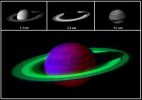
Saturn-PIA08735.jpgThree, for one and the same: Saturn, in infrared light65 visiteCaption NASA:"This false-color image of Saturn was constructed by combining 3 images at 3 different infrared wavelengths.
The image at the upper left was taken at 1,3 microns, where both Saturn and its Rings strongly reflect light. The center image in the top panel was taken at 2,4 microns, where the Rings strongly reflect light, but Saturn, because of the methane in its atmosphere, absorbs most of the light. The third image on the right in the panel was taken at a wavelength of 5 microns where, because they are composed of almost pure water ice, the Rings absorb almost all the light, and Saturn, because its interior is warm, glows. Assigning each of the three images to blue, green and red, respectively, results in the beautiful, false-color, composite image shown here.
These images were taken on June 21, 2004, with Cassini's VIMS (Visual and Infrared Mapping Spectrometer) from a distance of approx. 6,35 MKM (about 3,94 MMs) from Saturn".
|
|

Saturn-PIA08822.jpgSaturn's limb (NASA - natural colors)65 visiteCaption NASA originale:"From its unique perspective high above the Planet, the Cassini spacecraft looks down upon Saturn's murky Northern Hemisphere. The bluish hues seen in some Cassini views of Saturn's North are notably absent in this viewing geometry.
The dark side of Saturn's extensive Rings is just visible in the top half of the image.
The view looks toward the unlit side of the Rings, from about 44° above the Ring-Plane.
Images taken using red, green and blue spectral filters were combined to create this natural color view.
The images was taken with the Cassini spacecraft wide-angle camera on Oct. 30, 2006, at a distance of approx. 1,4 MKM (about 900.000 miles) from Saturn and at a Sun-Saturn-spacecraft, or phase, angle of 150°. Image scale is roughly 78 Km (about 49 miles) per pixel".
|
|

Saturn-PIA08823~0.jpgCrescent Saturn (Natural Colors; credits: NASA/JPL/Space Science Institute)80 visiteFrom Norther than the North Pole...
Caption NASA originale:"The Cassini spacecraft gazes down at the marvelous Rings and swirling clouds of giant Saturn from above the Planet's North Pole.
Such views are possible as the spacecraft performs its "180°-transfer," a key navigation maneuver that quickly raises the inclination of Cassini's orbit and shifts the orbital ellipse around to a different side of the Planet, before quickly lowering the inclination again.
The image was taken in visible light with the Cassini spacecraft wide-angle camera on Oct. 30, 2006. Cassini was then at a distance of approx. 1,2 MKM (about 700.000 miles) from Saturn and at a Sun-Saturn-spacecraft, or phase, angle of 142°.
Image scale is roughly 67 Km (about 41 miles) per pixel".MareKromium
|
|

Saturn-PIA08826.jpgVanishing Pan... (Natural Colors; credits: NASA/JPL/Space Science Institute)79 visiteCaption NASA originale:"The Cassini spacecraft looks down at the unlit side of the Rings as Pan heads into Saturn's shadow. The moon is accompanied by faint ringlets in the Encke Gap. At bottom, the bright F-Ring core fades slowly into darkness. This view looks toward the unlit side of the Rings from about 20° above the Ring-Plane.
The image was taken in visible light with the Cassini spacecraft wide-angle camera on Nov. 15, 2006. Cassini was then at a distance of approx. 1,7 MKM (about 1,1 MMs) from Saturn and at a Sun-Saturn-Spacecraft, or Phase, Angle of 163°. Image scale is roughly 10 Km (approx. 6 miles) per pixel".MareKromium
|
|

Saturn-PIA08833.jpgNorthern Latitudes of Saturn and the B-Ring's shadow72 visiteCaption NASA:"Streaks of cloud are overlain with graceful ring shadows in this view of Saturn's Northern Latitudes.
Structure is visible in the shadow of the A-Ring and Cassini Division, which widen at the highest latitudes, near lower right. The lower left half of the image does not show the blackness of space, but rather the shadow of the B-Ring, which is perfectly dark here.
The image was acquired from a high inclination above the Planet's Ring-Plane and looks obliquely toward the limb. (...)
The image was taken with the Cassini spacecraft narrow-angle camera using a spectral filter sensitive to wavelengths of infrared light centered at 938 nanometers on Oct. 30, 2006. Cassini was then at a distance of approx. 1,2 MKM (about 700.000 miles) from Saturn and at a Sun-Saturn-spacecraft, or phase, angle of 142°.
Image scale is roughly 7 Km (a little more than 4 miles) per pixel".
|
|

Saturn-PIA08838~0.jpgIn the Night of Saturn (Natural Colors; credits: NASA/JPL/Space Science Institute)80 visiteCaption NASA:"Only Cassini could provide this enchanting, Natural Color view of crescent Saturn, which gazes down onto the unlit side of the Planet's spectacular Rings. The robotic ship plies the peaceful black seas around the Ringed Giant, searching for answers to the many questions posed by the inquisitive minds of Earth.
This view looks toward the unlit side of the Rings from about 19° above the Ring-Plane. The view of Saturn is through the dark Rings at bottom; the Rings cast shadows onto the Northern Hemisphere at top. Images taken using red, green and blue spectral filters were combined to create this Natural Color view.
The images were taken with the Cassini Spacecraft wide-angle camera on Nov. 4, 2006 at a distance of approx. 1,7 MKM (a little more than 1 MMs) from Saturn and at a Sun-Saturn-Spacecraft, or Phase, Angle of 162°. Image scale is roughly 97 Km (about 61 miles) per pixel". MareKromium
|
|

Saturn-PIA08858.jpgInfrared Saturn (elab. NASA)76 visiteCaption NASA:"This psychedelic view of Saturn and its Rings is a composite made from images taken with the Cassini spacecraft wide-angle camera using spectral filters sensitive to wavelengths of infrared light centered at 728, 752 and 890 nanometers.
Cassini acquired the view on Dec. 13, 2006 at a distance of approx. 822.000 Km(such as about 511.000 miles) from Saturn. Image scale is roughly 46 Km (approx. 28 miles) per pixel". MareKromium
|
|

Saturn-PIA08864.jpgTurbulences... (False Colors; credits: Lunexit)70 visiteCaption NASA:"The Cassini spacecraft captures the ripples, loops and storms that swirl in Saturn's East-West flowing cloud bands.
The image was taken with the Cassini spacecraft wide-angle camera using a spectral filter sensitive to wavelengths of infrared light centered at 728 nanometers. The view was obtained on Dec. 13, 2006 at a distance of approx. 775.000 Km (about 482.000 miles) from Saturn. Image scale is roughly 43 Km (about 27 miles) per pixel".
|
|

Saturn-PIA08883.jpgSaturn's South Polar Regions (near Natural Colors - elab. NASA)76 visiteCaption NASA:"The Cassini spacecraft views Saturn's Southern Latitudes in color, spying a great, eye-shaped vortex just northward of the South Polar Region. Other dark vortices, common features of Saturn's general circulation, are visible in the Mid-Latitudes.
Contrast in the image was enhanced to make features in the atmosphere more visible.
Images taken using red, green and blue spectral filters were combined to create this near-natural color view. The images were taken in visible light with the Cassini spacecraft wide-angle camera on Jan. 14, 2007 at a distance of approx. 958.000 Km (such as about 595.000 miles) from Saturn.
Image scale is roughly 54 Km (about 33 miles) per pixel".MareKromium
|
|
| 2243 immagini su 187 pagina(e) |
 |
|
|
|
|
132 | |
|
|
|
|








