| |

Saturn: the "Ringed Beauty" and His Moons
|
|
|

Saturn-PIA08367.jpgSouthern Saturn67 visiteCaption NASA:"Cassini takes in a sweeping view of Saturn's South Polar Region as the planet's shadow masks the Rings and bright, icy Mimas looks on from left.
This view looks toward the lit side of the Rings from about 28° below the Ring-Plane.
Images taken using red, green and blue spectral filters were combined to create this color view. The view was acquired with the wide-angle camera on Feb. 20, 2007, at a distance of approximately 1 MKM (about 600.000 miles) from Saturn.
Image scale is roughly 58 Km (about 36 miles) per pixel".
|
|

Saturn-PIA08370.jpgSaturn (natural colors - elab. NASA)76 visiteCaption NASA:"Colorful Saturn tilts its darkened Ring-Plane toward Cassini. Against the dark sky, the Rings are made visible by the light that scatters through them toward the camera.
The F-Ring shepherd moon Pandora is faintly visible at the top, left of center. Pandora's brightness was increased by a factor of three to aid its visibility.
This view looks toward the unilluminated side of the Rings from about 18° above the Ring-Plane. The Planet is visible through the innermost and outermost portions of the Rings.
Images taken using red, green and blue spectral filters were combined to create this natural color view. The images were obtained by the Cassini spacecraft wide-angle camera on April 13, 2007, at a distance of approx. 1,8 MKM (about 1,1 MMs) from Saturn.
Image scale is roughly 108 Km (about 67 miles) per pixel".MareKromium
|
|
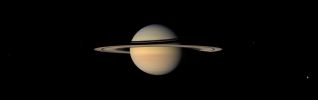
Saturn-PIA08387.jpgA View from Japetus75 visiteWhile on final approach for its Sept. 2007 close encounter with Saturn's moon Japetus, Cassini spun around to take in a sweeping view of the Saturn System.
Japetus is the only major moon of Saturn with a significant inclination to its orbit. From the other major satellites, the Rings would appear nearly edge-on, but from Japetus, the Rings usually appear at a tilt, as seen here.
This natural color mosaic consists of 15 red, green and blue spectral filter images acquired in five wide-angle camera footprints that swept across the scene.
Moons visible in this image: Dione at center left, Enceladus near the left side ansa (or ring edge), Mimas is a speck against the ring shadows on Saturn's Western Limb, Rhea can be seen against the bluish backdrop of the Northern Hemisphere, Tethys is near the right ansa, and Titan near lower right.
The images were obtained on Sept. 10, 2007, at a distance of approx. 3,3 MKM (such as about 2,1 MMs) from Saturn at a Sun-Saturn-Spacecraft, or phase, angle of 33°. Image scale is about 195 Km (approx. 121 miles) per pixel on the Planet. MareKromium
|
|

Saturn-PIA08388.jpgLooking at the Giant73 visiteSaturn sits nested in its rings of ice as Cassini once again plunges toward the graceful giant. This natural color mosaic was acquired by the Cassini spacecraft as it soared 39° above the unilluminated side of the Rings.
Little light makes its way through the Rings to be scattered in Cassini's direction in this viewing geometry, making the Rings appear somewhat dark compared to the reflective Planet. The view can be contrasted with earlier mosaics designed to showcase the Rings rather than the Planet, which were therefore given longer exposure times.
Bright clouds play in the blue-gray skies of the North. The Ring shadows continue to caress the Planet as they slide farther South toward their momentary disappearance during Equinox in 2009.
The Rings' reflected light illuminates the Southern Hemisphere on Saturn's night side.
The scene is reminiscent of the parting glance of NASA's Voyager 1 as it said goodbye to Saturn in 1981 (see PIA00335). Cassini, however, will continue to orbit Saturn for many years to come.
Three of Saturn's moons are visible in this image: Mimas (about 397 Km across) at the 2 o'clock position, Janus (about 181 Km across) at the 4 o'clock position and Pandora (about 84 Km across) at the 8 o'clock position. Pandora is a faint speck just outside the narrow F-Ring.
This mosaic was constructed from wide-angle camera images taken just before the narrow-angle camera mosaic PIA08389.
The view combines 45 images -- 15 separate sets of red, green and blue images -- taken over the course of about two hours, as Cassini scanned across the entire Main Ring System.
The images in this view were obtained on May 9, 2007, at a distance of approx. 1,1 MKM (about 700.000 miles) from Saturn.
Image scale is about 62 Km (approx. 39 miles) per pixel. MareKromium
|
|

Saturn-PIA08390.jpgMirrors of Darkness...63 visiteOur robotic explorer Cassini regards the shadow-draped face of Saturn.
This view looks toward the unilluminated side of the Rings from about 14° above the Ring-Plane. In this viewing geometry all of the Main Rings, except for the B-Ring, appear transparent. The Rings cast their mirror image onto the Planet beyond.
Images taken using red, green and blue spectral filters were combined to create this natural color view. The images were acquired with the Cassini spacecraft wide-angle camera on June 9, 2007, at a distance of approx. 1,6 MKM (about 972.000 miles) from Saturn.
Image scale is roughly 90 Km (about 56 miles) per pixel. MareKromium
|
|

Saturn-PIA08392.jpgShadows on the Giant75 visiteLike a silvery pearl, an icy moon crosses the face of Saturn, while 2 of its siblings cast shadows onto the Planet.
Rhea hangs in the foreground. Near upper left on Saturn is the small shadow of Mimas. Near lower right is the penumbral shadow of Japetus - the part of the moon's shadow where Japetus does not completely block the Sun.
This view looks toward the unilluminated side of the Rings from less than 1° above the Ring-Plane. The Rings' shadows drape across the Northern Hemisphere. Images taken using red, green and blue spectral filters were combined to create this natural color view. The images were obtained with the Cassini spacecraft wide-angle camera on June 15, 2007, at a distance of approx. 1,2 MKM (such as about 744.000 miles) from Rhea and 1,7 MKM (1,1 MMs) from Saturn.
Image scale is roughly 71 Km (about 44 miles) per pixel on Rhea and 103 Km (about 64 miles) on Saturn.MareKromium
|
|

Saturn-PIA08393.jpgThe "Opposition Effect" (again)76 visiteThe Opposition Effect, a brightness surge that is visible on Saturn's Rings when the Sun is directly behind the Spacecraft, is captured here as a colorful halo of light moving across Saturn's Sunlit Rings. The rainbow of color seen here is actually an artifact and a by-product of the spot's movement and the way the color image was produced. Cassini acquires color images by taking sequential exposures using red, green and blue spectral filters, which are then composited together to form a color view. The bright patch traveled across the Rings between exposures taken for this view, creating a series of 3 colorful spots showing its position at 3 separate moments.
This view looks toward the Sunlit side of the Rings from about 9° below the Ring-Plane.
The images in this view were acquired with the Cassini spacecraft wide-angle camera on June 12, 2007, at a distance of approx. 523.000 Km (such as about 325.000 miles) from Saturn.
Image scale is roughly 31 Km (about 19 miles) per pixel.
MareKromium
|
|
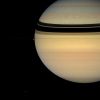
Saturn-PIA08394.jpgMoons... (natural colors; credits: NASA)65 visiteCaption NASA:"This colorful view, taken from edge-on with the Ring-Plane, contains 4 of Saturn's attendant moons. Tethys is seen against the black sky to the left of the Gas Giant's limb. Brilliant Enceladus sits against the Planet near right.
Irregular Hyperion is at the bottom of the image, near left. Much smaller Epimetheus is a speck below the Rings directly between Tethys and Enceladus. Epimetheus casts an equally tiny shadow onto the blue Northern Hemisphere, just above the thin shadow of the F-Ring.
Images taken using red, green and blue spectral filters were combined to create this natural color view. The images were acquired with the Cassini spacecraft wide-angle camera on July 24, 2007 at a distance of approx. 2 MKM (about 1,2 MMs) from Saturn. Image scale is 116 kilometers (72 miles) per pixel on Saturn".MareKromium
|
|

Saturn-PIA08396.jpgSquashed and Colourful (natural colors; credits: NASA)66 visiteCaption NASA:"Saturn in the Cassini era has proved to be an unexpectedly colorful place, compared to the browns and golds imaged by the two Voyager spacecraft. Saturn is headed toward Equinox in 2009, followed by Springtime in the Northern Hemisphere. Having a spacecraft in orbit while such changes occur will be of great benefit in scientists' quest to understand the atmospheres of the Giant Planets.
The Planet's oblate, or squashed, shape is clearly visible in this view.
The low-density Planet rotates so fast (in about 10,5 hours) that it flattens out slightly around its middle. The bluish tint of the Northern Latitudes is presumed to be a seasonal effect and will likely disappear entirely as the North receives increasingly greater amounts of sunlight.
Images taken using red, green and blue spectral filters were combined to create this natural color view.
The images were obtained with the Cassini spacecraft wide-angle camera on July 29, 2007 at a distance of approx. 3,1 MKM (about 2 MMs) from Saturn"MareKromium
|
|

Saturn-PIA08410.jpgElectrical Storm on Saturn's Upper Troposphere (natural colors; credits: NASA)64 visiteCaption NASA:"A bright, powerful, lightning-producing storm churns and coasts along the lane of Saturn's Southern Hemisphere nicknamed "Storm Alley" by scientists.
NASA's Cassini spacecraft detected this particular tempest after nearly 2 years during which Saturn did not appear to produce any large electrical storms of this kind. The storm appears as a bright, irregular splotch on the Planet near lower right.
Lightning flashes within the persistent storm produce radio waves, called Saturn Electrostatic Discharges, which the Cassini radio and plasma wave science instrument first detected on Nov. 27, 2007. Cassini's imaging cameras then spotted the storm, taking the images used to create this color view about a week later on Dec. 6, 2007.
This electrical storm is similar in appearance and intensity to those previously monitored by Cassini. All of these powerful electrostatic producing storms appeared at about 35° South Latitude on Saturn.
This storm has now been continuously tracked by Cassini for several months, whereas previous storms observed by the Spacecraft lasted for less than 30 days.
The view looks toward the un-illuminated side of the Rings from about 5° above the Ring-Plane. Tethys (about 1071 Km, or approx. 665 miles across) is seen here in the foreground, and casts its shadow onto the high Northern Latitudes.
Images taken using red, green and blue spectral filters were combined to create this natural color view. The images were acquired with the Cassini spacecraft wide-angle camera at a distance of approx. 1,7 MKM (1 MMs) from Saturn.
Image scale is roughly 97 Km (about 60 miles) per pixel".MareKromium
|
|

Saturn-PIA08411.jpgElectrical Storm on Saturn's Upper Troposphere (approx. true colors; credits: NASA)77 visiteCaption NASA:"It is no Great Red Spot, but these two side-by-side views show the longest-lived electrical storm yet observed on Saturn by NASA's Cassini Spacecraft.
The views were acquired more than 3 months after the storm was first detected from its lightning-produced radio discharges on Nov. 27, 2007.
Cassini imaging scientists believe the storm to be a vertically extended disturbance that penetrates from Saturn's Lower to Upper Troposphere.
The view at left was created by combining images taken using red, green and blue spectral filters, and shows Saturn in colors that approximate what the human eye would see. The storm stands out with greater clarity in the sharpened, enhanced color view at right. This view combines images taken in infrared, green and violet light at 939, 567 and 420 nanometers respectively and represents an expansion of the wavelength region of the electromagnetic spectrum visible to human eyes. This view looks toward the un-illuminated side of the Rings from about 3° above the Ring-Plane.
Janus (about 181 Km, or approx. 113 miles across) appears as a dark speck just beneath the Rings in both images.
These images were obtained with the Cassini spacecraft wide-angle camera on March 4, 2008, at a distance of approx. 1,3 MKM (about 800.000 miles) from Saturn.
Image scale is roughly 74 Km (about 46 miles) per pixel".MareKromium
|
|
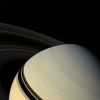
Saturn-PIA08414.jpgPerspectives... (natural colors; credits: NASA)66 visiteCaption NASA:"The Ringed Planet sits in repose, the center of its own macrocosm of many rings and moons and one artificial satellite named Cassini. Mimas (approx. 397 Km, or about 247 miles across) is visible at upper left. Although unseen in this view, Enceladus (approx. 504 Km, or about 313 miles across) casts its shadow upon the Planet. The Rings also block the Sun's light from the low Latitudes of the Northern Hemisphere.
During Cassini's extended mission, dubbed the Cassini Equinox Mission, which begins on July 1, 2008, the Ring shadows will slip past the Planet's Equator and into the Southern Hemisphere as Saturn passes through its Northern Vernal Equinox on August 11, 2009, and the Sun moves northward through the Ring-Plane.
This view looks down on the unilluminated side of the Rings, from about 22° above (such as North of) the Ring-Plane. Images taken using red, green and blue spectral filters were combined to create this natural color view. The images were obtained with the Cassini Spacecraft wide-angle camera on Dec. 16, 2007, at a distance of approx. 1,4 MKM (such as about 900,000 miles) from Saturn.
Image scale is roughly 86 Km (about 53 miles) per pixel".MareKromium
|
|
| 2243 immagini su 187 pagina(e) |
|
|
|
|
|
131 | |
|
|
|
|
|
|








