Saturn: the "Ringed Beauty" and His Moons
|
|
|

Saturn from approx. 9.000.000 Km (2).jpgWhat is this?!? (1)56 visiteEsistono centinaia di immagini negli archivi relativi alle raw-images della Sonda Cassini-Huygens che riprendono oggetti imprecisati che si trovano nello Spazio di Saturno. Nella maggior parte dei casi si tratta dei Satelliti (Maggiori e Minori) del Pianeta o di particelle cosmiche (raggi cosmici, forse) che lasciano strane tracce (punti e strisce). In altri casi, la risposta è lasciata al buon senso ed alla prudenza di chi guarda. Secondo noi questa luce è il Satellite Rhea, sovraesposto. E secondo Voi?...
|
|

Saturn from approx. 9.000.000 Km.jpgWhat is this?!? (2)56 visiteUn'immagine curiosa, misteriosa ed affascinante: gli strumenti di bordo della Sonda Cassini-Huygens dicono che questa ripresa si riferisce all'Anello "E"; in pratica diremmo che la fotocamera in questione stava riprendendo (come è già accaduto tante volte) lo Spazio di Saturno. Il chiarore rotondeggiante che vediamo in basso non sembra l'alone di luce che l'Anello "E" emana intorno a sè. E allora di che cosa si tratta?
|
|

Saturn in infrared-HST-PIA01268_modest.jpgInfrared view of Saturn - HST59 visiteCaption NASA originale:"The blue colors indicate a clear atmosphere down to a main cloud layer. The green and yellow colors indicate a haze above the main cloud layer. The red and orange colors indicate clouds reaching up high into the atmosphere and red clouds are even higher than the orange ones. The densest regions of two storms near Saturn's equator appear white hile the rings, basically made up of chunks of ice, are as white as images of ice taken in visible light".
|
|

Saturn in the darkness-N00015836.jpgSaturn (and Titan?) in the darkness59 visiteA volte, quando invitiamo i nostri Lettori ad immaginare, mentre guardano le "istantanee dell'Universo", di "essere lì", sospesi in una sorta di abisso senza confini visibili, circondati da oggetti maestosi ed impenetrabili, pensiamo al film "2001 - Odissea nello Spazio", quando Dave Bowman esce nello Spazio di Giove a bordo della sua navetta, per andare a vedere il Monolito da vicino. Questo frame, in qualche modo, ci ricorda quella sequenza e noi ve lo proponiamo...
|
|

Saturn storms_-PIA06477_modest.jpgAn "oval" storm near Saturn's South Pole58 visiteCaption NASA originale:"The region near Saturn's south pole shows a great deal of fascinating detail in this view from Cassini. Near upper right, an oval-shaped storm is bordered to the north and south by bright streaks of cloud, and two dark storms hover in a brighter cloud lane near the center.
The image was taken with the Cassini spacecraft narrow angle camera on Aug. 7, 2004, at a distance of 8.4 million kilometers (5.2 million miles) from Saturn through a filter sensitive to wavelengths of infrared light. The image scale is 50 kilometers (31 miles) per pixel".
|
|

Saturn&C.-PIA07510.jpgA "string" of Moons...57 visiteCaptionn NASA originale:"A string of three of Saturn's icy moons encircles the planet in this Cassini image.
Visible here are: Mimas, on near lower right; Janus just below the F-Ring and Enceladus on the lower left; the scene has been brightened to increase the moons' visibility.
The image was taken in visible light with the Cassini spacecraft wide-angle camera on April 25, 2005, at a distance of approx. 2,4 MKM (about 1,5 MMs) from Saturn. The image scale is 141 Km (approx. 87 miles) per pixel".
|
|
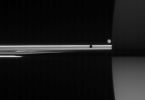
Saturn&Friends-PIA08220.jpgOne in the Shadows, one in the Lights55 visiteCaption NASA originale:"The unlit side of the Rings glows with scattered Sunlight as two moons circle giant Saturn. The light reaching Cassini in this view has traveled many paths before being captured.
At left, Mimas (397 Km, or 247 miles across) presents its "Dark Side". Enceladus (505 Km, or 314 miles across), on the Far Side of the Rings, is lit by "Saturnshine," or reflected sunlight coming from the planet. Saturn, in turn, is faintly lit in the south by light reflecting off the Rings.
Saturn's shadow darkens the Rings, tapering off toward the left side of this view.
The image was taken in visible light with the Cassini spacecraft narrow-angle camera on June 11, 2006 at a distance of approx. 3,9 MKM (about 2,5 MMs) from Mimas, 4,3 MKM (approx. 2,7 MMs) from Enceladus and 4,1 MKM (about 2,6 MMs) from Saturn.
Image scale is roughly 25 Km (approx. 16 miles) per pixel on Saturn".
|
|
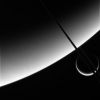
Saturn&Titan-N00060957.jpgSo close and yet so far...55 visitenessun commento
|
|
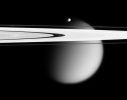
Saturn&Titan-PIA07786.jpgSo close and yet so far...55 visiteThe Cassini spacecraft delivers this stunning vista showing small, battered Epimetheus and smog-enshrouded Titan, with Saturn's A and F Rings stretching across the scene. The prominent dark region visible in the A-Ring is the Encke Gap, in which the moon Pan and several narrow ringlets reside. Moon-driven features that mark the A-Ring are easily seen to the left and right of the Encke Gap. The Encke Gap is about 325 Km (approx. 200 miles) wide. Pan is approx. 26 Km (about 16 miles) across. In an optical illusion, the narrow F-Ring, outside the A-Ring, appears to fade across the disk of Titan. A couple of bright clumps can be seen in the F-Ring. Epimetheus is approx. 116 Km (about 72 miles) across and giant Titan is roughly 5.150 Km (about 3.200 miles) across.
The image was taken in visible light with the Cassini spacecraft narrow-angle camera on April 28, 2006, at a distance of approx. 667.000 Km(about 415.000 miles) from Epimetheus and 1,8 MKM (about 1,1 MMs) from Titan. The image captures the illuminated side of the rings. The image scale is 4 kilometers (2 miles) per pixel on Epimetheus and 11 kilometers (7 miles) per pixel on Titan.
|
|
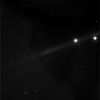
Saturn-E-Ring-W00012982.jpgOver-exposed Moons and the E-Ring55 visiteEscludendo che i due globi luminosi che vediamo in questo frame (in una posizione di quasi allineamento rispetto all'Anello E di Saturno) sìano dei photi-artifacts o degli UFO, la nostra sensibilità nell'analisi dei frames in arrivo dalla Sonda Cassini ci suggerisce l'idea che si tratti di due Lune di Saturno ampiamente sovraesposte.
Ma se ci chiedeste di quali Lune si tratta...Beh, non ci vergognamo di dire che questo proprio non lo sappiamo.
Caption originale:"W00012982.jpg was taken on January 11, 2006 and received on Earth January 12, 2006. The camera was pointing toward Saturn's E-Ring that, at the time, was approximately 2.048.891 Km away.
The image was taken using the CL1 and IRP90 filters and has not been validated or calibrated".
|
|
Saturn-EB-LXTT.jpgUn-Titan (an Image-Mosaic by Elisabetta Bonora - Lunexit Team)72 visitenessun commentoMareKromium
|
|

Saturn-EB-MF-LXTT.jpgLight Shades of Color... (Natural Colors; credits for te additional process. and color.: Elisabetta Bonora - Lunexit Team)94 visitenessun commentoMareKromium
|
|
| 2245 immagini su 188 pagina(e) |
 |
|
|
|
|
118 | |
|
|
|
|





