Saturn: the "Ringed Beauty" and His Moons
|
|
|

SATURN&MIMAS-PIA05416_modest.jpgSaturn and his Moon Mimas from Cassini-Huygens58 visitenessun commento
|
|

SATURN-61696main_soi7-516.jpgThe "F-Ring" of Saturn from Cassini-Huygens60 visitenessun commento
|
|
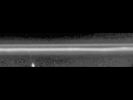
SATURN-F-RING-61900main_pia06351-516-387.jpgThe "F" Ring from Cassini-Huygens (2)93 visitenessun commento
|
|

SATURN-N00006384.jpgThe Rings from approx. 7.000.000 Km60 visitenessun commento
|
|

SATURN-N00006385.jpgThe Rings from approx. 6.990.000 Km (2)58 visitenessun commento
|
|

SATURN-PIA06097_modest.jpgThe "F" Ring - first picture67 visitenessun commento
|
|

SATURN-RINGSTRUCTURE-61896main_pia06349-516-387.jpgThe structure of the "Rings"62 visitenessun commento
|
|

SATURN.jpgSaturn58 visitenessun commento
|
|

Saturn & family-PIA06475_modest.jpgSaturn and Family57 visiteCaption NASA originale:"Satellites visible in this image are (clockwise from upper left): Dione (1.118 Km or 695 miles wide), Enceladus (499 Km or 310 miles wide), Tethys (1.060 Km or 659 miles wide), Mimas (398 Km or 247 miles wide) and Rhea (1.528 Km or 949 miles wide).
The image was taken in visible red light on Aug. 1, 2004, at a distance of 7.8 MKm (4.8 million miles) from Saturn. The image scale is 464 Km (288 miles) per pixel".
|
|

Saturn + 1-N00019307.jpgSaturn and one little Moon N 0001930756 visiteVi proponiamo due immagini da guarddare in stretta correlazione. In questo primo frame, Saturno è accompagnato da una delle sue tante Lune. Non sapremmo dire di quale si tratti, ma questo non è un dato - in questa sede - di importanza fondamentale. EccoVi il commento NASA al frame:"N00019307.jpg was taken on September 24, 2004 and received on Earth September 25, 2004. The camera was pointing toward SATURN at approximately 7.752.936 Km away and the image was taken using the BL1 and CL2 filters".
Accanto alla Luna di Saturno si può intuire - espandendo il frame sino a full-size - una leggera ombratura chiara. Noi abbiamo pensato che fosse un difetto dell'immagine. Ma ora andate a guardare il frame successivo...
|
|
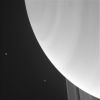
Saturn + 2-N00019308.jpgSatrun, one little Moon and "something else" - N 0001930756 visiteInnanzitutto il commento NASA originale: "N00019308.jpg was taken on September 24, 2004 and received on Earth September 25, 2004. The camera was pointing toward SATURN at approx. 7.752.875 Km away and the image was taken using the CL1 and UV3 filters".
Si vede subito che c'è un altro oggetto luminoso, accanto a Saturno, oltre alla Luna che avevamo già notato nel frame precedente. Se ingrandite l'immagine, poi, ecco la sorpresa: l'oggetto "nuovo" sembra essere il centro (o la causa?) di una sorta di "esplosione". Se osservate attentamente nell'area centrale dell'esplosione (!) vedrete qualcosa di simile ad un triangolino bianco: un effetto della possibile eccessiva luminosità dell'epicentro del fenomeno. Dunque, di che cosa si tratta?
Ancora un errore/difetto nella/della trasmisione dati? Una cometa che si disintegra?
E' purtroppo probabile che non lo sapremo mai, tuttavia il fenomeno immortalato (crediamo in maniera del tutto casuale) dalla Sonda potrebbe anche essere di valore storico. Potrebbe...
|
|

Saturn + 4 Moons-PIA05435_modest.jpgSaturn and 4 Moons from 8.900.000 Km73 visitecaption NASA originale:"Saturn's Moons visible in this image are (clockwise from upper left): Tethys (1060 Km wide); Dione (1118 Km wide); Enceladus (499 Km wide) and Mimas (398 Km wide).
The image was taken in visible red light at a distance of 8,9 MKM (5.5 million miles) from Saturn".
|
|
| 2245 immagini su 188 pagina(e) |
 |
|
|
|
|
115 | |
|
|
|
|





