Saturn: the "Ringed Beauty" and His Moons
|
|
|
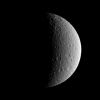
Rhea-PIA11630.jpgCrescent Rhea55 visiteCaption NASA:"The Cassini Spacecraft looks toward the battered Surface of the moon Rhea.
This view looks toward the Leading Hemisphere of Rhea. North on Rhea is up.
The image was taken in Visible Light with the Cassini Spacecraft wide-angle camera on Oct. 13, 2009. The view was acquired at a distance of approx. 44.000 Km (about 27.000 miles) from Rhea and at a Sun-Rhea-Spacecraft, or Phase, Angle of 103°.
Image scale is roughly 3 Km (a little less than 2 miles) per pixel".MareKromium
|
|

Rhea-PIA11638.jpgCraterland (Natural Colors; credits: Lunexit)55 visiteCaption NASA:"Craters imprinted upon other craters record the long history of impacts endured by Saturn's moon Rhea.
This view looks toward the Mid-Southern Latitudes of the Saturn-facing side of Rhea. North on Rhea is up.
The image was taken in Visible Light with the Cassini Spacecraft narrow-angle camera on Oct. 13, 2009. The view was obtained at a distance of approx. 45.000 Km (about 28.000 miles) from Rhea and at a Sun-Rhea-Spacecraft, or Phase, Angle of 105°.
Image scale is approx. 260 meters (about 860 feet) per pixel".MareKromium
|
|

Rhea-PIA12648.jpgGibbous Rhea (Natural Colors; credits for the additional process. and color.: Dr Paolo C. Fienga - Lunexit Team)131 visiteCaption NASA:"The Cassini Spacecraft looks toward the cratered plains of the Trailing Hemisphere of Rhea.
Some of the moon's fractures, appearing like wispy bright lines, can be seen on the left of the image. Rhea's North Pole is up and rotated 3° to the right.
This Celestial Body is about 1528 Km (approx. 949 miles) across.
The image was taken in Visible Light with the Cassini Spacecraft wide-angle camera on Nov. 21, 2009. The view was obtained at a distance of approx. 30.000 Km (about 19.000 miles) from Rhea and at a Sun-Rhea-Spacecraft, or Phase, Angle of 27°.
Image scale is roughly 2 Km (a little more than 1 mile) per pixel.
MareKromium
|
|

Rhea-PIA12746.jpgRhea's Terminator (Absolute Natural Colors; credits for the additional process. and color.: Dr Paolo C. Fienga - Lunexit Team)156 visiteCaption NASA:"The Cassini Spacecraft captured this High-Resolution view of the Cratered Surface of Saturn's moon Rhea as the Spacecraft flew by this Celestial Body on October 17, 2010.
This view is centered on highly Cratered Terrain located at approx. 60° North Lat. and 251° West Long.
The image was taken in Visible Light with the Cassini Spacecraft narrow-angle camera. The view was acquired at a distance of approx. 40.000 Km(such as about 25.000 miles) from Rhea and at a Sun-Rhea-Spacecraft, or Phase, Angle of 88°.
Image scale is roughly 238 meters (781 feet) per pixel".MareKromium
|
|

Rhea-PIA12768-PCF-LXTT.jpgIntersecting Lineae on Rhea (Enhanced Natural Colors; credits for the additional process. and color: Dr Paolo C. Fienga - Lunexit Team)226 visiteCaption NASA:"Thin Lineaments cross back and forth on the Surface of Saturn's moon Rhea in this Equatorial View. These Lines can be seen intersecting Craters on Rhea. This view is centered on Terrain at about 0° Latitude and approx. 165° West Longitude.
The image was taken in Visible Light with the Cassini Spacecraft narrow-angle camera on Jan. 11, 2011. The view was acquired at a distance of approx. 41.000 Km (such as 25.461 miles) from Rhea and at a Sun-Rhea-Spacecraft, or Phase, Angle of 15°. Image scale is roughly 238 meters (781 feet) per pixel".MareKromium
|
|

Rhea-PIA12809-PCF-LXTT.jpgThe Heavily Fractured Surface of Rhea (Absolute Natural Colors; credits for the additional process. and color.: Dr Paolo C. Fienga - Lunexit Team)105 visiteCaption NASA:"Icy Fractures on Saturn's moon Rhea reflect Sunlight brightly in this High-Resolution Mosaic created from images captured by NASA's Cassini Spacecraft during its March 2, 2010, Fly-By. This Fly-By was the closest one of Rhea up to then.
This mosaic of six images shows the Westernmost portion of the moon's "Wispy" Terrain. Among the interesting features depicted here is a very straight East-West Fracture near the top center of the mosaic that intersects two North-South Fractures. The large Crater at the bottom left of the mosaic is Inmar Crater (about 55 Km, or approx. 34 miles across).
The closest approach of the Spacecraft to Rhea during this encounter was of about 100 Km (approx. 62 miles). These images were obtained approximately 30 minutes later, at an altitude of about 16.000 Km (roughly 10.000 miles).
This mosaic shows part of the side of Rhea that always faces Saturn. The images were re-projected in an orthographic projection centered on Terrain at 7° North Latitude and 296° West Longitude. The mosaic itself shows Features centered on Terrain that is at 6° North Latitude and 293° West Longitude.
The images were taken with the Cassini Spacecraft narrow-angle camera. The view was obtained at a Sun-Rhea-Spacecraft, or Phase, Angle of about 2°. So, Cassini was almost directly between Rhea and the Sun as it acquired these images.
Image scale is roughly 85 meters (280 feet) per pixel".MareKromium
|
|

Rhea-PIA12854.jpgCratered Rhea (possible Natural Colors; credits: Dr Paolo C. Fienga - Lunexit Team)56 visitenessun commentoMareKromium
|
|

Rhea-PIA12855.jpgCratered Rhea (possible Natural Colors; credits: Dr Paolo C. Fienga - Lunexit Team)55 visitenessun commentoMareKromium
|
|

Rhea-PIA14574-PCF-LXTT-IPF.jpgIn the Saturnshine (Absolute Natural Colors; credits for the additional process. and color.: Dr Paolo C. Fienga - Lunar Explorer Italia/Italian Planetary Foundation)133 visiteSome Southern Terrain on the Gas-Giant Planet Saturn's moon Rhea is dimly illuminated by the Saturnshine (---> the Saturnian equivalent, on Rhea, of the Moonshine, on Earth) in this NASA - Cassini Spacecraft's view of the dark side of the moon. The camera of Cassini is looking toward the night side of Rhea (which is approx. 1530 Km - such as about 950 miles - across), but the Sunlight reflected off the day side of the immense Saturn is bright enough to illuminate the Surface - with all its Impact Craters - seen here. This view is centered on Terrain located at 23° South Latitude and 315° West Longitude. If you look carefully beyond the Limb of Rhea, you will notice that 4 (four) background Stars are visible.
The image was taken in Visible Light with the NASA - Cassini Spacecraft Wide-Angle Camera on August, 1st, 2011. The view was obtained at a distance of approximately 6000 Km (such as about 3726 miles) from Rhea and at a Sun-Rhea-Cassini Spacecraft, or Phase, Angle of 113°. Scale in the original image was 800 meters (such as 2600 feet) per pixel.
This frame (which is an Original NASA - Cassini Spacecraft image published on the NASA - Planetary Photojournal with the ID n. PIA 14574) has been additionally processed, contrast enhanced, and then colorized in Absolute Natural Colors (such as the colors that a human eye would actually perceive if someone were onboard the NASA - Cassini Spacecraft and then looked outside, towards the Saturnian moon Rhea), by using an original technique created - and, in time, dramatically improved - by the Lunar Explorer Italia Team. Different colors, as well as different shades of the same color, mean, among others, the existence of different Elements present on the Surface of Rhea, each having a different Albedo (---> Reflectivity) and Chemical Composition.MareKromium
|
|

Rhea-PIA14574-PCF-LXTT.jpgRhea in the Saturnshine (Enhanced Absolute Natural Colors; credits for the additional process. and color: Dr Paolo C. Fienga - Lunexit Team)142 visiteCaption NASA:"Southern Terrain on Saturn's moon Rhea is dimly illuminated by Saturnshine in this Cassini Spacecraft view of the dark side of the moon. The Spacecraft's camera is looking toward the night side of Rhea, but sunlight reflected off the day side of immense Saturn is bright enough to illuminate the Craters seen here. This view is centered on Terrain located at about 23° South Latitude and 315° West Longitude. A few background stars are visible.
The image was taken in Visible Light with the Cassini Spacecraft wide-angle camera on Aug. 1, 2011. The view was obtained at a distance of approx. 6000 Km (such as about 3700 miles) from Rhea and at a Sun-Rhea-Spacecraft, or Phase, Angle of 113°. Scale in the original image was 800 meters (2600 feet) per pixel. The image was contrast enhanced and magnified by a factor of 1.5 to enhance the visibility of the surface features".MareKromium
|
|

Rhea-PIA14605-PCF-LXTT-IPF.jpgRhea (Absolute Natural Colors; credits for the additional process. and color.: Elisabetta Bonora and Marco Faccin - Lunar Explorer Italia)184 visiteCaption NASA:"Cassini looks over the heavily Cratered Surface of Rhea during the Spacecraft's Fly-By of this Saturnian moon that occurred on March 10, 2012. This view is centered on Terrain located at about 58° North Latitude and 84° West Longitude.
This image was taken in visible light with the Cassini spacecraft narrow-angle camera. The view was obtained at a distance of approximately 27.000 miles (such as about 43.000 Km) from Rhea and at a Sun-Rhea-Spacecraft, or Phase, Angle of 67°. Image scale is 827 feet (252 meters) per pixel".MareKromium
|
|

Rhea-PIA14647-PCF-LXTT-IPF.jpgCrescent Rhea (Absolute Natural Colors; credits for the additional process. and color.: Dr Paolo C. Fienga/Lunar Explorer Italia/Italian Planetary Foundation)73 visiteThe NASA - Cassini Spacecraft captured, about four months ago, Saturn's moon Rhea during its Crescent Phase: a view, this one, which will never be visible from Earth. Near the Terminator, a few of Rhea's many Impact Craters show up their sharp and well defined outlines. With a diameter of approx. 950 miles (such as almost 1529 Km) Rhea is the Saturnian second-largest moon. This view looks toward the Leading Hemisphere of Rhea; North is up and rotated 12° to the right.
The image was taken in Visible Light with the NASA - Cassini Spacecraft Narrow-Angle Camera on November 6, 2012. The view was obtained at a distance of approximately 1,2 Million Miles (such as about 1,93 Million KiloMeters) from Rhea and at a Sun-Rhea-Cassini Spacecraft, or Phase, Angle of 129°. Scale in the original image was roughly 7 miles (approx. 11,26 Km) per pixel but, afterwards, the picture was magnified by a factor of 1.5 in order to enhance the visibility of some Surface Features.
This picture (which is an Original NASA - Cassini Spacecraft b/w frame published on the NASA - Planetary Photojournal with the ID n. PIA 14647) has been additionally processed, magnified (by applying a further 4.01 enlargement's factor) and then colorized, according to an educated guess carried out by Dr Paolo C. Fienga (LXTT-IPF), in Absolute Natural Colors (such as the colors that a human eye would actually perceive if someone were onboard the NASA - Cassini Spacecraft and then looked outside, towards the Saturnian moon Rhea), by using an original technique created - and, in time, dramatically improved - by the Lunar Explorer Italia Team. Different colors, as well as different shades of the same color, mean, among others, the existence of different Elements present on the Surface of Rhea, each having a different Albedo (---> Reflectivity) and Chemical Composition.MareKromium
|
|
| 2245 immagini su 188 pagina(e) |
 |
|
|
|
|
111 | |
|
|
|
|





