Saturn: the "Ringed Beauty" and His Moons
|
|
|

Rhea-PIA08148.jpgRhea (HR)82 visiteCaption NASA originale:"Rhea shows off her bright, fresh-looking impact crater in this Cassini view taken during a close approach. The view is toward the Leading Hemisphere on Rhea. North is up.
The image was taken in visible light with the Cassini spacecraft narrow-angle camera on Feb. 24, 2006 at a distance of approx. 343.000 Km (such as about 213.000 miles) from Rhea and at a phase angle of 27°. Image scale is 2 Km (about 1 mile) per pixel".
|
|
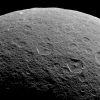
Rhea-PIA08173.jpgOld Rhea...54 visiteCaption NASA originale:"Cassini looks down upon Rhea, whose cratered surface was already ancient before any complex life developed on Earth. The terrain seen here has probably changed little in the past billion years (!). This view shows terrain on the Saturn-facing Hemisphere of Rhea. North is up.
The image was taken in visible light with the Cassini spacecraft narrow-angle camera on March 21, 2006 at a distance of approximately 94.000 Km (such as about 59.000 miles) from Rhea and at a phase angle of 109°. The image scale is about 558 mt (approx. 1.832 feet) per pixel".
|
|
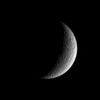
Rhea-PIA08186.jpgRhea: so "old" and yet so "beautiful...85 visiteCaption NASA:"Rhea displays a prominent scar in this view from Cassini. A large and ancient impact basin can be seen at upper right. The giant feature occurs within a terrain that appears rugged and which likely is saturated with other smaller craters.
Rhea is Saturn's second-largest moon at 1.528 Km (about 949 miles) across. This view shows terrain on the moon's Trailing Hemisphere.
North is up.
The image was taken in polarized ultraviolet light with the Cassini spacecraft narrow-angle camera on April 24, 2006 at a distance of approx. 2 MKM (such as about 1,2 MMs) from Rhea and at a Sun-Rhea-spacecraft, or phase, angle of 117°. Resolution in the original image was approx. 12 Km (about 7 miles) per pixel. The image has been magnified by a factor of two and contrast-enhanced to aid visibility".
|
|

Rhea-PIA08189.jpgBright "Splat", Bright "Ice"...55 visiteCaption originale:"Rhea's crater-saturated surface shows a large bright blotch, which was likely created when a geologically recent impact sprayed bright, fresh ice ejecta over the moon's surface. The rim of the great Tirawa impact basin can be seen near the top of the image. The giant feature is approx. 360 Km (about 220 miles) across.
This equatorial view captures Rhea's Leading Hemisphere. North is up and rotated 40° to the right.
The image was taken in visible red light with the Cassini spacecraft narrow-angle camera on April 28, 2006 at a distance of approx. 481.000 Km (about 299.000 miles) from Rhea and at a Sun-Rhea-spacecraft, or phase, angle of 23°.
Image scale is approx. 3 Km (about 2 miles) per pixel".
|
|

Rhea-PIA08208.jpgCrescent Rhea (Super HR)54 visiteCaption NASA originale:"Rhea's devastated surface creates a jagged terminator as mountains and crater rims break-up the line between day and night. Terrain on Rhea's night side is dimly lit by reflected light from Saturn.
The view looks toward the Southern Hemisphere on the moon's trailing side. North on Rhea is up.
The image was taken in visible green light with the Cassini spacecraft narrow-angle camera on May 22, 2006 at a distance of approximately 263.000 Km (about 164.000 miles) from Rhea and at a phase, angle of 138°. Image scale is approx. 2 Km (about 1,4 mile) per pixel".
|
|

Rhea-PIA08239.jpgRhea behind the Rings (natural colors)90 visiteCaption NASA originale:"The Rings cannot hide the ragged, icy crescent of Rhea, here imaged in color by the Cassini spacecraft: The second-largest moon of Saturn shines brightly through gaps in the Rings.
Rhea lies beyond the dim, unlit side of the Rings. A diffuse clump of material lies in the F-Ring, on the side nearest to Cassini.
Images taken using red, green and blue spectral filters were combined to create this natural color view, which approximates the scene as it might appear to human eyes. The view was acquired with the Cassini spacecraft narrow-angle camera on July 1, 2006 at a distance of approx. 1,2 MKM (about 700.000 miles) from Rhea and at a Sun-Rhea-spacecraft, or phase, angle of 118°. Image scale is roughly 7 Km (about 4 miles) per pixel".
|
|

Rhea-PIA08402.jpgRayed Crater on Rhea (3D)86 visiteRhea's surface gains some depth in this stereo image, or anaglyph, which features the bright and geologically young-looking rayed crater on the moon's Leading Hemisphere. The view was created from images taken during Cassini's close encounter with Rhea on Aug. 30, 2007.
The crater is about 48 Km (approx. 30 miles) wide, and its rays extend several hundred kilometers outward. The rim of this crater is quite sharply defined, and there are few small craters overprinted onto it. These characteristics, along with the brightness of the crater and its rays are indicative of a feature formed relatively recently in geologic history.
The hummocky floor of the crater possesses a central peak and clusters of small craters. The little craters may be secondary impact sites, formed by ejecta from the primary impact that landed in the crater, or they could have been formed by material that had broken off of the body that struck Rhea.
This stereo image is a mosaic consisting of seven Cassini spacecraft narrow-angle camera images. The view is an orthographic projection centered on 12° South Latitude, 112° West Longitude and has a resolution of 45 meters (148 feet) per pixel. An orthographic view is most like the view seen by a distant observer looking through a telescope. North is up.
The clear filter images for this stereo image were taken from distances ranging from about 17.000 Km (approx. 10.600 miles, for the red-colored image) to 7.500 Km (such as about 4.700 miles, for the blue/green-colored image) from Rhea.MareKromium
|
|
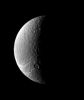
Rhea-PIA08851.jpgRhea72 visiteCaption NASA:"This view looks toward Rhea's North Polar Region, where icy fractures slither away toward the South. The lit terrain in this view is on the Saturn-facing Hemisphere of Rhea.
The image was taken in visible light with the Cassini spacecraft narrow-angle camera on Dec. 4, 2006 at a distance of approx. 773.000 Km (about 480000 miles) from Rhea and at a Sun-Rhea-spacecraft, or phase, angle of 105°.
Image scale is 5 Km (a little more than 3 miles) per pixel".MareKromium
|
|

Rhea-PIA08871.jpgRhea (natural & false colors)84 visiteSide-by-side natural color and false-color views highlight the wispy terrain on Rhea's Trailing Hemisphere. The extreme false color image makes it clear that the wisps - likely networks of fractures as on Dione - cut across older, cratered terrain.
In addition, a set of thin, North-South trending lineaments (also likely fractures) is visible on the left side of both views.
The natural color view was created by compositing images taken using red, green and blue spectral filters.
To create the false-color view, ultraviolet, green and infrared images were combined into a single picture that isolates and maps regional color differences. This "color map" was then superimposed over a clear-filter image that preserves the relative brightness across the body.
The combination of color map and brightness image shows how colors vary across the surface of Rhea. The origin of the color differences is not yet understood, but may be caused by subtle differences in the surface composition or the sizes of grains making up the icy surface material. North on Rhea (1,528 kilometers, or 949 miles across) is up.
The images were taken with the Cassini spacecraft narrow-angle camera on Jan. 17, 2007 at a distance of approximately 597,000 kilometers (371,000 miles) from Rhea. Image scale is 4 kilometers (2 miles) per pixel.
|
|

Rhea-PIA08886.jpgDrawing Out Details on Rhea55 visiteRhea displays a marked color contrast from North to South that is particularly easy to see in the extreme color-enhanced Cassini spacecraft view presented here.
A clear filter image is also presented (left) alongside the color composite (right).
To create the false-color view, ultraviolet, green and infrared images were combined into a single picture that isolates and maps regional color differences.
This "color map" was then superimposed over a clear-filter image that preserves the relative brightness across the body.
The combination of color map and brightness image shows how colors vary across the surface of Rhea. The origin of the color differences is not yet understood, but may be caused by subtle differences in the surface composition or the sizes of grains making up the icy surface material.
This view looks toward the Trailing Hemisphere on Rhea. The view shows southerly latitudes on Rhea, down to the South Pole. North is up and rotated 17° to the right.
The image was taken in visible light with the Cassini spacecraft narrow-angle camera on Jan. 17, 2007 at a distance of approx. 457.000 Km (about 284.000 miles) from Rhea.
Image scale is roughly 3 Km (a little less than 2 miles) per pixel.
|
|

Rhea-PIA08986.jpgRhea, in the Saturnshine (natural colors - elab. Lunexit)63 visiteCaption NASA:"The night side of Rhea shines softly in reflected light from Saturn. A similar effect, called Earthshine, can often be seen dimly illuminating the dark side Earth's Moon.
Background stars make short, dim trails across the black sky. The sunlit terrain on Rhea is so much brighter than the part lit by Saturn that the former is completely overexposed in this view, which took more than 30" to acquire.
This view looks toward the Leading Hemisphere on Rhea. North is up and rotated 28° to the left.
The image was taken in visible light with the Cassini spacecraft narrow-angle camera on June 11, 2007. The view was obtained at a distance of approx. 364.000 Km (such as about 226.000 miles) from Rhea and at a Sun-Rhea-spacecraft, or phase, angle of 154°. Image scale is roughly 4 Km (about 3 miles) per pixel".MareKromium
|
|

Rhea-PIA09799.jpgRising Rhea (natural colors; credits: Lunexit)76 visiteCaption NASA:"The low illumination angle near the Terminator makes visible the steep topography of craters on Rhea's battered surface. This view is centered on 10° North Latitude, 128° West Longitude.
The image was taken in visible light with the Cassini spacecraft narrow-angle camera on Nov. 16, 2007. The view was obtained at a distance of approx. 313.000 Km (such as about 195.000 miles) from Rhea and at a Sun-Rhea-spacecraft, or phase, angle of 128°. Image scale is 2 Km (a little more than 1 mile) per pixel".MareKromium
|
|
| 2245 immagini su 188 pagina(e) |
 |
|
|
|
|
109 | |
|
|
|
|





