|
|
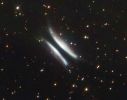
Gomez_s Hamburger - HST.jpgProtoplanetary Nebula - "Hamburger"145 visiteUn commento a questa immagine si impone: questa nebulosa protoplanetaria è stata chiamata "hamburger" - si, proprio come i panini di Mc Donald's... -. Un elevatissimo quantitativo di oggetti relativi allo spazio ed ai pianeti in generale ed a Marte in particolare viene quotidianamente battezzato usando una nomenclatura - quando va bene - "oscura" e, quando va male, "ridicola" sino ai limiti dell'offensivo. Ci siamo spesso chiesti il perchè di questo (per lo meno "curioso") approccio ai Misteri dell'Universo e, alla fine, ci siamo convinti che l'attribuzione di nomi ridicoli costituisca un modo di esorcizzare quello che non riusciamo a comprendere, in tutto o in parte, facendolo ricadere sotto una realtà che deve essere "nota" ed "innocua". Noi non sappiamo se questo modo di ragionare sia giusto o no, ma una cosa è certa: alle volte si esagera. La nebulosa "Hamburger", secondo noi, fa parte della casistica in cui si è esagerato nella semplificazione, ottenendo il risultato della "banalizzazione".
O no?!?..
|
|
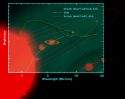
Graph-PIA07336.jpgA Brown-Dwarf's planetary system and the Solar System141 visiteThis artist's conception shows the relative size of a hypothetical brown dwarf-planetary system (below) compared to our own solar system. A brown dwarf is a cool or "failed" star, which lacks the mass to ignite and shine like our Sun. NASA's SST set its infrared eyes on an extraordinarily low-mass brown dwarf called OTS 44 and found a swirling disc of planet-building dust. At only 15 times the mass of Jupiter, OTS 44 is the smallest known brown dwarf to host a planet-forming, or protoplanetary, disc.
Astronomers believe that this unusual system will eventually spawn planets. If so, they speculate that OTS 44's disc has enough mass to make one small gas giant and a few Earth-sized rocky planets. Examples of these possible planets are depicted at the bottom of this picture, circling a low-mass brown dwarf. Above, the bodies of our own Solar System have been drawn to the same scale. In each system, the terrestrial planets have been enlarged and the distances between them and their parent bodies scaled down.
|
|
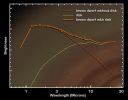
Graph-PIA07337.jpgOTS 44: another "failed" star132 visiteThis graph of data from NASA's SST shows that an extraordinarily low-mass brown dwarf, or "failed star," is circled by a disc of planet-building dust. The brown dwarf, called OTS 44, is only 15 times the mass of Jupiter, making it the smallest known brown dwarf to host a planet-forming disc.
SST was able to see this unusual disc by measuring its infrared brightness. Whereas a brown dwarf without a disc (red dashed line) radiates infrared light at shorter wavelengths, a brown dwarf with a disc (orange line) gives off excess infrared light at longer wavelengths. This surplus light comes from the disc itself and is represented here as a yellow dotted line. Actual data points from observations of OTS 44 are indicated with orange dots. These data were all acquired by using SST's infrared array camera.
|
|
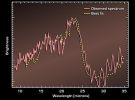
Graph-PIA07395.jpgLooking back...125 visiteThis graph, or spectrum, shows the light from a dusty, distant galaxy (invisible to optical telescopes) that is located 11 BLY away. NASA's SST was able to capture the light from it by using heat-seeking infrared eyes. Spectra are created when a spectrograph spreads light out into its basic parts, like a prism turning sunlight into a rainbow. The spectra contain the signatures of molecules that contribute to an object's light. In this case, the galaxy's spectrum reveals the fingerprint for silicate dust (large dip at right), a planetary building block like sand, only smaller. This particular fingerprint is important because it helps to determine how far away the galaxy lies as well as how much the galaxy's light had stretched ("redshifted") during its journey to SST's eyes. Because the universe is expanding, a galaxy's light will shift toward reddish wavelengths as it moves away from us. This galaxy has a redshift of 1,95, meaning that its light travelled for 11 BY before 'hitting" SST's eyes. The presence of the silicate fingerprint is also significant because it implies that galaxies were ripe for planetary formation 11 billion years ago - back to a time when the universe was 3 billion years old. The universe is currently believed to be 13.5 billion years old. This is the furthest back in time that silicate dust has been detected around a galaxy.
|
|

Gravitational Lens - GC 0024+1654.jpgGravitational Lens (GC 0024 + 1654)138 visite"...Transit umbra, sed lux permanet..."
(iscrizione su meridiana)
"...L'ombra (al pari delle cose effimere) passa e se ne va, ma la luce rimane (in quanto entità immortale)..."
|
|
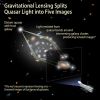
Gravitational Lenses-00.jpgGravitational Lenses (1)103 visite"...Nemo solus satis sapit..."
(Plauto)
"...Nessun (uomo) solitario (che viva lontano dagli altri uomini) può dire di sapere abbastanza..."
|
|
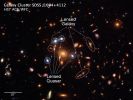
Gravitational Lenses-01.JPGGravitational Lenses (2)108 visite"...Ut ager, quamvis fertilis sine cultura fructuosus esse non potest, sic sine doctrina, Animus..."
(Cicerone)
"...come un campo, benché fertile, senza adeguate cure non può dare frutti, così è l'Animo, senza insegnamento né guida (---> doctrina)..."
|
|
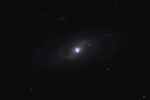
Gravitational_Lensing-00.jpgThe "Einstein Cross"118 visiteDalla Rubrica "NASA - Picture of the Day" del giorno 7 Febbraio 2010:"Most Galaxies have a single Nucleus, we know that. But does this Galaxy have four?
The strange answer leads astronomers to conclude that the Nucleus of the surrounding galaxy is not even visible in this image. The central cloverleaf is rather light emitted from a background Quasar. The Gravitational Field of the visible foreground galaxy breaks light from this distant Quasar into four distinct images.
The Quasar must be properly aligned behind the center of a massive galaxy for a mirage like this to be evident. The general effect is known as "Gravitational Lensing", and this specific case is known as the "Einstein Cross". Stranger still, the images of the Einstein Cross vary in relative brightness, enhanced occasionally by the additional gravitational microlensing effect of specific stars in the foreground galaxy".MareKromium
|
|

Gravitational_Lensing-01.jpgGravitational Lensing and "Light Distortion"71 visite"...Noi continuiamo a definire, reputare e trattare il Tempo e lo Spazio come ed in quanto Misure Lineari.
Questo, a mio parere, equivale a dire che non solo le nostre basi sono fatiscenti, ma altresì che noi non abbiamo la minima idea di che cosa il Tempo e lo Spazio siano effettivamente...
Comunque sia, dobbiamo aspettare.
La Verità, nella Vita come nella Scienza, alla fine si automanifesta e si dimostra da sola, nonostante tutto e tutti..."
Paolo C. Fienga (appunti)MareKromium
|
|

Gravitational_Lensing.gifGravitational Lensing133 visiteLensing by a Black Hole. This is an animated simulation of a phenomenon known as "Gravitational Lensing" and as caused by a Schwarzschild-type Black Hole moving in front of a background Galaxy. A secondary image of the Galaxy can be seen within the so-called "Einstein's Ring" of the Black Hole, on the opposite direction of the one of the Galaxy. The secondary image grows (still remaining within the Einstein's Ring) as the primary image approaches the Black Hole. The surface brightness of the two images remain constant, but their angular size varies, hence producing an amplification of the Galaxy Luminosity as seen from a distant observer. The maximum amplification occurs when the background Galaxy (or, like in the present case, a bright part of it) is exactly behind the Black Hole.MareKromium
|
|
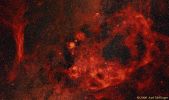
Gum Nebula-2.jpgThe "Gum Nebula"79 visite"...Maximus, in minimis, Deus (est)..."
(anonimo)
"...Dio si rivela (è) immenso per quello che ha fatto nelle cose più piccole (di questo mondo)..."
|
|
HARO 6-5B.jpgHARO 6-5B - HST142 visite"...Se un Giovane Uomo di Scienza dice che qualcosa, oggi impossibile o, magari, addirittura impensabile (come il viaggiare alla velocità della luce ed oltre), un domani - fra 10, 100 o magari 100.000 anni - potrebbe diventare una realtà, io penso che potrebbe avere ragione.
D'altra parte, se un Vecchio Uomo di Scienza dice che un qualcosa che, oggi, è impensabile ed impossibile, resterà per sempre impossibile ed impensabile, allora io dico che ha sicuramente torto..."
Arthur C. Clarke - Terza Legge
|
|
| 1039 immagini su 87 pagina(e) |
 |
|
|
|
|
20 | |
|
|
|
|








