Curiosity and the Exploration of Gale Crater
|
|
|

SOL3872-raw_images_1226579_site3Dmsl.jpgPanorama - Sol 3872231 visitenessun commentoMareKromium
|
|

SOL3872-raw_images_1226582_site3Dmsl.jpgPanorama - Sol 3872192 visitenessun commentoMareKromium
|
|
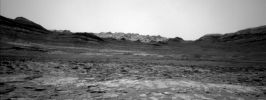
SOL4887-NLB_831328705EDR_S1220000NCAM00593M_.jpgNevado Sajama - Horizon (Sol 4887)81 visiteThis image was taken by the Left Navigation Camera onboard NASA's Mars Rover Curiosity on Sol 4887 (2026-05-06 - 09:48:49 UTC).MareKromium
|
|
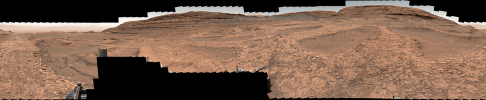
SOL4887-PIA26696_figA.pngNevado Sajama - Horizon112 visiteThe image was taken at a ridgetop site nicknamed “Nevado Sajama,” where Curiosity collected a rock sample using a drill on the end of its Robotic Arm.
Since May 2025, Curiosity has been exploring a region full of geologic formations called boxwork, which crisscross the surface for miles and look like giant spiderwebs when viewed from space.
The new panorama shows them as they really are: low ridges standing roughly 3 to 6 feet (1 to 2 meters) tall and about 30 feet (9 meters) across with sandy hollows in between.MareKromium
|
|
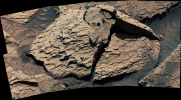
SOL4887-PIA26724.pngAtacama - Sol 4877 (Credits: NASA/JPL-Caltech)122 visiteNASA’s Curiosity Mars rover used its Mast Camera, or Mastcam, to capture this view of a rock nicknamed “Atacama” on May 6, 2026, the 4,877th Martian day, or sol, of the mission. The rock had gotten stuck to the drill on the end of Curiosity’s robotic arm on April 25. Engineers spent several days repositioning the arm and vibrating the drill to try and get the rock loose, finally detaching the rock on May 1.
Atacama is estimated to be 1.5 feet in diameter at its base and 6 inches thick. It would weigh roughly 28.6 pounds (13 kilograms) on Earth (and about a third of that on Mars). The circular hole produced by Curiosity’s drill is visible in the rock.
This mosaic is made up of eight images that were stitched together after being sent back to Earth. The color has been approximately white-balanced to resemble how the scene would appear under daytime lighting conditions on Earth.
Curiosity was built by NASA’s Jet Propulsion Laboratory, which is managed by Caltech in Pasadena, California. JPL leads the mission on behalf of NASA’s Science Mission Directorate in Washington as part of NASA’s Mars Exploration Program portfolio. Malin Space Science Systems in San Diego built and operates Mastcam.MareKromium
|
|

SOL4992-Turtl_Rock.jpgTurtle Rock (Credits: NASA/JPL-Caltech/MSSS; Processing & License: Thomas Thomopoulos)127 visiteIs this a fossilized turtle on Mars? No. Although resembling a large Earth tortoise, this is a layered rock outcrop on Mars that is estimated to span about 15 meters, making it much larger than turtles on Earth. NASA’s robotic Curiosity rover came across this unusual mound, dubbed Miraflores, last month during its 4922nd Martian day exploring Mars. The small butte may survive because it was somehow more resistant to erosion than surrounding rock. More recent wind has now covered its top with orange Martian sand. Below the top shell, many layers of stratified rock are visible, possibly indicating a long history of intermittent wind-blown sand being deposited and then hardened by ground water. Similar wind-eroded layered landforms, such as yardangs in the Qaidam Desert of China, exist here on Earth. Curiosity and its companion rover Perseverance continue to investigate the ancient history of Mars as well as searching for signs of primeval life.
(Note: It's with great pain that I note the increasingly ridiculous color processing of images coming from Mars. However, if they and the Space Enthusiasts are happy, that's fine...)MareKromium
|
|

W-Martian_Clouds-00.gifClouds...110 visiteJust beautiful, what else to say?MareKromium
|
|

W-Martian_Clouds-01.gifClouds...86 visiteJust beautiful, what else to say?MareKromium
|
|

W-Martian_Clouds-02.gifClouds...95 visiteJust beautiful, what else to say?MareKromium
|
|
|
|
|
| 261 immagini su 22 pagina(e) |
 |
|
|
|
|
|
|
|
|
22 |
|








