Curiosity and the Exploration of Gale Crater
|
|
|

SOL0490-EB-MF-LXTT-IPF-00.jpgWheels... - Sol 490 (an Image-Mosaic in Natural Colors by Elisabetta Bonora and Marco Faccin/LXTT/IPF)101 visitenessun commentoMareKromium
|
|

SOL0490-EB-MF-LXTT-IPF-01.jpgWheels... - Sol 490 (an Image-Mosaic in Natural Colors by Elisabetta Bonora and Marco Faccin/LXTT/IPF)86 visitenessun commentoMareKromium
|
|

SOL0528-CICAS-1.jpgMartian "Snake" at Gale? - Sol 528 (White Balanced - CTX Frame - Credits: NASA/JPL-Caltech/MSSS; credits for the Research: Ciro Casizzone/a.k.a. "Cicas65"/LXTT/IPF)146 visitevedi il commento al frame che segue.MareKromium
|
|

SOL0528-CICAS-3.jpgMartian "Snake" at Gale? - Sol 528 (White Balanced - EDM - Credits: NASA/JPL-Caltech/MSSS; credits for the Research: Ciro Casizzone/a.k.a. "Cicas65"/LXTT/IPF)101 visiteDal nostro Senior Partner Ciro Casizzone (alias "Cicas65") un dettaglio controverso colto dal Rover Curiosity all'interno del Cratere Gale, mentre si accingeva a superare una larga - ma non troppo alta - duna.
Guardate attentamente: già la roccia inquadrata, in sé, è strana parecchio (per configurazione estreriore, la quale mi porta a supporre una sua eventuale "natura mista"), ma qulla specie di "verme" (o "serpentello") di un bel color bianco, decisamente lungo e palesemente flessuoso, Vi pare anch'esso un qualcosa di "roccioso"?!?
La "Creatura" - se creatura è, ed apparentemente io, assumendomene le responsabilità, direi proprio di si - si sta estendendo, partendo dal terreno retrostante al macigno, sul macigno e, nel contempo, proietta una netta ombra scura su di esso. Illusione ottica? Vista l'ombra, direi proprio di NO!
OTIIMO Cicas! ed ora, i commenti a Voi!...
p.s.: se guardate con ESTREMA attenzione la parte anteriore dell'Anomalia (la cui colorazione, per altro, NON è uniforme), potreste anche riuscire a scorgere due incavi frontali, ai quali potrebbero corrispondere le orbite degli occhi della "Creatura"...MareKromium
|
|

SOL0528-PIA17931-PCF-LXTT-IPF-3.jpgBizarre-looking Rocks - Sol 528 (Absolute Natural Colors; credits for the additional process. and color. Dr Paolo C. Fienga/LXTT/IPF)91 visiteDue rocce decisamente curiose (specie quella posta alla Sx dell'Osservatore), le quali presentano una caratterizzazione superficiale assolutamente peculiare. Se Gale Crater, effettivamente ed in un'era remota, fu veramente un Lago, allora quello che si vede sulle due rocce potrebbe essere il residuo - fossile - di vegetazione sub-lacuale. E non solo! Sulla roccia di Sx, si vede NETTAMENTE l'esistenza di un foro il quale, come già ipotizzammo in passato - per un caso simile - potrebbe essere un Predatory Borehole.
Ovviamente la NASA, su questo ed altri rilievi similari, ha detto il solito. E cioè nulla. Voi che ne pensate?!?
p.s.: guardate la roccia "porosa", "irregolare" e "forata" a Dx ed osservate come essa sembra essere "parte integrante" della roccia stratificata sottostante. Sono tutt'uno? Sono l'una "appoggiata" all'altra? Si sono "incollate" nelle ere?.... Che ne dite?MareKromium
|
|

SOL0538-6012_PIA17944-FigA_Mcam-SOL538-raw-full2.jpgLooking Back - Sol 538 (Natural Colors - Credits: NASA)99 visiteThis look back at a dune that NASA's Curiosity Mars rover drove across was taken by the rover's Mast Camera (MastCam) during the 538th Martian Day, or Sol, of Curiosity's work on Mars (Feb. 9, 2014). The Rover had driven over the dune three days earlier. For scale, the distance between the parallel wheel tracks is about 9 feet (i.e.: approx.
2,7 meters). The dune is about 3 feet (a little more than 1 meter) tall in the middle of its span across an opening called "Dingo Gap". This view is looking Eastward. This raw color image was recorded by the camera under Martian lighting conditions. MareKromium
|
|

SOL0589-NRB_449790582EDR_F0310000NCAM00262M_.jpgBright Spark in the distance (Original NASA - Mer Curiosity Frame) - Sol 589152 visiteThis image from the Navigation Camera (Navcam) on NASA's Curiosity Mars rover includes a bright spot near the upper left corner. The sun is in the same direction, west-northwest, above the frame. Bright spots appear in images from the rover nearly every week. Typical explanations for them are cosmic rays hitting the light detector or sunlight glinting from rocks.
The right-eye camera of the stereo Navcam recorded this frame during the afternoon of the 589th Martian day, or sol, of Curiosity's work on Mars (April 3, 2014), from the site where the rover reached a waypoint called "the Kimberley" by that sol's drive. An image taken by the Navcam's left-eye camera within one second of the same time (http://mars.jpl.nasa.gov/msl/multimedia/raw/?rawid=NLB_449790582EDR_F0310000NCAM00262M_&s=589) does not include a bright spot of this type. A pair of Navcam images in the same direction from the previous afternoon has a bright spot similarly located in the right-eye image http://mars.jpl.nasa.gov/msl/multimedia/raw/?rawid=NRB_449700848EDR_F0301254NCAM00252M_&s=588) but not in the left-eye image (http://mars.jpl.nasa.gov/msl/multimedia/raw/?rawid=NLB_449700848EDR_F0301254NCAM00252M_&s=588).
One possible explanation for the bright spot in this image is a glint from a rock surface reflecting the sun. Another is a cosmic ray hitting the camera's light detector, a CCD (charge-coupled device). Cosmic ray patterns in Mars rover images vary from a dot to a long line depending on the angle at which the ray strikes the detector.
NASA's Jet Propulsion Laboratory, a division of the California Institute of Technology, Pasadena, manages the Mars Science Laboratory Project for NASA's Science Mission Directorate, Washington. JPL designed and built the project's Curiosity rover and the Rover's Navcam.MareKromium
|
|

SOL0710-0710MR0030150070402501E01_DXXX-000.jpgThe "Crab/Octopus-like Feature" (CTX Frame) - Sol 710152 visiteUn'immagine bella ma, apparentemente, insignificante per gli Anomaly Hunters. Eppure...
MareKromium
|
|

SOL0710-0710MR0030150070402501E01_DXXX-001.jpgThe "Crab/Octopus-like Feature" (EDM) - Sol 710176 visite...eppure sembrea esserci qualcosa, "appiccicata" alla parete rocciosa (ed indicata dalla freccia), che di "Insignificante" non ha proprio nulla....MareKromium
|
|

SOL0710-0710MR0030150070402501E01_DXXX-002.jpgThe "Crab/Octopus-like Feature": the best image we can have (SEDM) - Sol 710193 visiteAllora: che si tratti di una "Creatura Marziana" non lo possiamo dire ed é pure impossibile dirlo, a questo livello di definizione.
Ma che si tratti di "qualcosa" che SEMBRA essere "attaccata/appiccicata" alla parete rocciosa, non vi sono dubbi. Perché? Perché la "texture" ed il colore é/sono completamente diversa/i (e questo é un fatto).
Noi distinguiamo nettamente una "Struttura Tentacolare" (che ci ricorda "Alien", in verità...). Sembra una sorta di "polpo" (od un "Ragno", od anche un "Granchio", ma di un qualche tipo "Esotico" - NON Terrstre) che sta attaccato alla roccia.
Come sempre: é una svista? Un gioco (pazzesco) di luci ed ombre? E' un'Anomalia della roccia stessa? O é "qualcosa" d'altro?!? Scrivete...MareKromium
|
|

SOL0738-1581_PIA25821-web.gif153 visiteNASA’s Perseverance Mars rover used one of its navigation cameras to take a series of images of drifting clouds just before sunrise on March 18, 2023, the 738th Martian day, or sol, of the mission.
Scientists on both the Perseverance mission and NASA's Curiosity rover mission are studying the formation process of Martian clouds.
A key objective for Perseverance's mission on Mars is astrobiology, including the search for signs of ancient microbial life. The rover will characterize the planet's geology and past climate, pave the way for human exploration of the Red Planet, and be the first mission to collect and cache Martian rock and regolith (broken rock and dust).
Subsequent NASA missions, in cooperation with ESA (European Space Agency), would send spacecraft to Mars to collect these sealed samples from the surface and return them to Earth for in-depth analysis.
The Mars 2020 Perseverance mission is part of NASA's Moon to Mars exploration approach, which includes Artemis missions to the Moon that will help prepare for human exploration of the Red Planet.MareKromium
|
|
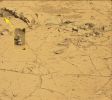
SOL0753-ML0032370000400001E01_DXXX-000.jpgSol 753 - What is "That"?!?142 visiteImmagine (secondo me straordinaria!) segnalata dal Nostro Amico e Partner, Lorenzo Leone, con Anomalia di Superficie identificata da sconosciuti.
In altre parole, come bene ha detto Lorenzo, "non é farina del nostro sacco".
Certo é che si tratta di una Surface Feature davvero peculiare ed assai difficile da spiegarsi razionalmente.... O no?!?MareKromium
|
|
| 261 immagini su 22 pagina(e) |
 |
|
|
|
|
15 | |
|
|
|
|








